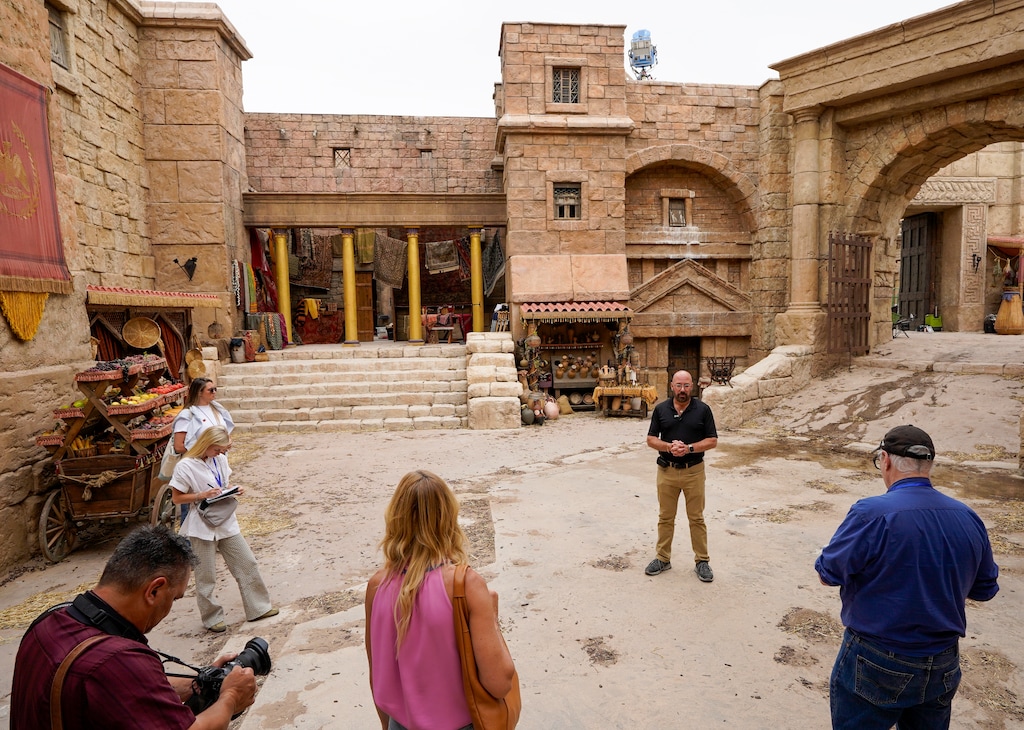
A man who invested $300,000 in the business behind the hit Christian historical drama “The Chosen” is alleging that he and thousands of other shareholders who helped propel the show to prominence were squeezed out of profits by the company’s leadership.
“The Chosen,” which chronicles the life and ministry of Jesus through the eyes of those who interacted with him, was financed with the help of thousands of early investors. For the first of five seasons, released in 2019, its creators broke a television crowdfunding record by raising around $11 million.
The series has grown from a small-scale project into a moneymaker that drew what its makers estimated to be 300 million global viewers, and is now on the cusp of its greatest potential returns yet.
Its final two seasons will be streamed on Prime Video and will focus on the biblical accounts of the Crucifixion and Resurrection of Jesus. Several spinoff series are expected, Dallas Jenkins, the show’s creator, announced this year.
Along with the show’s success have come disputes.
Christopher Garabedian, a former biopharma executive who invested $300,000 in a predecessor of 5&2 Studios in 2019, filed a class-action lawsuit last month arguing that the company had forcibly cashed out over 16,000 minority stockholders and failed to compensate them fairly for their shares. According to the lawsuit, those stockholders represented 45% of the company’s economic interests.
“As with other investors, Garabedian’s deep involvement in 5&2 was due both to his strong belief in the project as an evangelical tool and his expectation that he would be a long-term stockholder,” the complaint says.
The lawsuit, filed in the Delaware Court of Chancery, says that 5&2 understated potential future earnings while taking the production company private through a reverse stock split.
During an earlier period in which the company was attempting to sell, the complaint says, 5&2 offered financial projections that garnered third-party bids implying a value of about $150 million. When it moved toward buying out minority shareholders instead, the company was valued at about $52.9 million. The lawsuit says the company never adequately explained the adjusted valuation to shareholders.
One of Garabedian’s lawyers, Derrick Farrell, declined to comment on the lawsuit. Jenkins, the executive chair and co-founder of 5&2, denied its allegations.
“We’ve been transparent and accountable from the moment we formed our company and have gone above and beyond to follow all legal and financial requirements,” Jenkins said in a statement. “Any suggestion of impropriety is categorically false, and the full record thoroughly addresses every concern. We’re eager for the court’s review to affirm that.”
The lawsuit says Garabedian was introduced to “The Chosen” through a short film that Jenkins shared to kick off fundraising for the show. It says he was the company’s “largest single crowdfunding investor” and a co-executive producer of the show’s first season.
Garabedian held 150,000 shares of minority stock that the complaint says were cashed out over his objections. At $3.75 per share, he received about $560,250 after his $300,000 investment.
In a similar legal case from 2022, the Delaware Court of Chancery essentially paved a way for disgruntled shareholders to challenge payouts they considered unfair.
As “The Chosen” grew more successful, 5&2 — named after the biblical miracle in which Jesus feeds a crowd of more than 5,000 with only five loaves of bread and two fish — shifted its business model. It had previously partnered with Angel Studios on distribution and crowdfunding, but that partnership ended in 2024 after a third-party arbitrator confirmed that Angel had breached its contract.
5&2 now has a nonprofit partner, the Come and See Foundation, that helps manage donations, while the studio collects revenue through licensing, merchandise sales and limited theatrical runs.
In Garabedian’s complaint he also accuses 5&2 of using the Christian liturgical calendar to its advantage. The vote on the reverse stock split was held during Holy Week, when the complaint says shareholders “were more likely to be focused on their families and worship than business dealings.” Nearly 80% of those who owned minority stock shares did not vote.
The lawsuit, which is laden with religious language and biblical references, also says that 5&2 borrowed money that had previously been earmarked for production of the show’s final season to finance the shareholder buyout.
“Shockingly, the company decided that squeezing out minority stockholders was a better use of funds than guaranteeing the production of the final season of ‘The Chosen,’” the complaint says. “In other words, to fund the reverse split, the company borrowed from Peter to pay Paul.”
This article originally appeared in The New York Times.