 Jessica Schreifels
Attorneys for the Utah man accused of fatally shooting Charlie Kirk ended this week’s preliminary hearing by trying to poke holes in one of prosecutors’ key pieces of evidence: DNA found on the rifle authorities say was used in the killing.
Caitlin Oliver, a DNA analyst for Bureau of Alcohol, Tobacco, Firearms and Explosives, testified on Friday that she had determined the DNA found on the rifle’s stock, grip, scope and other areas could have been Tyler Robinson’s. She concluded there was “evidentiary support” that Robinson was a “possible contributor.”
(Tess Crowley | Pool) Caitlin Oliver, forensic biologist with the Bureau of Alcohol, Tobacco, Firearms, and Explosives, testifies during a preliminary hearing for Tyler Robinson, the Utah man accused of fatally shooting Charlie Kirk, at the 4th District Court in Provo on Friday, July 10, 2026.
But Oliver testified that DNA analysts can never say with absolute certainty that there is a DNA match — something that Robinson’s lawyers seized on as defense attorney Michael Burt questioned Oliver about how some of DNA samples had degraded, and that the samples taken showed a mix of multiple people’s DNA.
He highlighted how Robinson’s father was also identified as a possible DNA contributor on the firearm’s bolt — though he emphasized the father was not a suspect, and his DNA had been taken as an exclusion sample. Oliver testified that DNA from Robinson’s parents and his roommate, Lance Twiggs, were all collected for this purpose.
Burt also emphasized in his questioning that Oliver’s findings don’t answer how someone’s DNA got on the gun, and when that happened.
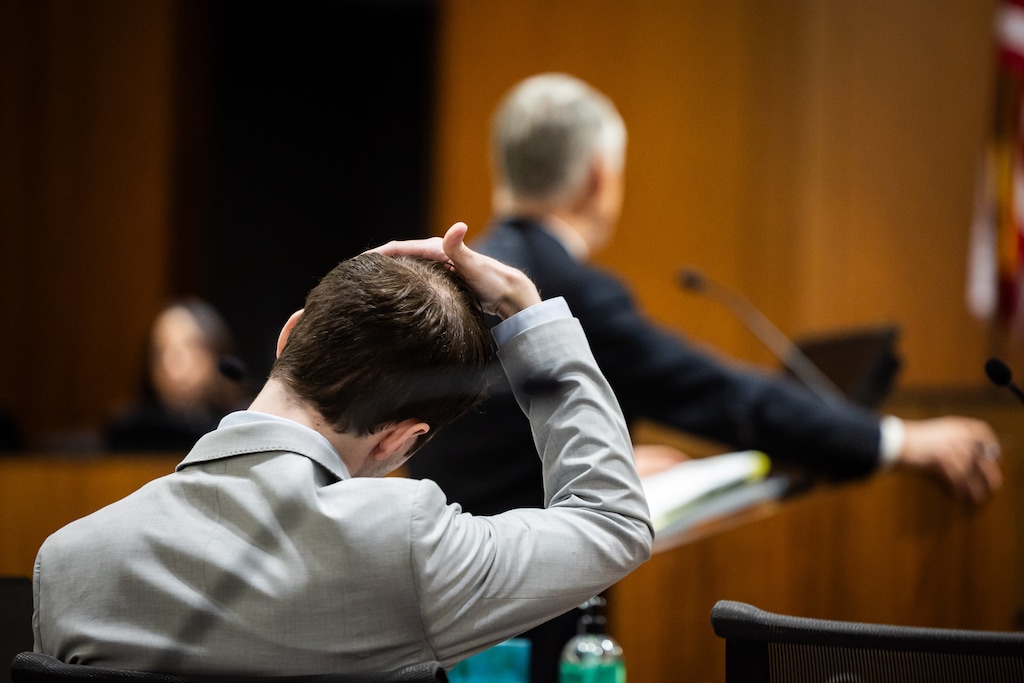
(Tess Crowley | Pool) Defense attorney Michael Burt speaks during a preliminary hearing for Tyler Robinson, the Utah man accused of fatally shooting Charlie Kirk, at the 4th District Court in Provo on Friday, July 10, 2026.
Though attorneys have wrapped up their cases, 4th District Judge Tony Graf is still weeks away from deciding whether prosecutors have shown that there’s enough evidence for the case to move forward. The attorneys will argue in court on Sept. 1, then Graf will likely issue a written ruling later.
This week’s preliminary hearing was not a trial, and the burden of proof is much lower. Graf will determine only if there is “probable cause” that Robinson likely committed a crime, compared to “beyond a reasonable doubt” standard that jurors must find in a trial.
The judge must also view all evidence in the light most favorable to the prosecution, which is why defense attorneys generally don’t present a full case at this stage of the proceedings. Defendants rarely testify during this type of hearing, and Robinson didn’t take the stand.
Kirk’s parents and his widow, Erika Kirk, have attended every day of the preliminary hearing, stepping outside in moments when there was testimony about the shooting itself.
(Francisco Kjolseth | The Salt Lake Tribune) Charlie Kirk’s parents, Robert and Kathryn Kirk, arrive at 4th District Court in Provo for a weeklong preliminary hearing for Tyler Robinson, the man accused of killing Charlie Kirk, on Monday, July 6, 2026. Kirk’s widow Erika Kirk also attended.
His mother, Kathryn Kirk, and Erika Kirk broke down in tears at the end of Friday’s hearing as zoomed-in video surveillance was played in court, showing someone run across the roof of a campus building, lay out in a “prone” position, then jump off the building and run away after Kirk was shot.
The unaltered footage was previously shown in court, but an edited, zoomed-in version was played at Kirk’s family attorney’s request.
The family released a statement Friday saying that, while being in court was difficult, “it brings our family comfort to know that the world has witnessed the overwhelming evidence of what occurred to Charlie that day.”
(Marielle Scott | AP) Erika Kirk leaves the Fourth District Courthouse, Monday, July 6, 2026, in Provo after a hearing for Tyler Robinson, accused in the fatal shooting of Charlie Kirk.
“Nothing will ever undo the loss of our beloved Charlie,” the statement reads. “As this case moves into its next phase, we pray that truth will continue to be heard through a process that is fair, transparent, and grounded in the facts.”