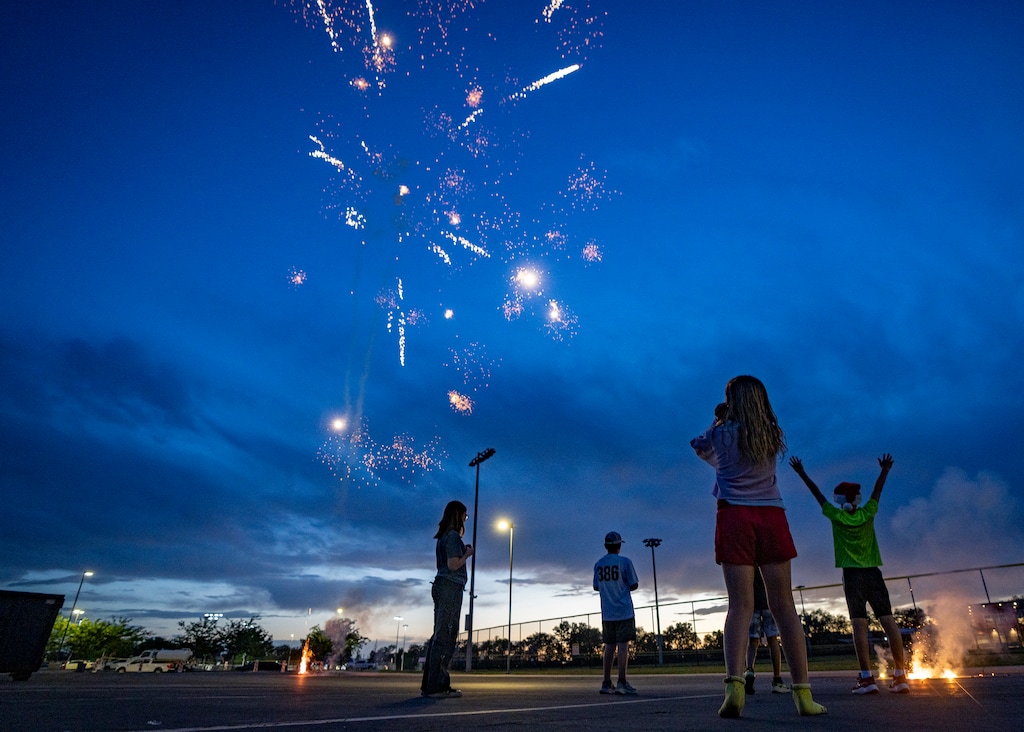
 Jose Davila IV
Widespread bans on personal fireworks in Utah seemed to achieve the main goal over the July Fourth weekend: limiting new wildfire starts.
But the restrictions may have also contributed to lower-than-usual levels of Independence Day air pollution in Salt Lake and Utah counties.
In each of the past three years, according to monitoring data collected at stations in Midvale and Lindon, July Fourth has been the worst day of the year for air pollution known as fine particulate matter. This type of pollution is made up of tiny airborne particles, like metals, that can penetrate humans’ lungs and bloodstreams. It appears when — yes, you guessed it — fireworks go off.
Usually, air quality readings for fine particulate matter become “very unhealthy” on July Fourth. This year, though, the dangerous particles peaked at “moderate” levels, per the Utah Department of Environmental Quality’s website.
“When I was looking across the [Salt Lake] Valley, evening of the Fourth into the fifth, I noted that there was not the level of haze that I normally see,” said HEAL Utah Executive Director Lexi Tuddenham, whose nonprofit works on environmental protection and public health issues in the Beehive State.
Even short-term exposure to fine particulate matter can have serious implications, Tuddenham said. When fireworks wreck air quality, she said, emergency room visits, asthma attacks and other breathing issues spike.
After Gov. Spencer Cox issued an order banning fireworks statewide, most Wasatch Front cities stuck to it, even though they had the authority to designate zones where fireworks were allowed.
Tuddenham said the ban has shown a measurable impact on air quality. “You can see that,” she said.
What we looked at • We reviewed state data and found Saturday’s holiday to have the lowest level of fine particulate matter of the five most recent Independence Days. The Salt Lake County data we used comes from a monitoring site at Copperview Elementary School in Midvale. For Utah County, we looked at a monitor stationed at Lindon Elementary School. The charts we made don’t track other air pollutants, like the other traditional summer scourge: ozone.
Why we chose the Midvale site • We checked out monitoring stations in Salt Lake City, West Valley City and Murray for this analysis, but we didn’t use them due to how close they are to dust from the Great Salt Lake or Interstate 15. The Copperview station is also close to the geographic heart of Salt Lake County.
Why we picked Lindon • We chose this monitor as a proxy for Utah County, given its close proximity to denser suburban neighborhoods and because the only other possible option, a station at Spanish Fork Airport, is in a city that did allow some personal fireworks use this year.
What about wildfire pollution? • While wildfire smoke also often shows up as particulate matter, it was unlikely to cause the higher pollution levels each of the past three years. A record-breaking winter ending in 2023 produced a calm wildfire season that year, while smoke didn’t show up along the Wasatch Front until mid-July in 2024. In 2025, July Fourth fell during a lull in smoke between wildfires in June and late July.
So what’s up with 2022 pollution levels being so low? • Short answer: We can’t tell for sure. But we do know the holiday that year had a fire weather warning from the National Weather Service, that Independence Day fell on a Monday, and that public officials at the time encouraged Utahns to leave fireworks displays to the professionals. Tuddenham said gusty conditions that year may have also blown gunky air away from the Wasatch Front.