 Andrew Christiansen
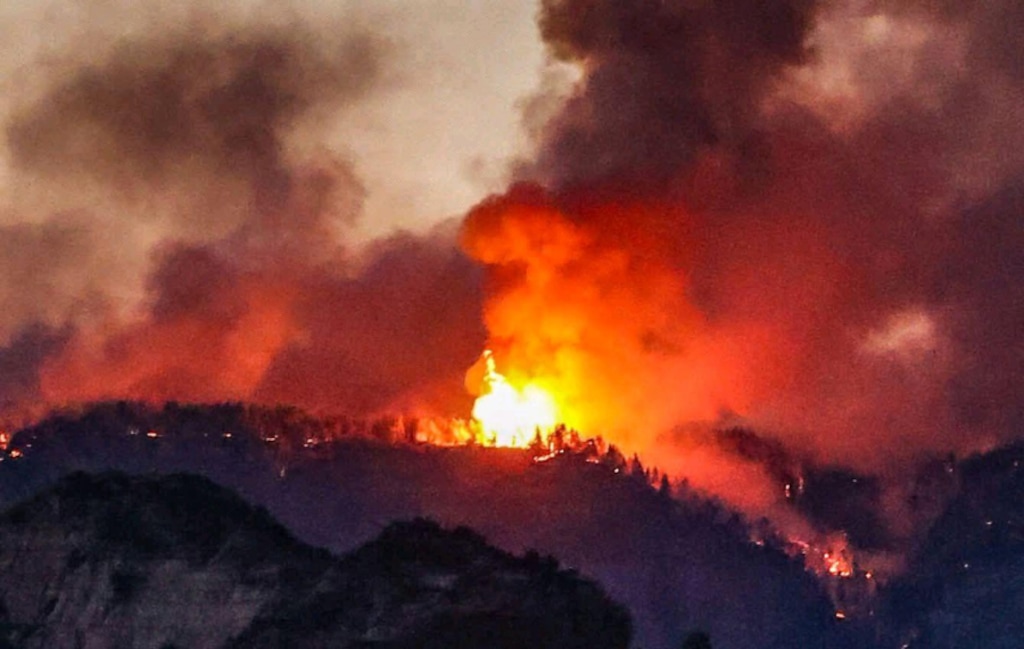
The Babylon Fire has grown into the largest wildfire burning in the U.S. and one of Utah’s largest fires in recent history.
The blaze has burned more than 96,500 acres across federal lands southwest of Monticello, as firefighters continue working to protect nearby communities while keeping the fire within broad containment lines, according to the U.S. Forest Service.
The Babylon Fire supplanted the Cottonwood Fire burning near Beaver as the largest active wildfire list in the U.S., per the National Interagency Fire Center. The Cottonwood Fire has burned roughly 95,800 acres since igniting on June 22, and is 47% contained.
The Babylon Fire remained 0% contained Monday after growing significantly over the weekend, according to the Forest Service. Fire activity increased Sunday as the fire spread farther northeast, prompting the San Juan County Sheriff’s Office to place six evacuation zones west of Monticello into set status, meaning residents should prepare to evacuate if conditions worsen. The advisory does not currently include the city of Monticello.
The fire, which started June 26 about 25 miles southwest of Monticello, has burned across federal lands in southeastern Utah, including portions of Bears Ears National Monument and the Monticello Ranger District of the Manti-La Sal National Forest. Five structures have been destroyed, and the cause is currently unknown.
According to Monday’s incident update, firefighters remain focused on keeping the fire within established indirect containment lines while taking advantage of opportunities to directly suppress portions of the fire where conditions allow. Crews are using drones equipped with infrared cameras to locate hidden heat sources along the northern flank before sending hand crews to extinguish them where it is safe.
To the east, firefighters continue refining structure protection plans around Monticello, while heavy equipment and ground crews are strengthening containment features and clearing vegetation along the western and southern portions of the fire.
Firefighters are also reinforcing containment features along roads near Monticello, including Blue Mountain Road, Harts Draw Road and Highway 211, according to Sunday’s evening update.
As of Sunday, 913 personnel were assigned to the fire, including 24 hand crews, 34 engines, nine helicopters, two dozers and five water tenders.
The latest incident update said extremely hot and dry conditions are expected to continue, with increasing winds later this week likely to support active fire behavior. The update also said unstable atmospheric conditions could produce pyrocumulus clouds capable of generating erratic winds, lightning and sudden downdrafts that can rapidly influence fire behavior.
Extensive public land closures remain in effect. The U.S. Forest Service has closed the entire Monticello Ranger District of the Manti-La Sal National Forest, while the Needles District of Canyonlands National Park remains closed.
The Bureau of Land Management has also closed all managed lands west of Harts Draw Road, extending north through the Indian Creek Corridor to Indian Creek Falls, including Shay Mesa, Beef Basin, Dark Canyon and Sweet Alice. Officials advised the public to avoid the Monticello Ranger District and all BLM and Forest Service lands south of Highway 211, west of Highway 191 and north of Highway 95 while firefighting operations continue.
This story was first published by The Times-Independent.