 Paighten Harkins
For the last week, since Gov. Spencer Cox announced a statewide ban on personal fireworks, Jamie Stansfield and her kids have been dutifully — albeit reluctantly — staffing their stand in Harrisville.
“I am a by-the-book type of person,” Stansfield said. “I’m a rule follower, and then to be out here and make it look like I’m putting up my middle finger to the ban just really sucks.”
Stansfield has contracted with Phantom Fireworks to run the Weber County stand with her children for the past two years. Each time, they brought home enough money to pay for the kids’ extracurricular activities — competitive ballroom dancing, soccer and marching band.
They had that same dream this year. Like many sellers, they were expecting a particularly good season, propelled by customers’ extra patriotism to celebrate the country’s 250th anniversary.
The climate had other plans. A dismal snowpack has meant for extraordinarily parched mountains and wildlands across the state. After a particularly brutal start to the wildfire season, including the “most destructive” wildfire in Utah history, state officials acted to reduce risk.
Cox’s executive order, announced June 25, allowed the state forester to restrict fireworks across the state, and allowed cities and towns to work with fire officials to choose areas where residents could light fireworks.
The ban surprised the state’s firework sellers, who were legally allowed to start selling the day before the governor’s announcement.
For these sellers, the ban means less money.
In Stansfield‘s case, she is unsure how the family will pay for her kids’ activities. Last year, by June 30, her family had sold $7,800 worth of product. This year, they sold less than $2,000, she said.
In addition to her own cognitive dissonance, she’s also endured some unkind words from passersby, who tell her she shouldn’t be selling, saying, she recalled, “There’s a fireworks ban!”
Oh, does she know it.
The terms of her contract state that she will be charged $200 every day the stand isn’t operating. She could also be charged rental fees for being in the shopping center lot where the stand operates. Phantom sent an email reminding sellers of this after the ban was announced.
She remembers thinking: “OK, well, we definitely can’t afford to not be here.”
Restrictions in place
Utah restricts fireworks for most of the year, with exceptions around Independence Day, Pioneer Day, New Year’s Eve and the Lunar New Year.
This year, Cox’s executive order prohibits fireworks in Utah from July 2-5. While it also allows towns and cities to work with fire officials to designate areas for firework use. Dozens of communities have instituted a total ban.
That includes Sandy, where Mad Matts Fireworks has operated its most popular stand for nearly two decades.
Owner Matt Shadle said he’s been preparing for this Independence Day for the last five years.
His stands are filled with America 250 and Donald Trump-themed products and more red, white and blue offerings than usual. While he said that this season won’t ruin him —he also operates other seasonal businesses, including a corn maze, pumpkin patch and Christmas tree farm — he is concerned for the other small, local sellers he knows.
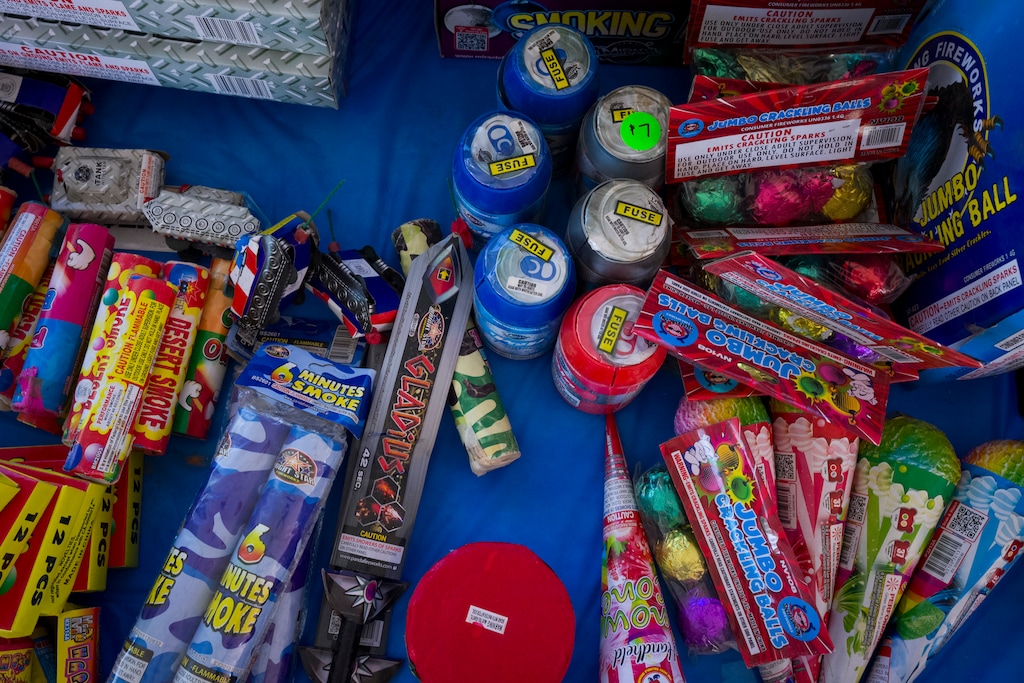
(Chris Samuels | The Salt Lake Tribune) Fireworks for sale at Mad Matts fireworks in Sandy, Monday, June 29, 2026.
(Chris Samuels | The Salt Lake Tribune) A sign from Sandy Fire Department warning about a fireworks ban is seen across the street from Mad Matts fireworks in Sandy, Monday, June 29, 2026.
He declined to share revenue figures, but said the first day of sales this year “was by far and away better than any other first day of operation, any year, in the last 35 years I’ve been selling fireworks.”
Now, Shadle said, sales are so low, “I won’t even be able to afford fuel to drive back and forth to my stand.”
“I’d gladly close all my tents up if somebody would compensate us,” he said, “but the problem right now is there’s no talk of any compensation.”
State officials haven’t yet said if they plan to continue the restrictions through Pioneer Day.
“There is that glimmer of hope that the ban is lifted by then, but,” Stansfield said, “who are we kidding at this point?”
Fire danger and expense
Shadle has other concerns. Data from the Utah Division of Forestry, Fire and State Lands show that only a small percentage of wildfire starts are caused by fireworks. He worries that restricting fireworks in residential areas, where there’s typically more noncombustible concrete than dry grasslands, will push people into the wilderness.
Utah Rep. Matt MacPherson, who is a partner at PyroCrate Fireworks, echoed those concerns in a lengthy X post on June 25 — and encouraged Utahns to disregard the ban.
“Those that choose to use fireworks dangerously or illegally will not follow any regulations, laws, bans or common sense with fireworks anyways,” he wrote.
On Wednesday, MacPherson softened his criticism, saying that though he believes Cox overstepped his legal authority, he doesn’t want people to defy the governor.
Kayli M. Guild, the fire communications, prevention and education coordinator with the Division of Forestry, Fire and State Lands, said in a written statement that this year’s restrictions aren’t “based on fireworks alone.”
The grass and other fire fuels are exceptionally dry this year and already cured — easy tinder for a wildfire to eat through rapidly and grow, as crews have already seen multiple times this year.
She added that many firefighters and firefighting resources, like planes and fire engines, are already in use in Utah and elsewhere.
(Bethany Baker | The Salt Lake Tribune) Signs hang from a table where fireworks sit at a Dragon Dynamite Fireworks stand in Clinton on Monday, June 29, 2026.
“In other years, a spark might have burned a small patch of grass and gone out. But because our fuels and vegetation are so much drier than in years past, that same spark has a much greater chance of becoming a wildfire that spreads quickly, threatens homes and requires significant firefighting resources,” she wrote.
She also acknowledged that historically fireworks have accounted for a small percentage of the state’s human-caused wildfire starts.
“However, that doesn’t mean the risk is insignificant. Every wildfire starts with a single ignition, and under this year’s conditions, one fire has the potential to become a large, fast-moving incident,” she said. “We don’t measure risk solely by how often something happens — we also consider what can happen when it does.”
The National Fire Protection Association takes an even stronger stance: “They are simply too dangerous and unpredictable to be used safely by individuals.”
The association’s data has found that firefighters respond to more than five times the average amount of brush, grass, and forest fires on July 4th.