 Carmen Nesbitt
 Paighten Harkins
A year ago, egg shortages had Utah consumers and businesses scrambling. Now, the state’s about see an influx.
Utah will receive about 125,000 cartons as part of a proposed settlement over a scheme involving three major egg producers who conspired between June 2022 and March 2025 to illegally drive up prices across Utah and 16 other states, the Utah attorney general’s office announced Tuesday.
Utah joined the other affected states and the U.S. Department of Justice in filing a complaint and proposed final judgment against egg producers Cal-Maine Foods, Inc., Versova Holdings and Hickman’s Family Farms on Monday. The filing came after a joint federal and state investigation into the scheme, according to a news release.
The complaint alleges that the companies colluded to raise egg prices by submitting coordinated bids to Urner Barry, a market price index, and by sharing competitively sensitive information, according to the news release.
“The producers submitted bids with the sole intention of artificially raising market prices, while regularly sharing pricing plans and bidding strategies with competitors,” the news release states.
For example, the complaint states, in October 2022, a Cal-Maine executive texted the CEO of Hickman’s, saying, “We are bidding up. Let’s hold it today.”
By the end of that day, Hickman’s and Cal-Maine’s bids accounted for over half of the bids submitted that day, and Urner Barry’s price quotations indeed held. A Cal-Maine executive texted Hickman’s CEO in acknowledgement, according to the lawsuit, saying, “No change.”
Two months later, in December, Urner Barry increased price quotations for white, large, shell eggs across the country. The complaint states Hickman’s CEO then sent the other conspiring executives a message saying, “[e]gg prices [were] hitting records,” and added, “great job in the northwest today!”
The complaint alleges the companies’ actions violated the Sherman Act, a federal antitrust law that prohibits “every contract, combination, or conspiracy in restraint of trade,” and any “monopolization, attempted monopolization, or conspiracy or combination to monopolize.”
“Utah families were already stretched thin, and inflated egg prices stretched them further,” Attorney General Derek Brown said. “Now our settlement changes how these companies do business and sends eggs straight to Utah food banks.”
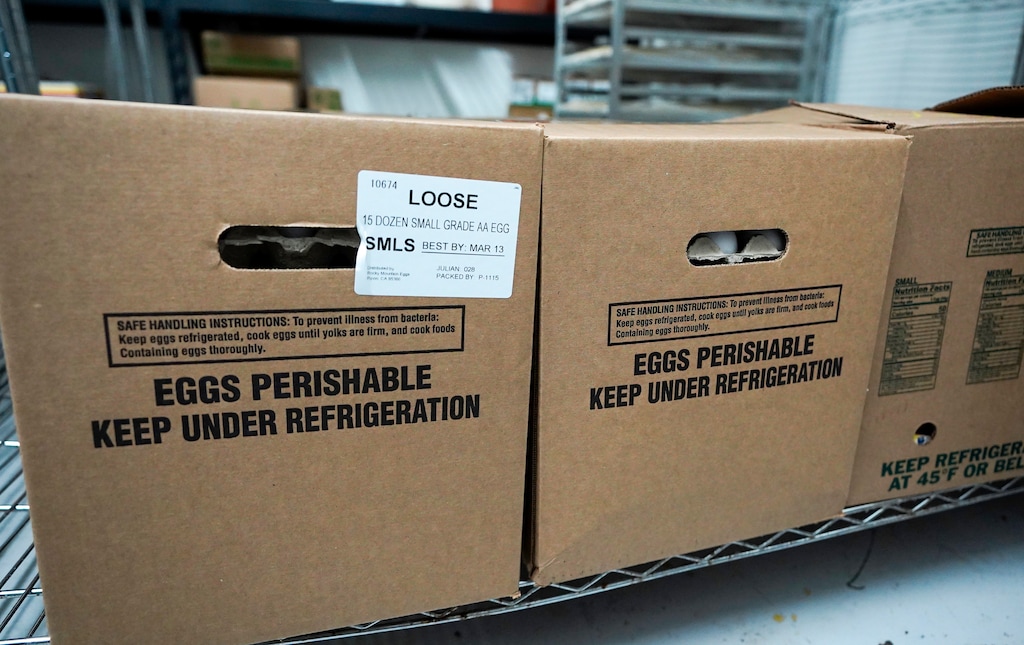
The seized eggs Utah receives will be distributed through nonprofit organizations, though those logistics are still being worked out, a spokesperson for the attorney general’s office said.
Utah will also receive $93,000 for “antitrust enforcement,” according to the news release.
Overall, the companies will provide over 53 million eggs and $3.3 million in monetary recovery to the participating states.
For the next five years, the companies are also barred from communicating with competitors about bids, agreeing on prices or supply, or influencing competitors’ bidding, the news release states. They must submit annual compliance certifications under penalty of perjury.