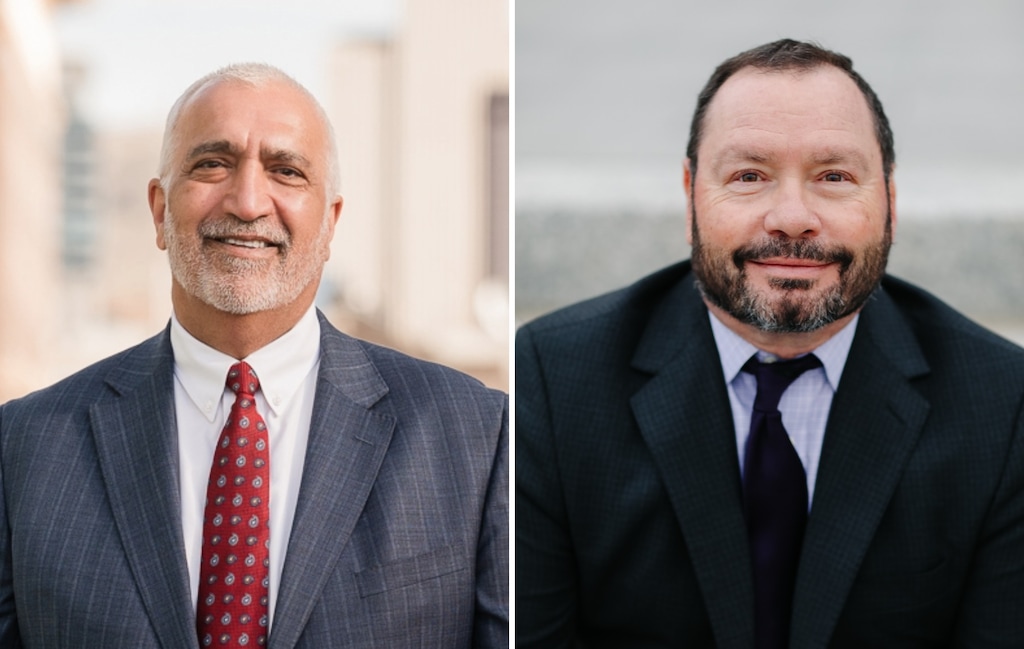
 Jordan Miller
Incumbent Sim Gill hopes to fend off a Democratic challenger in the primary for Salt Lake County District Attorney.
Gill was elected as the county’s top prosecutor in 2010. In April, he was nearly unseated by challenger Shawn Robinson at the Salt Lake County Democratic convention, who was just a few delegates shy of blocking Gill from appearing on the ballot.
Robinson has worked as a prosecutor and public defender in his 30-year law career, but he currently serves as an assistant attorney general.
The winner of the June 23 primary will face Republican Kent Davis in the November general election.
The Salt Lake Tribune posed the following questions to both candidates. Their answers — listed in alphabetical order by candidate name — may have been edited slightly for length, style or grammar.
Immigration and Customs Enforcement has been top of mind for many Utahns, especially as ICE conducts enforcement operations at local courthouses. What is the Salt Lake County district attorney’s role in immigration enforcement, and what is your message to witnesses and victims who may feel uncomfortable working with prosecutors because of their immigration status?
Gill: The District Attorney’s office prosecutes crimes; we are not ICE. When victims and witnesses fear coming forward, crimes go unreported, and communities become less safe. As D.A., I’ve had multiple trainings with nonprofits and police leadership on protections available for immigrant victims, such as T-Visas and U-Visas. I will explore every avenue under the law to hold accountable those who violate constitutional rights. If you are a victim or witness, we need to hear from you. Your cooperation makes Salt Lake County safer, and you deserve protection when you engage with our office.
Robinson: The Salt Lake County District Attorney has no responsibility to assist or collaborate with ICE and [U.S. Customs and Border Protection] with unconstitutional enforcement actions. As D.A., I will ensure any crimes reported by county residents are taken seriously, and I commit to publishing a “Know Your Rights” document so residents understand how to navigate reporting regardless of immigration status. In our courtrooms, I will require officers to communicate that they will serve their warrants before they spring arrests in plain clothes. Federal agents must follow the law, and I will hold them accountable.
Reviewing police shooting cases is the district attorney’s responsibility. How would you ensure the office can maintain a working relationship with agencies while also holding officers accountable if they are not justified in using deadly force?
Gill: We review every officer-involved shooting in Salt Lake County. This work demands honesty and professionalism, not deference, and certainly not reflexive prosecution. When force is unjustified, we file those cases supported by evidence and the law. I proposed 22 distinct changes in an open letter to the Legislature that would increase accountability without compromising officer safety. If we want different outcomes, we need to change the law. I will always apply the law, even if it’s unpopular.
Robinson: I will hold officers accountable for unjustified uses of force, reviewing every outstanding case of substantial public interest and bringing charges where the evidence warrants. As a public defender, a Clearfield City prosecutor, and an Assistant Utah Attorney General, I have worked alongside law enforcement and built relationships in difficult environments. As D.A., I will work with agencies to align their internal use-of-force policies with our review standards, overhauling them into a clear, countywide policy on excessive force. Real accountability and public trust begin with transparency.
Salt Lake County is planning big investments in the criminal justice system in consultation with The Leifman Group. How would you assure residents that those who commit crimes will be held accountable while also ensuring people get the services they need so they don’t return to jail?
Gill: It is possible to reform the criminal justice system without compromising public safety. My office created Utah’s first Mental Health Court and Veterans Court, along with programs that reduce recidivism, like pre-filing diversion. The Leifman framework aligns with what we’ve already proven locally, and our office supports its continued involvement with the county. Residents should expect that people who harm others face real consequences, and people whose behavior stems from untreated illness get real help. That’s how we stop the cycle and implement true restorative justice.
Robinson: For violent and repeat offenders, my office will establish clear, written policies for holding them accountable and openly disclose plea deals and case dismissals with victims, bringing real transparency to how we pursue justice. With nonviolent offenders, I will fight to protect and expand access to our restorative justice programs, including the existing recovery and veteran courts. These alternatives to incarceration connect residents with the treatment and support they need and ease their transition back into the community, and by investing in them, we can meaningfully reduce recidivism.
The Leifman Group recommendations also tie in to how Salt Lake County can work on addressing homelessness. How would you approach homelessness as a prosecutor, and what role do you believe the criminal justice system should have in the issue?
Gill: You cannot prosecute your way out of homelessness. We have to provide services for this population outside the criminal justice system. Criminal justice cannot be our default to a broken mental health system. Affordable housing is critical and prosecution is a costly answer to that deficit. The criminal justice system has a role: holding accountable those who cause harm, while connecting those in crisis to services. Prosecution without support simply recycles suffering. I’ll continue building pathways that address root causes while maintaining public safety standards our community deserves.
Robinson: If an unhoused individual commits a crime in Salt Lake County, this office will be careful to consider the arrest of nonviolent offenders. If the office does choose to charge a nonviolent offender, we will look to direct them into alternative programs, such as the currently running recovery and veterans courts. I will fight to invest and expand these programs to reduce recidivism, transition individuals back into the community, and discourage inhumane solutions such as the proposed mega-campus in Salt Lake City. We must center compassion when fighting homelessness.
What do you believe is the most pressing issue before voters this year in the Salt Lake County district attorney’s race? What can be done to address it?
Gill: The nexus between homelessness and the criminal justice and mental health systems is in need of critical reform, and it’s going to take experienced leadership. As your district attorney for the past 16 years, I’ve earned trust through transparency, consistent standards, and measurable outcomes, while creating innovative programs. With democracy and our public institutions under attack, it’s more important than ever to have experienced leaders on the local level. I’m proud to work for the people of Salt Lake County, and I’m running for reelection to continue that important work.
Robinson: This is the first Democratic primary of my opponent’s career, and I believe restoring accountability and transparency is the most pressing issue in this race. Amid mounting controversies, from the 2025 Legislative audit’s findings to the Emiliano case disqualification and persistent high turnover, I will bring a fresh perspective to the office. As D.A., I will publish a public list of our internal policies for pleas and case dismissals, hold officers accountable for excessive force, and work to reform the office’s internal culture. Real progressive change begins by rebuilding community trust.