 Jessica Schreifels
Provo • Early one April morning, Utah County Attorney Jeff Gray got a phone call from Turning Point USA, whose leaders were concerned about fresh headlines suggesting that the prosecution’s case against the man accused of fatally shooting founder Charlie Kirk had fallen apart.
One of the earliest headlines came from the Daily Mail: “Bullet used to kill Charlie Kirk did NOT match rifle allegedly used by suspect Tyler Robinson, new court filing claims.”
Turning Point USA was “asking if there was any merit to these media stories,” testified Christopher Ballard, the Utah County attorney’s office general counsel and spokesperson.
Ballard said his office believed the media reports were based on a sentence in a motion filed by Robinson’s defense attorneys that “mischaracterized” bullet evidence in the case. Worried about the media coverage — and after receiving inquiries from journalists wanting comment — Ballard testified on Friday that he spoke with Gray and they decided Ballard should grant interviews to the reporters.
A “no-comment” response, Ballard said he feared, would only “feed this idea that the state really doesn’t have sufficient evidence to proceed.” So he spoke with TMZ, exchanged emails with USA Today and was interviewed on Fox News.
“The goal of these interviews was to respond to specific media inquiries that were being generated by the misinformation that was circulating about the bullet testing,” Ballard testified.
But 4th District Court Judge Tony Graf has set strict rules to limit pretrial publicity in Robinson’s case, which has garnered worldwide attention — and his order includes setting limits on what attorneys on the case can say publicly to journalists.
Calling Ballard’s actions a willful “media tour,” Robinson’s defense team now argues that Ballard crossed that line when he spoke to journalists. And they want Graf to hand down a hefty consequence: An order banning prosecutors from seeking the death penalty for Robinson.
But Ballard said he was only correcting the defense’s mischaracterization, which fueled intense media coverage. He emphasized that he spoke “generally” about bullet analysis reports, noted in his interviews that Robinson was presumed innocent, and that a jury ultimately will determine the man’s guilt.
His testimony on Friday came as Graf is weighing whether Ballard violated his gag order. Later, he’ll determine whether sanctions are warranted.
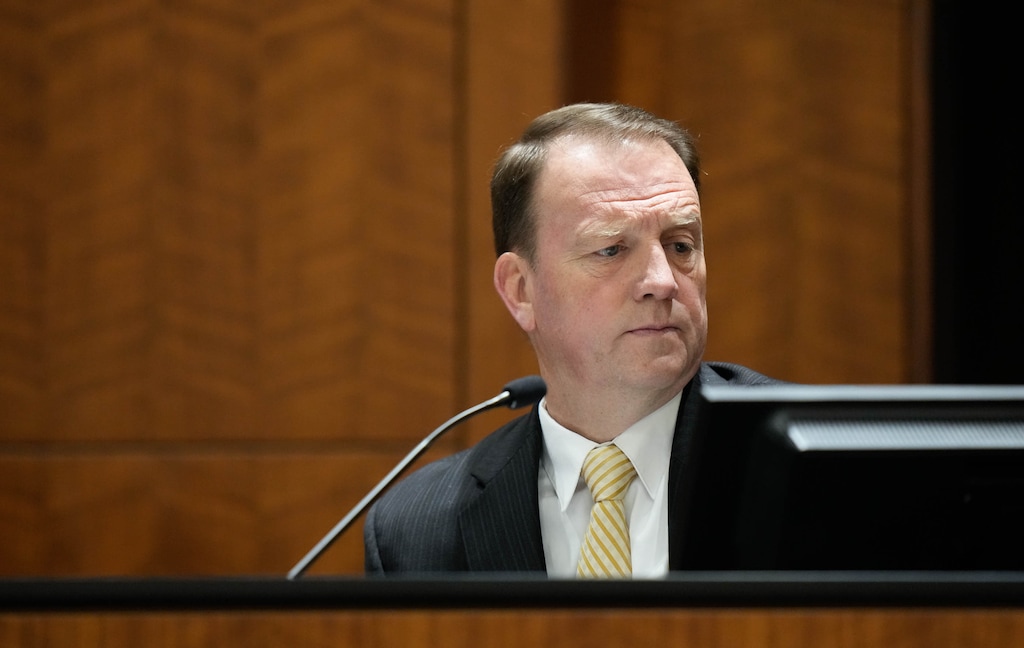
(Francisco Kjolseth | The Salt Lake Tribune) Fourth District Court Judge Tony Graf in Provo on Friday, June 12, 2026, during a hearing for Tyler Robinson, accused in the fatal shooting of Charlie Kirk.
Defense attorney Richard Novak argued to Graf on Friday that a lesser penalty, short of taking the death penalty off the table, doesn’t match the severity of Ballard’s actions, which he said was an attempt to influence potential jurors.
Other penalties — like ordering Ballard to take a continuing education class, or referring him to the Utah State Bar for potential discipline — don’t address his client’s constitutional rights, Novak argued.
“We can’t wait until we start picking the jury to find out what harm has been caused,” he said.
This dispute centers around a report from the Bureau of Alcohol, Tobacco, Firearms and Explosives about the bullet that killed Kirk. Attorneys for Robinson wrote in a motion that the agency was “unable to identify the bullet recovered at autopsy to the rifle allegedly tied to Mr. Robinson.”
But prosecutors say this was a mischaracterization of the report, which they say states that the bullet jacket fragment “could not be identified or excluded” as having been fired from that rifle.
Also on Friday, Graf ruled that he will not pause the criminal case — including not canceling a week-long preliminary hearing in July — so Robinson can appeal the judge’s ruling allowing cameras in the courtroom.
(Francisco Kjolseth | The Salt Lake Tribune) Tyler Robinson, accused in the fatal shooting of Charlie Kirk, appears during a hearing in 4th District Court in Provo on Friday, June 12, 2026.
Attorneys also argued Friday about whether hearsay evidence — which is when a witness testifies that someone told them something — can be presented during that preliminary hearing. That type of evidence is typically allowed at this stage of a case under Utah’s constitution, but can’t always be used at a trial. Robinson’s attorneys argue it shouldn’t be allowed and violates his federal constitutional rights.
Robinson is facing multiple charges, including aggravated murder, in connection with Kirk’s Sept. 10 death. Prosecutors have indicated they will seek the death penalty if Robinson is convicted.