 Tony Semerad
Huge federal tax breaks that have unleashed a rush of development in Salt Lake City’s Granary District and along North Temple may soon be applied to the Ballpark area and big chunks of the west side.
That prospect has emerged as so-called opportunity zones created in 2018 in Utah and across America are getting a major redo — and city officials are weighing in.
With the U.S. government reshaping its strategy and locations for these tax zones, leaders in Utah’s capital have endorsed putting them in seven key areas this time around. That includes major portions of the west side and a wide swath of the city’s south-central neighborhoods between State Street and Interstate 15.
The recommended list, which along with Ballpark includes parts of Glendale, Central City, Fairpark, Poplar Grove, Rose Park and the city’s Northwest Quadrant, will now go to state officials for a final vetting.
[Click here for a map of areas that potentially qualify as opportunity zones across Utah.]
New opportunity zones — ultimately to be endorsed by Utah Gov. Spencer Cox and forwarded to Washington D.C. — would then take effect in 2027 and last through the end of 2036. A similar nomination process is underway for several other cities along the Wasatch Front and in Tooele, Sanpete, Carbon, Piute, Sevier, Iron, Washington and San Juan counties.
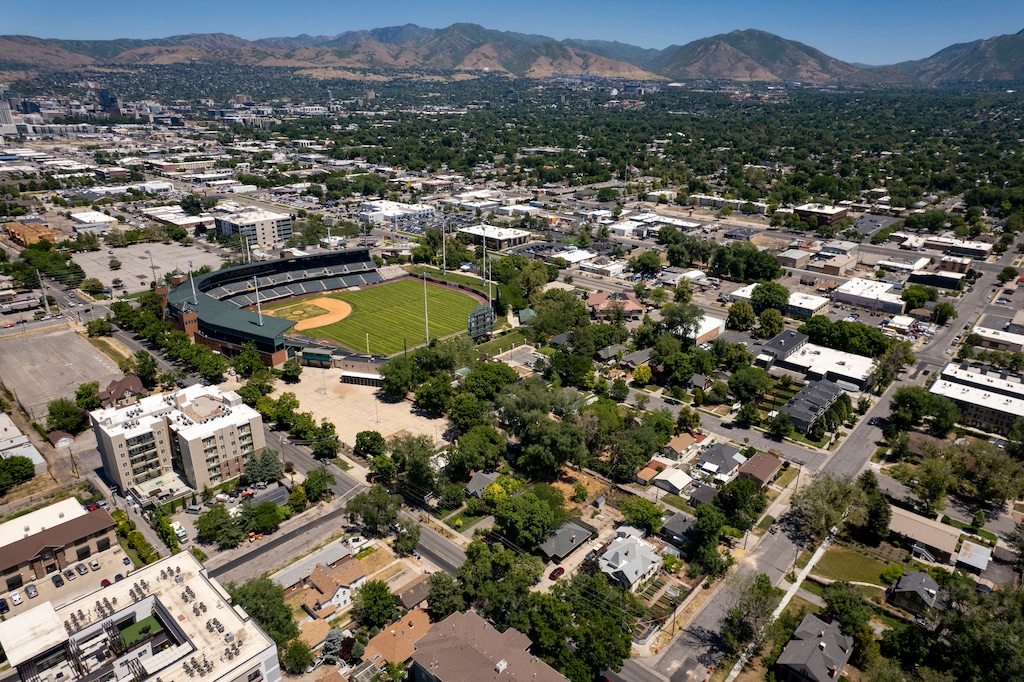
Salt Lake City Council member Erika Carlsen, whose District 5 spans Ballpark, said that neighborhood, which lags behind others in the city on key economic metrics and has seen its centerpiece Smith’s Ballpark vacated in recent years, was “a prime space” for what a new opportunity zone might bring.
“That’s why I chose it as my neighborhood years ago,” Carlsen said as the council endorsed the seven potential areas last week. “I’m excited to see if this moves forward greater economic development and investment into that part of the city.”
What are opportunity zones?
(Christopher Cherrington | The Salt Lake Tribune)
Introduced in President Donald Trump’s first term, the idea behind opportunity zones has been to encourage investment in low-income neighborhoods by offering sizable breaks on capital gains to those willing to leave their money in place for between five and 10 years.
The tax breaks to deep-pocketed investors are thought to have pumped billions into largely urban development across the country and have spurred a spate of investments in certain parts of Salt Lake City, notably along North Temple and in the Granary District.
Developers in those areas have credited the tax incentives for making new housing units and other projects financially viable. Ventures have included mid-rise apartment complexes, adaptive reuses of historic buildings, hotel projects and big residential developments like the Post District and The Silos.
A leading developer who’s used opportunity zones for several of those projects, especially in the Granary, says it could be a future boon for Ballpark.
(Francisco Kjolseth | The Salt Lake Tribune) The Post District in 2025.
“It’s a huge win,” Brandon Blaser of Salt Lake City-based Blaser Ventures said of the city’s nomination. “For Ballpark to progress and the vision for redeveloping that area to happen, we need to have every tool in the tool belt possible to make it make sense.”
Having it as an opportunity zone, Blaser said, “is a huge advantage.”
Research at the University of Utah and elsewhere, meanwhile, indicates the opportunity zone incentives have helped to create jobs and housing units across the U.S., but they’ve sparked concerns the zones have deepened patterns of gentrification.
New tighter standards are changing the map
(Bethany Baker | The Salt Lake Tribune) People bike and walk across Redwood Road along North Temple in Salt Lake City. That corridor has seen rapid housing development largely spurred by opportunity zones.
Now, under a major overhaul to the program as part of Trump’s One Big Beautiful Bill, rules for which census tracts across the nation might qualify as an opportunity zone have changed.
Salt Lake City’s economic development director, Lorena Riffo-Jenson, said the revisions have tightened low-income standards for which areas might qualify, required more local hiring and enacted safeguards aimed at reducing residents being displaced by newly spurred growth.
So while some neighborhoods continue to be eligible under the latest federal criteria, Riffo-Jenson and other city officials said, the new rules have altered the future map for others.
Final nominations for these future zones in Utah will fall to the Governor’s Office of Economic Opportunity.
Of the 22 census tracts within city limits that meet the new criteria, Salt Lake City is giving a thumbs-up to seven, based on a complex review. That has included a study of other, overlapping city tax incentives in place through its Community Reinvestment Agency and the likelihood of drawing investments in sought-after industries such as technology, aerospace, financial tech, life sciences and energy.
Along with that, the city is favoring areas close to 2034 Olympics venues, mass transit corridors and hubs dedicated to hospitality.
Ballpark tops its list, with officials calling it “one of the most ideal locations.”
Why SLC is suggesting these neighborhoods
(Rick Egan | The Salt Lake Tribune) The Ballpark neighborhood on Friday, June 5, 2026.
The south-central Ballpark neighborhood has favorable zoning allowing taller and more dense construction, lots of development potential, transit access and more, according to the city’s analysis. And under plans developed since the Salt Lake Bees left Smith’s Ballpark in 2024 for South Jordan’s Daybreak, the city is eyeing an investment boost for a central community space and additional open areas to the neighborhood.
Other places the city has nominated as potential opportunity zones include:
• Poplar Grove and the Power District - Large parts of this neighborhood south of North Temple are already eyed for development by the Larry H. Miller Co., the city says, as part of a bid to bring Major League Baseball to Utah’s capital. Plans call for mixed-use development including hospitality outlets over about 100 acres in the area.
• The Northwest Quadrant near the Great Salt Lake and Kennecott - This sprawling census tract has been identified as potentially supporting the city’s targeted industries and already permits most land uses. It’s served by long- and short-haul freight rail lines and is close to Salt Lake City International Airport and to downtown.
• Glendale - Like Ballpark, the city sees this area as having large amounts of land that has recently been rezoned for additional mixed uses and could be accessible to both small startups and large established employers looking to expand.
• Fairpark - This portion of the west side north of North Temple is already slated for development on private land and state-owned parcels at the fairgrounds as part of a state-initiated remake of the area. An opportunity zone here, according to the city, could see a lift from the nearby Power District and its envisioned emphasis on hospitality.
• Central City - This is the smallest of the city’s nominated areas, with about 80 acres in the northwest corner of the neighborhood. But it meets a lot of the city’s standards, including favorable zoning, attracting favored industries and transit access tying it to the U. and the airport.
• Rose Park and Northpoint - Proximity to the airport, supportive zoning for key industries and residential opportunities in Rose Park have landed this area on the city’s list of recommendations. It is also close to downtown, the planned Power District and 2034 Olympic venues.