 Jordan Miller
Utah’s longest-serving female legislator announced she would not run for reelection last year, and two Democrats are vying to replace her.
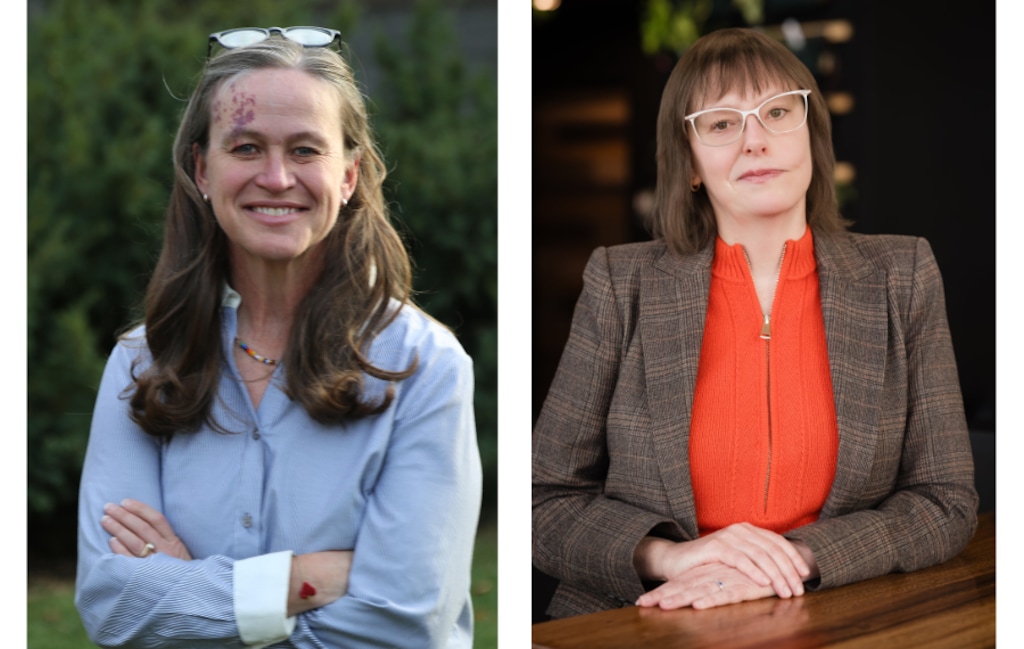
Julie Jackson and Erin Jemison are on the ballot to replace longtime representative Carol Spackman Moss, a Democrat, in House District 34’s June 23 primary. The district covers parts of Holladay, Millcreek and Murray.
Jackson is a former teacher who currently serves as president-elect of the Utah School Boards Association, while Jemison works as director of public policy at the Utah Domestic Violence Coalition.
The Salt Lake Tribune posed the following questions, based on a reader survey about the issues Utahns felt were most important this election season, to each of the four candidates. Their answers — listed in alphabetical order — may have been edited slightly for length, style or grammar.
A plurality of voters, more than 30%, said elected official corruption is the primary issue driving who they’ll vote for, with another nearly 14% of voters saying it is their second-highest issue. Why are so many Utah voters concerned about corruption in politics? How will you build trust with Utahns?
Jackson: Lately, I feel that what is ethical has been confused with “what I can get away with” or even “what is legal.” I hold myself to a higher standard. As your elected Granite School Board representative, I have demonstrated my commitment to taking accountability and holding others accountable. I’ve shown myself to be courageously honest, transparent, and communicative. As your representative, I not only listen to you, but I get others to listen to you too. I will continue to work for my neighbors with integrity and an eye on what is best for Utahns.
Jemison: Utah’s one-party supermajority means there are few structural checks on how power gets used. When one party controls every branch of government for decades, transparency and public trust suffers. National political corruption also shapes what becomes acceptable at the state level. I’ll rebuild trust by being transparent in my decisions, accessible to constituents, and honest when I disagree with legislative actions. I’ve spent two decades working on policy reform because I believe the government can work for everyday people. But it requires elected officials who truly answer to constituents.
After corruption, more than 16% of Utah voters said everyday affordability — like the cost of housing, groceries, gas, etc — is the first thing on their minds as they vote this year. Another 15% said it is their second-highest issue. What will you do to help make life more affordable for Utahns?
Jackson: I love so many people who are struggling. I’m tired of working to Band-Aid the situation and want to fix our economic problem. I’ll begin by removing regulation from child care centers to make child care more affordable, providing incentives to developers and more flexibility to cities so we can incentivize developers to build housing that is reasonably priced and increasing the minimum wage (it has been at $7.25 since 2009). My background — small business owner, teacher, parent, elected official, nonprofit board, and foundation operator — makes me a valuable asset in these conversations.
Jemison: Housing affordability is Utah’s biggest cost issue. Utah’s population has grown faster than housing supply for years, and despite annual promises and budget allocations, state policy has failed to close the gap. Fragmented policies, unclear funding outcomes and restrictive zoning have kept supply artificially low while demand surges, and median wages haven’t kept pace. We need state level solutions to address these issues. I’d also focus on programs to lower other costs: removing the tax on food, investing in healthcare and child care, and ensuring the state budget supports working families.
Utah has experienced drought for much of the last two decades. The availability of water is the third-most-pressing issue for voters this year. What can elected officials do to ensure Utahns have enough water for the future?
Jackson: Our water crisis is personal to each one of us and none of us is immune. Our experts have given us viable solutions to our water problem, but all of them require a significant financial investment. I will spend the next six months becoming an expert on the budget, looking for funds and policies that we can reposition to invest in water conservation. Once we have solutions to the financial portion of the problem, we’ll need to help legislators on both sides of the aisle understand that if they support laws that invest in water, their constituents will continue to vote for them.
Jemison: We need to take a hard look at landscaping and agricultural water use, curb excessive consumption, and incentivize conservation. We also need to be honest that some development decisions are not viable long-term given Utah’s limited water resources. Restoring the Great Salt Lake to healthy levels is urgent, and needless to say, we should not approve large-scale data centers that will consume massive amounts of water we don’t have. I support investing in water recycling infrastructure, redirecting water to the lake, and prioritizing long-term sustainability over short-term economic interests.
Should the state continue to pursue nuclear energy? What can be done to address Utah’s growing energy needs?
Jackson: No. I will continue to work to stop the proposed Box Elder County project and will bring my knowledge from my tech background to have real conversations about how we want to handle data centers as a state. We must create policy that works in the best interest of Utahns, rather than for data center owners. Where we need more energy, I want to pursue the geothermal energy that exists in the West Desert as well as renewable energy such as solar and wind power. I’d like to incentivize consumer and industry behavior that conserves energy.
Jemison: No. I support an “all of the above” energy strategy that diversifies our resources. Nuclear may have future potential, but we should prioritize technologies that are affordable, clean, safe, low impact, and fastest to deploy today. We’re sitting on enormous untapped potential in solar, geothermal and wind, and we need to invest in modernizing our energy grid to support them. What we cannot do is focus solely on fossil fuels and expensive nuclear that is not yet commercially proven. Our approach to growing energy demands needs to make sense both financially and environmentally.
In 2018, voters narrowly passed the Better Boundaries initiative, creating an independent redistricting commission and prohibiting partisan gerrymandering. The Legislature’s attempts to significantly weaken the Better Boundaries initiative spawned years of litigation, culminating in a court adopting new congressional boundaries. Who should be responsible for drawing Utah’s political boundaries? Why?
Jackson: I’ll protect the independent redistricting commission. It is a conflict of interest for the legislature to draw its own maps and directly undermine the voice of the people. Parties do not run our state — the people do.
Jemison: Maps should be drawn by an independent redistricting committee, free from partisan influence and elected officials with a direct interest in district boundaries. Allowing the Legislature to draw its own district lines is a structural conflict of interest. Voters solved this issue in 2018 with the Better Boundaries initiative, and the Legislature continues to do everything they can to undo the work of the initiative. I support an independent commission that has binding authority, and as a legislator, I will fight to protect Proposition 4 and secure fair maps for Utahns at all levels.
Is there an imbalance of power between the Legislature and the courts? If so, what should be done about it?
Jackson: The supermajority in the legislature has made the checks and balances in our state constitution for the three branches of government nonexistent. I will always vote to encourage a healthy balance of power. Let’s start by funding the lower courts to reduce backlogs. I will demand transparency in the appointment process of our new supreme court judges and will preserve the process of having a nonpartisan nomination committee. We must elect more Democrats to bring a balance of power back to the legislature so it cannot pass bills that disempower the other branches of government.
Jemison: Yes. The judiciary is meant to check legislative overreach, but Utah’s supermajority has increasingly undermined judicial independence by expanding the supreme court, creating new review panels for their own cases, threatening judges, and rigging the system to benefit themselves. If elected, I will oppose efforts to politicize our courts and will fight to protect judicial independence. Separation of powers exists to prevent any one branch from accumulating too much authority, and the Legislature has tested those limits too often. We need more lawmakers willing to push back.
What do you believe is the most pressing issue before voters this year? What can be done to address it?
Jackson: In addition to the issues discussed above, my neighbors are concerned about school funding and property taxes. Education funding makes up 40% of the state budget. I have many neighbors on a fixed income who are in danger of losing their home every time property taxes go up. Property taxes go up because education funding from the state does not meet the needs of the schools. I will work to fix the structural education funding issues so our seniors can have confidence that they can stay in their homes, while ensuring our kids get the best education our tax dollars can provide.
Jemison: Utah is at a critical point. Housing costs are increasingly out of reach for working people, our water future is dire, and too many Utahns feel like the legislature isn’t listening. That doesn’t change without putting new people in the rooms where decisions get made. I’ve spent two decades working in policy and advocacy because I know that the government can deliver real solutions, but it’s only possible when representatives answer to the people they serve, not insiders or special interests. I’m running to be an accountable, transparent and effective representative for District 34.