 Paighten Harkins
Corinne • When the Artemis III mission launches next year, marking a pivotal next step in NASA’s effort to return humans to the moon, they will be propelled off the launch pad by boosters made in Utah.
That journey to take off at Florida’s Kennedy Space Center started Tuesday morning in Corinne, as the machinery was shipped out on Union Pacific trains, led by locomotives painted in patriotic colors and named for presidents Donald Trump and Abraham Lincoln.
The eight solid rocket motors should arrive in Florida in a little over a week, said Chris Cianciola, NASA’s acting Space Launch System program manager. Mark Pond, Northrop Grumman’s senior director for space exploration, christened the journey by smashing a Champagne bottle against the Trump-themed engine. White foam erupted to enthusiastic cheers and applause.
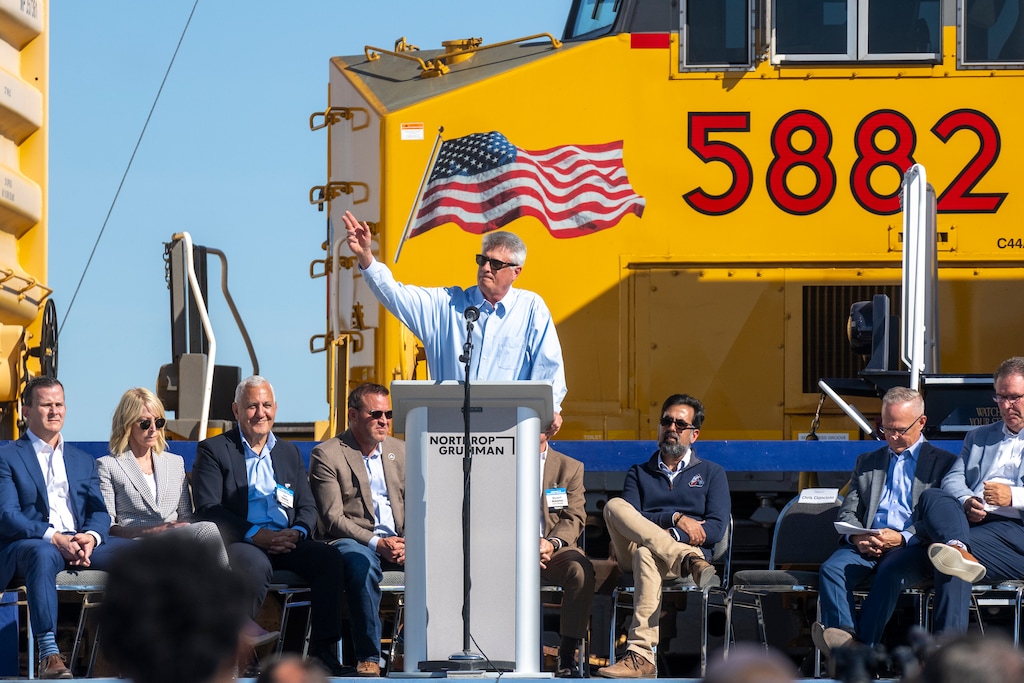
(Rick Egan | The Salt Lake Tribune) Jim Kalberer, Northrop Grumman's vice president of propulsion systems, speaks at the farewell for the boosters for the Artemis III mission on Tuesday, June 2, 2026.
(Rick Egan | The Salt Lake Tribune) Participants listen to speeches during a Northrop Grumman farewell event for the boosters for the Artemis III mission on Tuesday, June 2, 2026.
Once in Florida, crews will process the pieces before stacking them to form the Space Launch System rocket’s twin boosters, providing some 7.2 million pounds of thrust, Cianciola said.
The Artemis III mission is not as flashy as II, where astronauts swung out to the far side of the moon before returning to Earth, nor IV, which aims to land humans back on the moon.
But it is an important step in the process, where crews will test the machinery necessary to achieve another moon landing, NASA associate administrator Amit Kshatriya told a crowd of Northrop Grumman employees gathered at the railroad to send off the boosters Tuesday.
The launch, planned for as early as March 2027, will send the Orion spacecraft atop the Space Launch System into orbit to test how the spacecraft docks with private commercial landers from Elon Musk’s SpaceX and/or Jeff Bezos’s Blue Origin.
“We’re going to learn about how these machines work,” Kshatriya said, “and then we’re going to take shots on the moon.”
Utah and Northrop Grumman have long been key to U.S. space exploration. Through its predecessor companies, including Thiokol and ATK, Northrop Grumman has supplied solid rocket motors for U.S. spaceflight programs from Apollo to the space shuttle program and now Artemis.
For decades, components shipped from her company’s Promontory complex have left from this railroad in Corinne, said Wendy Williams, vice president and general manager of Northrop Grumman’s launch and exploration division.
“Up here, it’s a special place where the employees are really connected with human space flight and human exploration,” she said.
(Rick Egan | The Salt Lake Tribune) Wendy Williams, Northrop Grumman's vice president and general manager of launch and exploration, waves from the window of the train that will transport the boosters for the Artemis III rocket on Tuesday, June 2, 2026.
Tuesday’s send-off featured a mix of Northrop Grumman, NASA and Union Pacific leaders, as well as Utah Senate President J. Stuart Adams and House Speaker Mike Shultz.
“You may have watched the space shuttle get launched into space with the [solid rocket] boosters built right here in Box Elder County and Promontory, right very close to where the Transcontinental Railroad met,” Shultz said.
Shultz reflected on the work and vision it took to get to that moment — and this moment, 250 years after America’s founding and 130 years after Utah’s statehood.
Past generations built up the communities that became Utah. They pieced together the railroad to connect the country across the west’s rugged terrain, and now Utahns build the technology that launches rockets into space.
“We need to think about what’s going to happen another 250 years from now,” he said.
“I hope that at that point in time,” Shultz continued, “they can look back and say these are the things that they did 250 years ago and 500 years ago that made America and Utah a great place.”
(Rick Egan | The Salt Lake Tribune) Participants check out the trains during a farewell event for the boosters for the Artemis III mission on Tuesday, June 2, 2026.