 Andrew Christiansen
Timed-entry reservations at Arches National Park likely reduced visitation to the park, even as the local tourism economy continued growing overall, according to a long-awaited study commissioned by Grand County.
The report from the University of Utah’s Kem C. Gardner Policy Institute arrives after years of debate in Moab and across Grand County over whether timed entry discouraged tourism and hurt the local economy or successfully reduced congestion and improved visitor experiences without significantly harming tourism-related businesses.
Arches introduced timed entry in 2022 after visitation surged 74% between 2011 and 2021. According to the National Park Service, the increase contributed to traffic backups, temporary park closures, crowding and resource concerns inside the park. The system required advance reservations during peak visitation periods, but is not being used at Arches this year. It remains unclear whether it could return in future years.
Researchers estimated timed entry likely reduced Arches visitation by the equivalent of roughly 170,000 fewer visitors annually between 2022 and 2024 — about 14.1% below what the study projected visitation might have been without the reservation system.
The report also estimated that, if broader economic conditions had otherwise remained roughly similar, the reduced visitation would have been associated with between $41.4 million and $55.1 million less annual visitor spending in Grand County than the model projected without timed entry.
But researchers stressed those figures reflected hypothetical economic modeling rather than actual measured losses in Grand County during the timed-entry years.
In reality, inflation-adjusted visitor spending, tourism jobs and visitor-generated tax revenue all increased during the 2022–2024 timed-entry years compared with the study’s 2017–2019 pre-timed-entry baseline. Visitor spending increased 22.2%, visitor-generated tax revenue increased 27.8% and tourism jobs increased 16.3%, according to the report.
Researchers said broader economic activity elsewhere in Grand County appears to have offset potential losses associated with reduced Arches visitation.
The commission approved the $60,000 study last June.
During a May 5 presentation to the Grand County Commission, Gardner Institute Research Director and Chief Economist Phil Dean described the study as a “credible, reasonable estimate” and emphasized that the analysis used statistical modeling to estimate what conditions might have looked like without timed entry rather than drawing definitive conclusions.
How researchers reached their conclusions
The Gardner Institute compared conditions before timed entry was implemented — 2017 through 2019 — with conditions from 2022 through 2024, after the reservation system began. Researchers excluded 2020 and 2021 because pandemic-related tourism disruptions made those years unusually volatile for comparison purposes.
Average annual visitation at Arches declined about 9.3% during the timed-entry years compared with the pre-timed-entry period, according to the study. Researchers estimated visitation likely would have been higher without reservations in place.
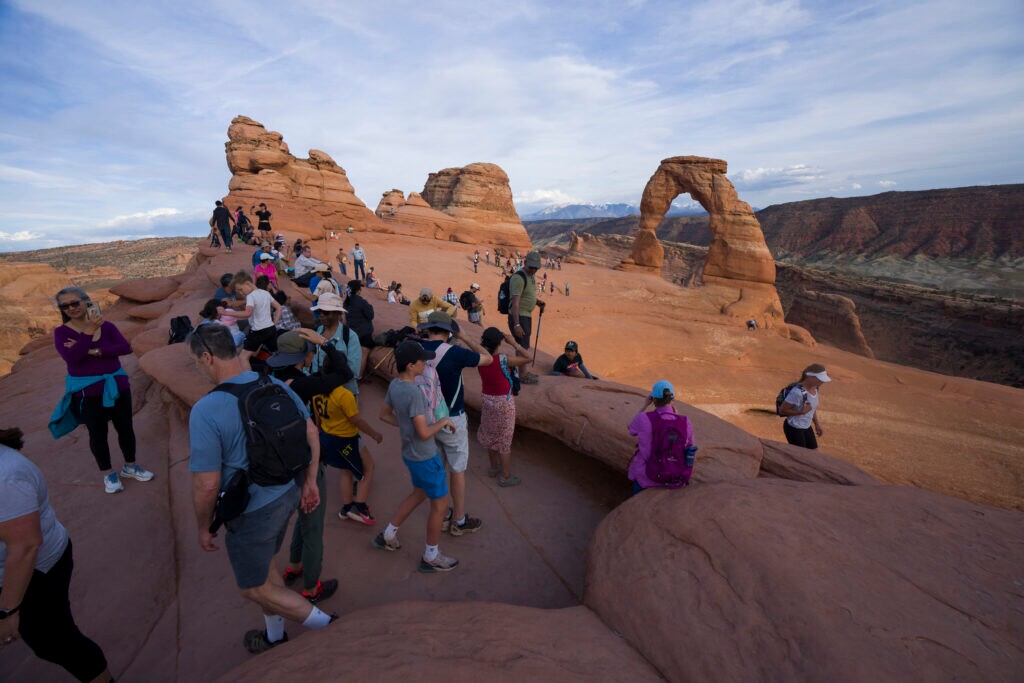
(Bethany Baker | The Salt Lake Tribune) Tourists line up to enter Arches National Park near Moab on Thursday, April 9, 2026.
Meanwhile, visitation increased at nearby parks. The report found average visitation rose 8.2% at Canyonlands National Park and 28.3% at Dead Horse Point State Park, while combined visitation across the three parks increased 4.7% overall.
Researchers said those trends may suggest some visitors shifted toward other parks and recreation opportunities in Grand County during the timed-entry years, though the study did not directly track individual visitor behavior.
Broader tourism and economic trends in Grand County also remained relatively strong during the timed-entry years. Compared with the 2017–2019, inflation-adjusted visitor spending, tourism employment and visitor-generated tax collections all increased during the timed-entry years. Although visitor spending and tax revenue declined modestly between 2022 and 2024, both remained above pre-timed-entry averages.
Rather than directly measuring a version of Grand County without timed entry, researchers used statistical modeling to estimate what visitation and tourism activity might have looked like without the reservation system.
The report relied heavily on a method called “synthetic control” modeling, which uses data from comparable parks and counties to estimate what conditions might have looked like without timed entry for comparison purposes.
“This isn’t what actually happened,” Dean told commissioners while discussing the model’s spending estimates. “We did see increases in the visitor spending, meaning other conditions changed.”
The report also noted the modeled visitation differences were not statistically significant, meaning researchers could not say with high statistical confidence that timed entry alone caused the estimated declines.
The report states that “a range of factors beyond timed entry” likely influenced Grand County’s economy during the study period, including changing travel behavior, inflation, regional tourism trends and recreation activity elsewhere in the county.
In a webpage summarizing the study, Grand County said the report will help inform future work related to visitor economy management, coordination with the park service and other land managers, economic diversification and ensuring tourism-related revenue benefits residents, businesses and community life.
Commissioners emphasize different interpretations of the findings
Commissioners offered little discussion immediately following the May 5 presentation, but later told The Times-Independent they were divided on what the county should take away from the report’s findings.
Vice Chair Bill Winfield and Commissioner Brian Martinez said the report’s estimated reductions in visitation and modeled spending impacts were significant, and emphasized that Grand County’s economy remained resilient during the same period.
“That is a significant hit to our workforce and business community, and it should not be brushed aside,” Winfield said of the report’s findings. Winfield said the county should pursue alternative solutions to address congestion and parking challenges inside the park rather than relying solely on timed entry reservations.
“Vehicles, not visitors, are the problem in the park,” Winfield said.
(Bethany Baker | The Salt Lake Tribune) Tourists hike along Double Arch Trail inside Arches National Park near Moab on Thursday, April 9, 2026.
Martinez pointed to broader economic contributors outside Arches, mentioning the Rocky Mountaineer train service as an example, and said the report reinforced the importance of continuing to diversify Grand County’s economy beyond the national park.
“Our economy still grew despite fewer visitors coming to Arches under the timed-entry system,” Martinez said.
Commissioners Trish Hedin and Jacques Hadler pointed to the report’s actual economic outcomes during the timed-entry years, arguing the study showed Grand County’s continued economic growth while the reservation system was in place.
Hedin pointed to increases in visitor spending, tourism-related tax revenue, tourism jobs and private-sector employment, describing those figures as the study’s “actual measured impacts” rather than hypothetical modeling estimates.
“I’m happy to hear that this system, which has helped Arches National Park manage visitation, had no adverse effects on our economy,” Hedin said.
Hedin also emphasized the National Park Service’s primary responsibility is protecting park resources rather than maximizing local economic activity and said timed entry helped manage visitation while preserving the park experience.
Like Hadler, Hedin questioned the county’s decision to spend taxpayer money on the study, arguing a broader economic analysis would have provided more long-term value to the community.
Hadler said the report showed “little to positive effect on the overall economy” and suggested timed entry may have shifted visitation away from lower-spending travelers making quick park stops toward visitors who stayed longer and spent more money locally.
Hadler also said he believes timed entry improved congestion and visitor experiences inside the park and supports making the reservation system permanent. He criticized the county’s decision to commission the study, calling it politically motivated and arguing the report ultimately left room for competing interpretations.
“Everyone is going to read this and come to their own conclusions,” Hadler said.
This story was first published by The Times-Independent.