 Andrew Christiansen
Arches National Park recorded its highest March visitation on record in 2026, as the park implements measures to manage entrance lines during a busy spring period.
The park logged 163,515 visits in March, up nearly 7% from the same month last year and the highest March total since monthly tracking began in 1979, according to National Park Service data.
Across Utah’s national parks, March visitation also reached record levels at Zion, Bryce Canyon, Capitol Reef and Canyonlands, according to NPS data.
Year-over-year growth varied widely, with roughly 15% increases at Zion and Bryce Canyon and more than 30% at Capitol Reef, while Canyonlands saw a more modest increase of less than 1%.
While March set a record for Arches, it remains unclear how visitation has trended into April, as preliminary data is typically released in the middle of the following month.
The record comes as Arches enters its first peak season in years without a timed entry reservation system, which was used to spread visitation throughout the day, reduce congestion and improve visitor access and experience.
NPS announced in February that timed entry would not be required in 2026 at Arches and several other parks. The system typically ran from April through October in recent years, though it was paused from July 7 through Aug. 26 in 2025.
Sharon Kienzle, retail sales manager for the Canyonlands Natural History Association, which operates the Moab Information Center and visitor center stores at Arches and Canyonlands national parks, said in an email that visitation has felt busier this spring.
“In the Arches Visitor Center store we are back [to] the ups and downs of visitation,” Kienzle said. “We will be slammed with visitors then turn around and be almost empty.”
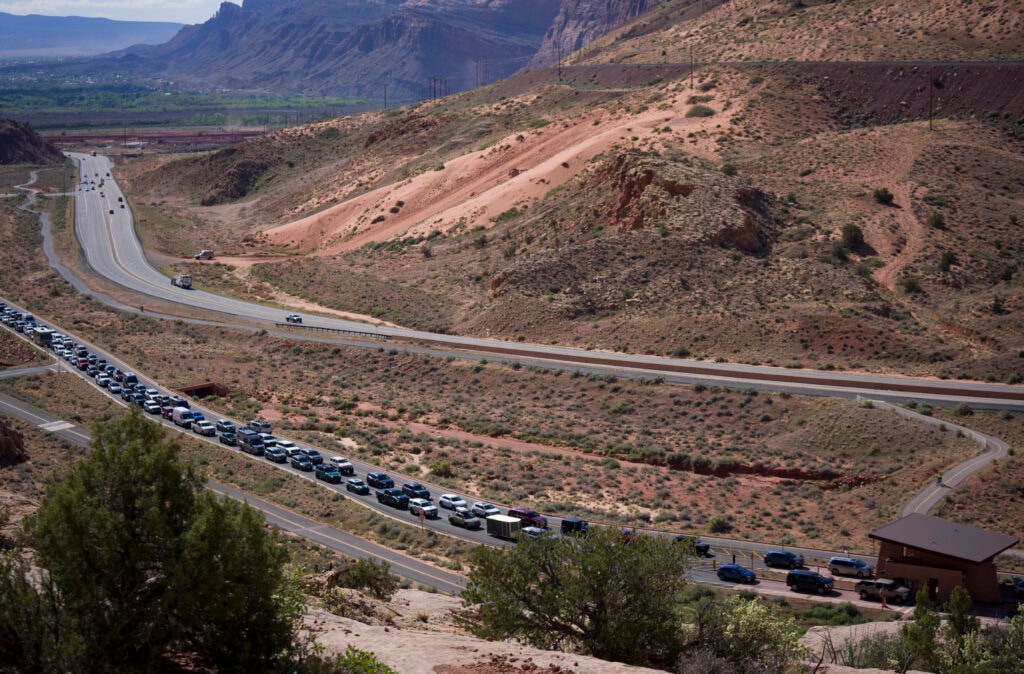
Kienzle said visitors have frequently reported long waits during peak morning hours, with lines forming between about 7:30 and 8 a.m. and sometimes reaching 45 minutes to an hour before noon.
Managing increased demand
The National Park Service’s Intermountain Region said in an email the park is “trying a range of approaches” to manage demand, including encouraging visitors to purchase passes in advance, streamlining entrance booth interactions and deploying staff with handheld tablets to check passes when backups form.
“We monitor the entrance line via the webcam and trailhead parking lots via direct observation, and implement protocols as appropriate to keep the lines moving and parking lot traffic flowing smoothly and safely,” NPS wrote.
NPS also encouraged visitors to have their pass or payment and identification ready when reaching the entrance to help keep lines moving.
(Bethany Baker | The Salt Lake Tribune) Tourists visit the Garden of Eden area inside Arches National Park near Moab on Thursday, April 9, 2026.
Sam Wainer, executive director of the Canyonlands Natural History Association, said purchasing passes locally can help streamline entry and support park operations, noting that passes bought at the Moab Information Center or park entrances are retained by the Southeast Utah Group, while online purchases may not be directed to the same local funding source.
Kienzle previously told the Moab Tourism Advisory Board in February that the park had faced challenges filling positions, with many applicants declining job offers due to a lack of housing availability or accepting other jobs. She said at a March meeting that the park hasn’t “hired everyone yet.”
When asked about staffing levels and how the park is positioned for the busy season, NPS said, “New staff are still arriving and getting trained, and we are continuing targeted local recruitment of additional seasonal and permanent positions.”
Kienzle said park staff have also taken steps to move vehicles through the entrance more quickly during busy periods, including separating lanes for pass holders and using rangers to check passes in line.
She said that during periods of heavy congestion, park staff have at times needed to “flush” the entrance line — allowing vehicles to enter without stopping to check passes or collect fees — to relieve backups and prevent traffic from extending farther toward the highway.
“It is a huge concern when they have to ‘flush’ the line,” she said. “Not only no passes are checked or entry fees taken, it is putting a huge strain on the park itself.”
She said that when that happens, it can lead to more crowded conditions inside the park, including full parking areas, congestion on trails and potential safety concerns.
Visitor experiences on the ground
Visitors interviewed in the late morning on Thursday, April 23 described generally manageable conditions entering Arches, with timing playing a key role.
“We came real early, 7:30, so we got right in,” said Susan Sprouse.
Christie Kennedy, visiting from Arizona, said she and her travel partner arrived before 6 a.m. after hearing about potential lines.
“I thought it was better than expected,” she said.
Others who arrived later in the morning still reported short waits. Maureen Sturza, who works in the travel industry, said her group waited about 12 minutes after arriving around 10:45 a.m.
(Bethany Baker | The Salt Lake Tribune) A tourist visits the Garden of Eden area inside Arches National Park near Moab on Thursday, April 9, 2026.
Dan Arci, who was traveling from Houston, said drivers who had purchased passes in advance moved through the entrance more quickly, while those who were not prepared slowed the line.
He said parking lots were busy but he was able to find a space, and that trails and restrooms appeared clean and well maintained.
Tom Poyen, visiting from New Jersey, said some popular areas were busy, but overall conditions were not overwhelming.
Possible factors behind the increase
NPS said visitation trends are difficult to predict and influenced by a range of local and global factors.
“We continually monitor these dynamic conditions and work to provide great visitor experiences while preserving park resources,” the agency wrote.
Wainer said retail sales at Arches and other park stores increased about 7% in March, closely tracking visitation growth.
He said sales have also remained elevated in April but began to level off slightly toward the end of the month.
Wainer said the timing of Easter — which fell later in April 2025 — may have shifted activity earlier in the month this year.
Kienzle said her observations from the visitor center align with that pattern, noting that the Easter Jeep Safari — a popular Moab event that draws an estimated 15,000 to 20,000 visitors — fell earlier this year than in 2025, with some dates occurring in late March.
Wainer said the strong start to the year may also reflect broader travel patterns, including a weaker-than-usual ski season across the Rocky Mountain region, where low snowpack and warm conditions led to many ski areas to close earlier than usual. Vail Resorts also reported earlier this year that skier visits at its North American resorts were down about 20% amid poor snowfall conditions in the West.
“We have historical sales data that supports the factor that when skiing sucks, we’re busier,” Wainer said, adding that those conditions may have redirected visitors to southern Utah.
NPS encourages visitors to plan ahead, check current conditions before arrival and consider early morning or evening visits during busy periods.
This story was first published by The Times-Independent.