 Andrew Christiansen
A San Juan County copper mine is restarting with automated equipment and AI-assisted systems designed to improve efficiency, even as the company plans to grow its workforce.
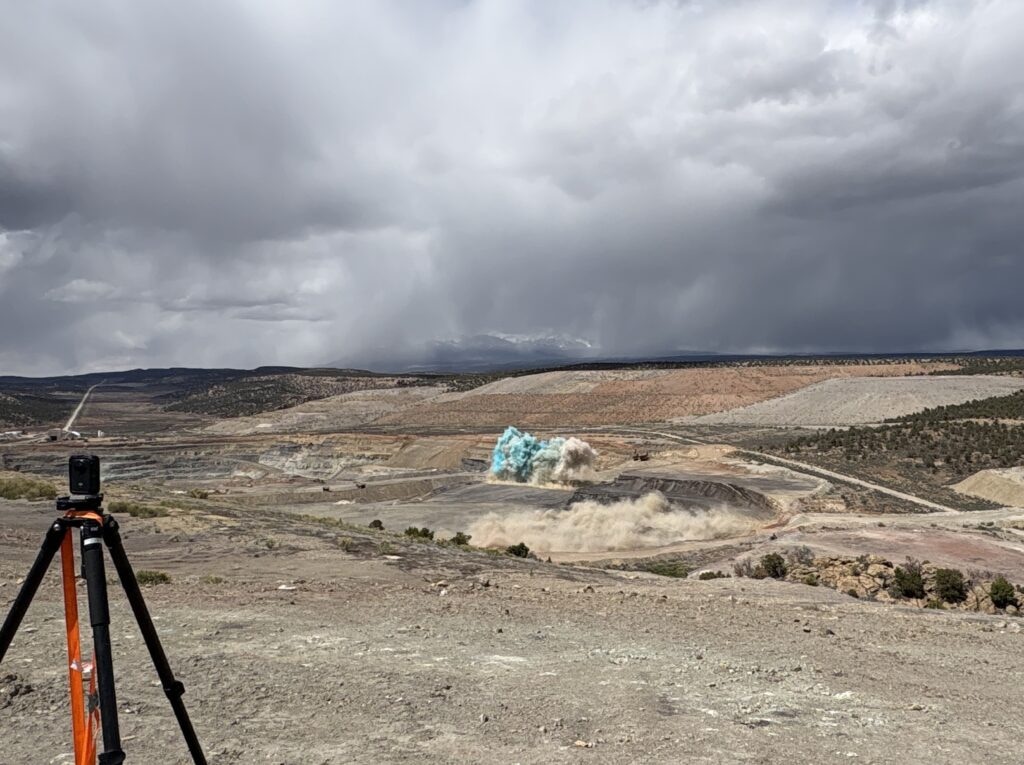
Mariana Minerals on April 27 held a ceremonial first blast at its Copper One site in Lisbon Valley, marking a public milestone in its ongoing ramp-up of mining operations following its acquisition of the site in late 2025. Mining had been paused in late 2024 under the previous operator, while refining continued during that period.
The San Francisco-based company says it plans to grow from about 80 employees to nearly 300 as it ramps up production using autonomous haul trucks, remotely operated drilling systems and AI-controlled refining processes.
At a ceremony overlooking the open pit, attended by lawmakers, engineers, investors and business leaders, CEO Turner Caldwell — a former Tesla engineer — described the restart as part of a broader shift in how mining operates as demand for critical minerals accelerates.
“Mariana’s mission is to fundamentally reinvent and transform how mining and refining is done across the globe, how infrastructure is built, how mines are operated, and how refineries are operated,” Caldwell said.
Caldwell said that demand for copper and other critical minerals is rising rapidly, driven by artificial intelligence infrastructure, electric vehicles, energy systems and defense technologies — all of which rely heavily on metal-intensive supply chains.
Gov. Spencer Cox, who attended the event, framed the project as part of a broader push to expand domestic mineral production and reduce reliance on foreign supply chains, describing it as part of a larger effort to rebuild U.S. energy and industrial capacity.
“I truly believe that what is happening on this spot is exactly what we need to change the world, to save our country and to promote freedom across the globe,” Cox said.
(Andrew Christiansen | The Times-Independent) Utah Gov. Spencer Cox speaks during a ceremony at Mariana Minerals’ Copper One site, highlighting efforts to expand domestic mineral production and reduce reliance on foreign supply chains.
He said state leaders have worked in recent years to speed up permitting and attract energy and mining development, arguing that the country must rebuild its ability to produce its own energy and critical minerals after becoming too reliant on foreign supply chains.
Copper prices in 2026 are near decade highs, trading around $12,000 to $13,000 per metric ton, according to commodity market data.
Mariana, founded in 2024, has already raised about $100 million in venture funding. Caldwell said the company expects to invest roughly $1 billion in capital and operating costs at the site over the next decade and aims to scale production to about 50,000 metric tons of refined copper annually by 2030, including both newly mined and recycled material.
The Lisbon Valley site has produced copper since 2009 and spans roughly 10,000 acres. Mariana acquired the operation in late 2025 and is restarting mining under existing permits, allowing operations to begin without new approvals. The site is also part of a previously approved expansion plan that includes additional mining areas and new extraction methods.
Local officials described the restart as a significant opportunity for San Juan County, pointing to ongoing economic challenges and a lack of local job opportunities.
“This mine represents real, measurable opportunity,” said San Juan County Commission Chair Lori Maughan. “It brings good-paying jobs that can support families … and allows us to keep our workforce here at home.”
Maughan said the project could generate tax revenue for schools, infrastructure and emergency services while supporting local businesses.
Automation, cost and a changing industry
Caldwell said the company’s approach is driven by rising demand for critical minerals and a shrinking labor pool across the mining industry, making automation central to expanding production.
“In the next 10 years, we need to build around 500 new mines and refineries,” he said. “And we don’t have the people to do it.”
(Andrew Christiansen | The Times-Independent) Mariana Minerals CEO Turner Caldwell speaks at the Copper One site in Lisbon Valley, where the company is deploying autonomous equipment and artificial intelligence to manage mining and refining operations.
He said the industry has already lost a significant portion of its workforce and could lose even more in the coming decade, making it difficult to scale production using traditional methods.
To address that gap, Mariana is deploying what it describes as a fully integrated system — combining mining, refining and project development under a single software platform.
Mariana Minerals says Copper One is the first mine to deploy autonomous tools across mining, refining and capital project execution under a unified operating system known as MarianaOS.
At the site, that includes driverless haul trucks, remotely operated drilling equipment, robotic inspection systems and machine learning tools that adjust refining conditions in real time.
Caldwell said the goal is not incremental efficiency gains, but a fundamental shift in how mining operates.
“This is not about incremental cost savings,” he said. “It’s about maximizing efficiency and giving ourselves a fighting chance at delivering the minerals that the world needs.”
Firouz Khodayari, a mining engineer manager at Mariana Minerals with nearly 20 years of experience, said the technology is being introduced in stages, with other equipment, including loaders, expected to be automated over time.
He said the goal is to improve how the entire system functions together, reducing delays and improving efficiency across the site.
“You won’t have traffic, you don’t have congestion, you don’t have queue times,” he said. “You’re shortening the cycle times … which improves productivity and utilization.”
Caldwell said that while automation can reduce the number of workers needed for specific tasks, it can allow mines like Copper One to remain economically viable — keeping operations running and supporting jobs that might otherwise not exist.
The company also plans to expand refining at the site, including processing recycled copper alongside newly mined material — an approach Caldwell said could reduce the need to export raw material for processing overseas.
(Andrew Christiansen | The Times-Independent) Recycled copper material is displayed during a demonstration at Mariana Minerals’ Copper One site, where the company plans to refine both newly mined and recycled copper.
Water use and local concerns
Mining operations use water for dust control and processing, including leaching, where solutions are used to extract copper from ore.
The project has also drawn attention for a previously proposed underground recovery method that would involve circulating solutions through ore-bearing rock formations. The method has undergone federal and state review and has raised concerns among some residents.
Scott Stevenson, who operates a bed-and-breakfast near the site, told The Times-Independent water use remains the biggest concern for nearby residents.
“The mine … needs a lot of water to function and operate,” Stevenson said. “That’s really the biggest issue for us.”
Stevenson said he is not opposed to mining or new technology, but questioned whether the operation is sustainable in an arid region already facing water constraints.
(Andrew Christiansen | The Times-Independent) Equipment and infrastructure are seen at Mariana Minerals’ Copper One site, where the company is integrating automated systems into mining and refining operations.
Caldwell said the company’s current focus is on conventional open-pit mining and refining while working to reduce water use.
“The main focus right now is reducing the water intensity of the base operation,” he said.
He said technologies such as insitu, Latin for “on site,” recovery can be effective if “done intelligently,” but emphasized the company would not move forward with any approach irresponsibly.
Caldwell said the project is intended to show how new technology can reshape mining while keeping operations viable in places like southeastern Utah.
“We are here to be a positive force in the community in the short term, in the medium term and in the long term,” he said. “When we say that, we’re saying it authentically, we’re saying the truth. We are here to stay.”
This story was first published by The Times-Independent.