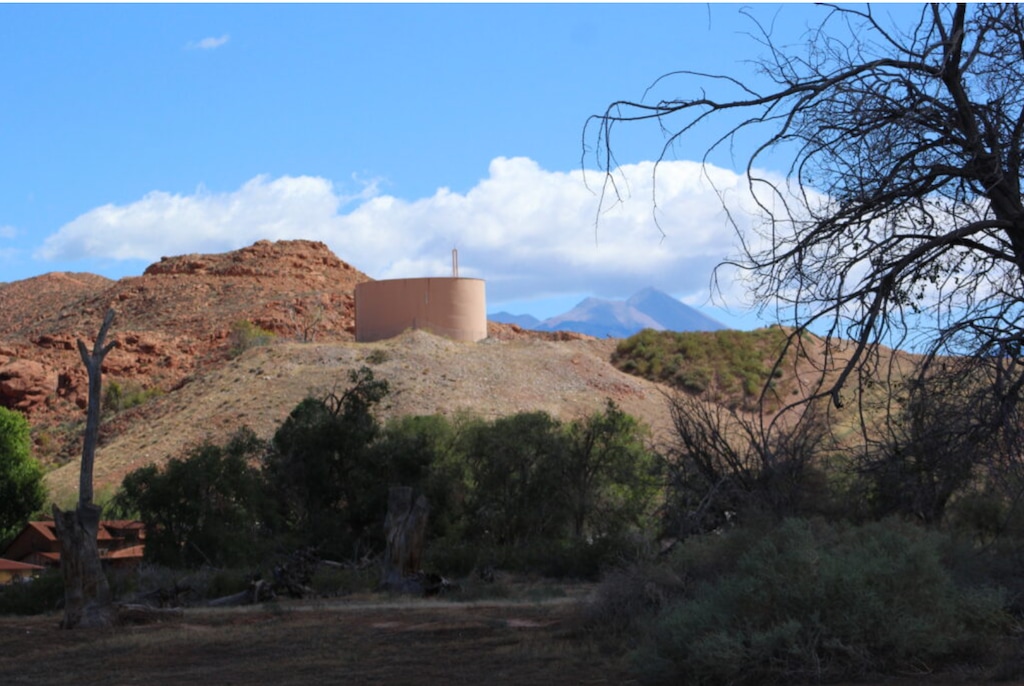
To bolster water storage in the region, the city of Moab hoped for $3 million in support from the state Community Impact Board, which funds projects in areas affected by mineral resource development on federal lands.
But members unanimously voted to reject the city’s request April 2. Ahead of the vote, board Chair Curtis Wells did not comment on the project itself.
Instead, he said Moab has a “very consistent and well-demonstrated record” of opposing oil, gas and coal production on public lands and is disrespectful to the impact board, in part by not acknowledging its support of past projects.
“I feel compelled to have a necessary but difficult conversation with the board regarding our relationship with Moab City,” Wells said after Community Development Director Cory Shurtleff presented the city’s request.
“If the institution of the CIB [Community Impact Board] is going to be protested and insulted, disrespected every step of the way, at some point, we need to pause and have a conversation,” Wells later said. “And I believe that’s where we’re at here.”
The Community Impact Board provides loans and grants to counties, cities and towns that face impacts from mineral development on federal lands — where they can’t collect taxes. A portion of federal lease fees are returned to the CIB to help communities provide necessities like roads, buildings, and water and sewer.
Moab wanted a $500,000 grant and a $2.5 million loan, Shurtleff told the board. The total cost of the city’s water storage project is about $5.6 million, he said, including a new 1.5 million-gallon reinforced concrete culinary water storage tank and an on-site chlorination station.
“This is to address the existing water storage deficiencies, improve our system resiliency and prepare for long-term growth and emergency demands,” Shurtleff said at the meeting.
Based on Utah’s standards, Moab lacks .64 million gallons of water storage, he said, and that’s projected to rise to 2.18 million gallon deficiencies by 2060.
The project design will improve water equalization storage, emergency response capacity and fire suppression pressures and create redundant support for times when other tanks are shut down during maintenance or emergencies, Shurtleff explained.
( Doug McMurdo | The Times-Independent, File) This city-owned parcel in Spanish Valley is the site of the City of Moab’s proposed water tank project.
The tank would support about 5,000 residents in Moab, 4,000 residents in unincorporated Grand County, as well as residents in northern San Juan County, he said.
“This project has been identified as a critical need to support the Moab area community and all those that enjoy our region,” Shurtleff said, “ensuring safety, quality and security of our essential services.”
‘Push has come to shove’
In an interview after the meeting, Wells told The Times-Independent that the environmental activist community has “fused” itself with Moab’s local government, and they have a “repeated record” of protesting natural resource development, but then “coming in with their hand out.”
“Frankly, liberal Moab has really created a difficult situation for local government and its relationship with the CIB, that’s gone on for a long time,” said Wells, who ran for mayor and lost to incumbent Mayor Joette Langianese in 2025.
Wells alleged that the city “consistently elects or hosts” environmental activists. In an interview, Langianese denied that the city works with environmental activists.
Over approximately 30 years, the CIB has contributed about $25 million to Moab city projects, Wells said during the board meeting.
His concerns about continuing to fund city projects are not just about funding a “non-producing” community, he told the board, “but a question of a community that’s litigating and protesting and advocating for the removal of production on public land, both in southeastern Utah and the rest of Utah.”
Unlike other communities, he added, Moab doesn’t acknowledge CIB support of its funded projects.
“Push has come to shove on this, and if we don’t stand up for the producing counties in this fund, they’re going to continue to take advantage of this in a very disrespectful manner,” Wells said at the meeting. “I’m not going to have it.”
(The Times-Independent | File photo) Curtis Wells and Joette Langianese take part in a Moab City Council candidates' event on Sept. 15, 2025, at the Moab Arts and Recreation Center.
He elaborated in the later interview.
“The elected leaders of the city, they don’t want to face down their constituents and say that they’re financing these projects with oil and gas money,” Wells said, echoing similar comments he made during the meeting. “They don’t acknowledge it … They just come in and get money and kind of run away. That’s a huge problem, and so we need to get to the bottom of that.”
Wells told The Times-Independent that the City of Moab has had 11 projects funded by the CIB over the years, including City Hall, the Moab Recreation and Aquatic Center, and recently, Kane Creek Boulevard.
He has been a firm opponent of how the city used funds to rebuild the boulevard, referring to it during the meeting as “the most expensive mile of road the CIB has ever financed, which includes over approximately a million dollars in landscaping.”
CIB awarded the city $7.9 million for the project, making it 90% CIB-funded via a grant of nearly $3.7 million and a loan of $4.2 million. The way funding was spent on the boulevard was an “abomination,” he said in the interview.
‘That was a little confusing’
When the CIB approved funding for Kane Creek Boulevard, Langianese said, she sent a letter to the board members to thank them and invite them to a groundbreaking.
The groundbreaking did not occur because the city couldn’t coordinate a time with the board, she said. She had hoped to do a ribbon cutting ceremony with the board, she added, but the members didn’t visit Moab.
She noted the entirety of the Kane Creek project was unanimously approved by the CIB and the way it was presented to the board was how “it was put to the ground.”
( Doug McMurdo | The Times-Independent) Construction on Kane Creek Boulevard in Moab is seen here on June 3, 2024. Ninety percent of the cost of the rebuilding project, completed last year, was covered by a grant and and a loan from the Permanent Community Impact Board.
Langianese said she thought the city was in good standing with the CIB and was confused by the decision to deny funding for the water tank.
“We don’t have any say in oil-gas development,” Langianese told The Times-Independent. “It’s not even in our jurisdiction to do that. And so that was a little confusing. So we’re not quite sure the real purpose for the denial.”
The county has jurisdiction over mineral production, she said. “There aren’t any oil and gas developments within the city limits, and that’s the case for most cities in the state of Utah,” she said.
While Wells alleged city leadership has opposed energy development, Langianese said the city hasn’t taken a stance on oil and gas production.
“I don’t even remember anybody coming in here to talk to us about oil and gas,” Langianese said. “I don’t even remember anything happening since I’ve been the mayor where we’ve weighed in on any position on oil and gas development … It’s not true.”
The last resolution the city signed to oppose oil and gas production was the beginning of 2020, when Langianese was not the mayor. The city opposed the Bureau of Land Management leasing two parcels in the Sand Flats Recreation Area for oil and gas production.
According to CIB policy, an applicant can send a representative to present a proposal. But Wells also criticized the city for sending Shurtleff and not elected leadership.
“Every other city and county in the state does, because it’s that big of a deal for the community,” Wells told The Times-Independent.
( Doug McMurdo | The Times-Independent) The rebuild of Kane Creek Boulevard was completed last spring, seen here on May 5, 2025. The Permanent Community Impact Board CIB awarded the city $7.9 million for the project, making it 90% CIB-funded via a grant of nearly $3.7 million and a loan of $4.2 million.
According to Wells, Grand County ranks number six in the state for oil and gas production. He said that rank is “amazing” but added it could be “a lot higher” if the city hadn’t “pushed all of the industry out.”
In December, the county had 415 active wells for natural resource production. Last year, the county produced about 112,000 barrels of oil and 3.3 billion cubic feet of gas, which equates to about 37,000 Olympic-size swimming pools.
The state of Utah consumes about 269 billion cubic feet of natural gas each year, according to the Utah Office of Energy Development.
What comes next
At the meeting, Wells said he can’t dictate Moab City policy. But as the CIB chair, recently reappointed by Gov. Spencer Cox for another four-year term, he said, he has a “fiduciary responsibility to stick up for this institution.”
Wells said he would like the City of Moab to pass a resolution that affirms its support for oil, gas and coal production. He would also like to see leaders’ acknowledgment of CIB projects.
“I read all of the mayor’s [opinion pieces] and she talks about all these projects that the city’s doing, as if they’re doing fine financially,” Wells said. “And it really comes across as if it’s being financed by sales tax … She goes in and lists the projects they’re completing, and they’re all CIB projects … We’re not being honest with the public about who’s financing these projects.”
Langianese told The Times-Independent it doesn’t make sense for the city to pass a resolution on oil and gas. “We don’t have oil and gas development in our community, so it kind of doesn’t make sense for us to create a policy for something we don’t have oversight for,” she said.
(Bethany Baker | The Salt Lake Tribune) Moab City Hall in Moab on April 8, 2026. At an April meeting of the Permanent Community Impact Board (CIB), board chair Curtis Wells criticized the City of Moab's relationship with the board. "The CIB built and financed Moab City Hall," he pointed out, "and they sit in there, and they fight all of our (oil, gas and coal-)producing counties, and they network with environmental activists, and it's got to come to an end."
While the city is “disappointed,” she said, city leaders will search for other funding resources to keep the project moving.
In October, the Grand County Commission approved a zoning overlay for the project. But Commissioner Bill Winfield, who also is a voting member of the CIB, voted against the funding at the April 2 CIB meeting. Winfield also ran for mayor in 2021, and lost to Langianese.
“We appreciate them [CIB] … we did acknowledge them and reach out to them, and we’ve done all that,” Langianese said. “I’m not sure what more they want from us.”