 Andrew Christiansen
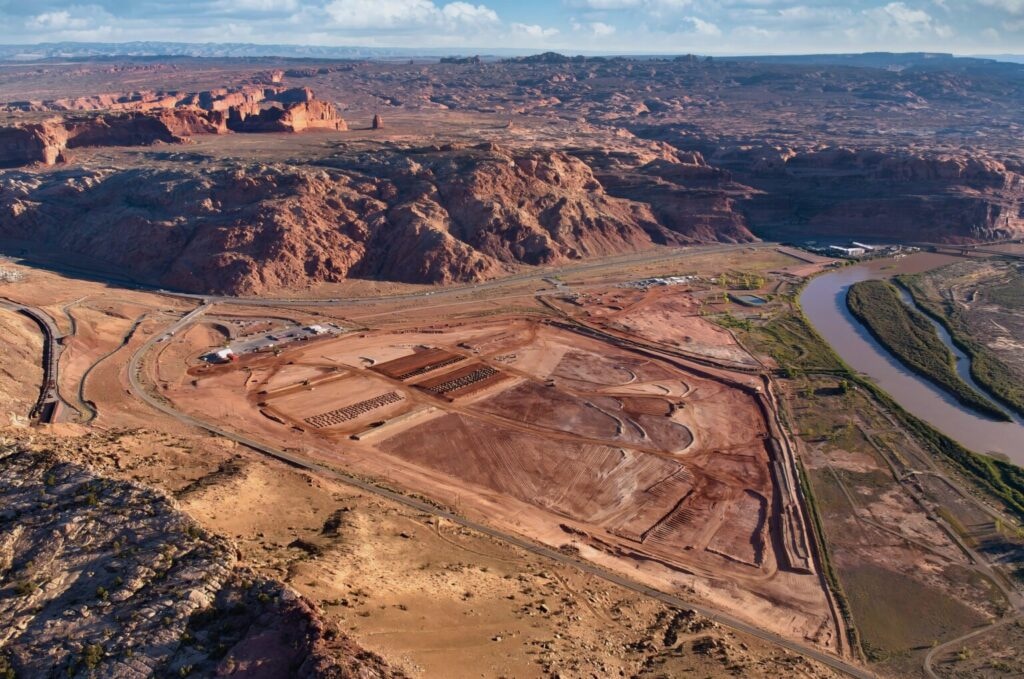
Nearly 100 people gathered Thursday, April 9 at the Grand Center to mark a milestone some local leaders once were not sure they would live to see: the removal of the massive uranium mill tailings pile that for decades loomed above the Colorado River north of Moab.
The ceremony recognized the removal of more than 16 million tons of radioactive mill waste from the former Atlas Minerals site, a decades-long federal cleanup effort aimed at reducing contamination risks to groundwater and the Colorado River.
The event drew county and city officials, Department of Energy staff and contractors, representatives of Utah’s congressional delegation and the Metropolitan Water District of Southern California.
“It’s such a huge, historic milestone,” said Matt Udovitsch, federal cleanup director for the Moab Uranium Mill Tailings Remedial Action Project. “What once was a longstanding environmental liability is now a meaningful opportunity for reuse.”
The milestone was reached at the end of December, when shipments to an engineered disposal cell near Crescent Junction surpassed the project’s original 16-million-ton estimate. By then, about 16.2 million tons of tailings and mill debris had been removed from the site and transported by rail about 42 miles north of Moab for permanent disposal.
“16 million tons is about the same amount that 100,000 Blue Whales weigh, or 2.5 times the Great Pyramid of Giza,” said Tim Davis, executive director of the Utah Department of Environmental Quality, speaking on behalf of Lt. Gov. Deidre Henderson. “It’s truly a monumental lift that you’ve accomplished here.”
Cleanup work is ongoing. As of last December, about 1 million tons of sub-pile and off-pile material remained, along with groundwater treatment and site stabilization, as the Department of Energy continues toward a planned 2029 closure. Federal legislation advancing in Congress would allow the site to be transferred to Grand County once cleanup is complete and deemed safe, with local leaders broadly envisioning future uses such as recreation, community space and other public-serving amenities.
For decades, the pile sat in an unlined impoundment along the river, raising concerns about groundwater contamination and impacts to a water source relied on by millions of people across the West. Large-scale removal began in 2009, addressing waste left behind by uranium milling operations that ran from the 1950s through 1984.
Moab Mayor Joette Langianese, who has been involved in the effort for more than 25 years, said reaching this point required sustained advocacy from local leaders, federal agencies and partners outside the region.
“Finally, finally this project is almost completed,” she said. “There was a time when we never thought this project would end.”
(Andrew Christiansen | The Times-Independent) Moab Mayor Joette Langianese, who has worked on the project for more than 25 years, speaks during an April 9 event marking removal of the uranium tailings pile.
Langianese said support from downstream Colorado River water users — particularly the Metropolitan Water District of Southern California — along with members of Utah’s congressional delegation and former U.S. Rep. Grace Napolitano of California, helped secure the funding needed to keep the project moving forward.
“A town of 10,000 people is never going to move the needle of commerce,” she recalled being told. “Forty million water users downstream, California, Arizona, Nevada, they’re going to move the deal. And they did. Here we are today.”
She said U.S. Sen. Mike Lee often emphasized the federal government’s responsibility for the site.
“You know what? The federal government created this problem,” Langianese recalled him saying. “They need to fix it. They need to take care of it.”
Grand County Commissioner Mary McGann, who has worked on the project for years, helped advocate for federal funding and chairs the Moab Tailings Project Steering Committee, said the milestone reflects decades of work by a wide network of people involved in the project.
Holding up a long scroll listing names of those who contributed, McGann said she could not possibly thank everyone individually.
“I have a lot of people to thank,” she said, adding that the list includes “everyone in this room, everyone on the steering committee, everyone on the future sites committee … the list goes on and on of people who made this happen.”
McGann, whose father was a superintendent at the former Atlas Minerals mill during the uranium boom, reflected on the site’s history in personal terms.
“We lived here in the ’50s,” she said. “We drove into this town and there wasn’t a pile, and we had the misfortune, or the fortune, because it was our economy to watch it grow to 90 feet high.”
“I’ve always said my dad built the pile, and I’m tearing it down.”
(Andrew Christiansen | The Times-Independent) Grand County Commissioner Mary McGann holds a long scroll listing people involved in the UMTRA cleanup during a ceremony April 9 at the Grand Center in Moab.
Grand County Commission Chair Melodie McCandless said the disappearance of the pile marks a visible change for the community.
“For decades, when people looked at the north gateway of Moab, they saw a pile and this was a landmark that we didn’t want,” she said. “Now that landmark is officially gone.”
“So today we’re celebrating the safety of our water, the health of our community and the restoration of our landscape,” McCandless said.
Udovitsch also recognized the workforce that carried out the cleanup, noting that crews worked “day in, day out, day after day” under challenging conditions. Jeff Scott, president of North Wind Portage, the contractor hired by the Department of Energy to perform the remediation work, said many workers have been involved since the project’s early years.
“We have a truly amazing team, and it takes a truly amazing team to do something like this,” Scott said.
Looking ahead, Laura Beasley, deputy director of the Department of Energy’s Office of Legacy Management, said her office will oversee long-term stewardship of the site after cleanup is complete and continue working with the community as the land transitions to future use.
“We are the enduring responsibility for the Department of Energy and the U.S. government’s impact on your land,” she said. “We’re here to partner with everyone in this room until the very end.”
Local leaders are also beginning to focus more directly on what the site could become, building on years of planning by the Moab Tailings Project Site Futures Committee, which has gathered public input on potential uses.
“We’re not just getting 480 acres of land back,” McCandless said. “We are looking at a community vision for enhanced recreation, community assets and economic diversification.”
A joint meeting between the Grand County Commission and the Moab City Council is planned for 12:30 p.m. Friday, April 17, where officials are expected to discuss several issues, including the UMTRA site and its potential future use, according to Langianese.
The ceremony concluded with a symbolic “tile transfer,” in which officials placed the final tile on a commemorative display tracking each million tons of material removed from the Moab site to Crescent Junction, marking completion of the original tailings pile removal.
“The community has waited a long time for this day,” Udovitsch said.
This story was first published by The Times-Independent.