 Jessica Schreifels
Provo • Jesse Taggart has long said he fired his gun at an SUV during a Black Lives Matter protest in Provo because he feared for his life — and the lives of others.
A jury didn’t believe him, convicting him of attempted aggravated murder and other serious crimes. And on Monday, nearly six years after the shooting, a Utah County judge handed down the maximum punishment: a 15-year-to-life prison sentence.
His defense attorney had requested leniency, urging 4th District Court Judge Kraig Powell to consider probation. Taggart’s family pleaded for mercy, describing him as a loyal protector and a peacemaker who wanted others to understand why people were protesting police violence.
But Powell was swayed to give the harsh sentence, he said, after hearing from victims like Kenneth Dudley, the man who was driving the white SUV that Taggart fired at. Dudley was struck in the arm by the first bullet, and drove away as Taggart fired a second shot that lodged inside the SUV near the steering column.
Dudley told the judge Monday that he drove himself to a hospital after he was shot, wondering whether he was going to bleed to death before he got there.
“On June 29, 2020, Mr. Taggart attempted to end my life,” he said in the Provo courtroom on Monday. “... Justice must be served.”
(Bethany Baker | The Salt Lake Tribune) Kenneth Dudley walks back to his seat after speaking during the sentencing for Jesse Taggart, who shot him during a 2020 Black Lives Matter protest.
Taggart gave a tearful and winding explanation of his life and his views to the judge on Monday before he was sentenced, talking about living in a broken home as a child but finding a love for hunting and shooting when he was a young teenager. He said he had attended other Black Lives Matter protests in Salt Lake City that summer, and decided to travel to Provo when he heard of a protest there — but now wishes he hadn’t. “I should have listened to my gut telling me not to go,” he said.
He also apologized to Dudley for the trauma he caused him and his family.
“I know no words I will say will change the outcome of that day,” he said. “And I just hope, like Jesus, you will find it in your hearts to forgive me.”
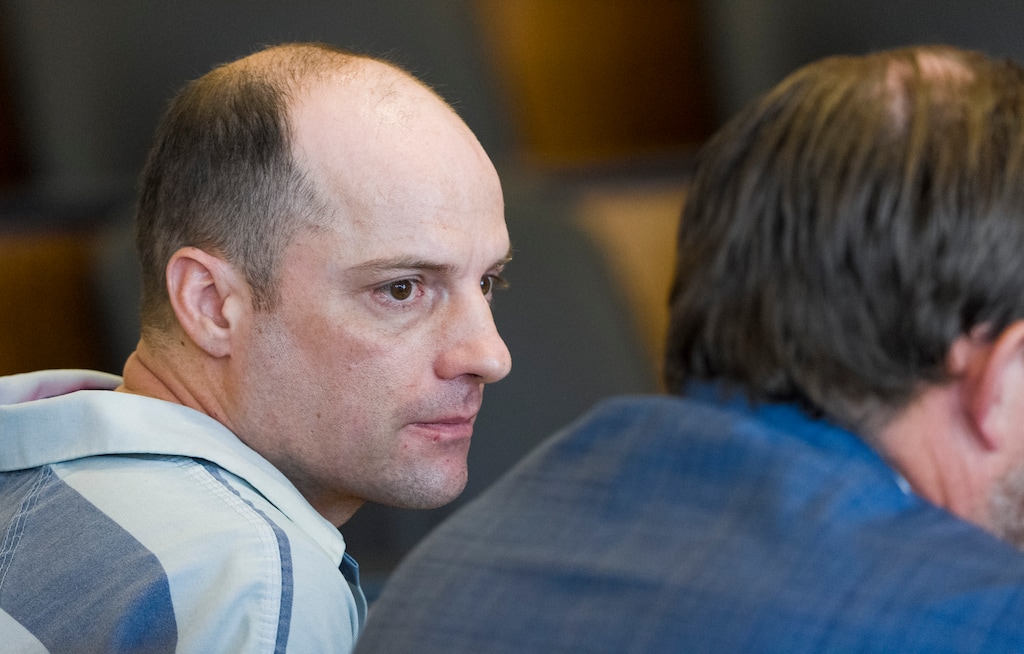
(Bethany Baker | The Salt Lake Tribune) Jesse Taggart was emotional when he spoke before he was sentenced to prison.
Was he legally justified?
Long before trial, Taggart sought out a relatively new kind of hearing in Utah, where people who claim self-defense after firing a gun can ask a judge to decide whether their use of force was legally justified.
If the judge agrees, the charges are dismissed — sparing the defendant a lengthy and costly trial.
But Powell rejected Taggart’s claim. Here’s what the judge said happened:
Dudley had left his home that June evening to go to Home Depot, and became frustrated when protesters blocked the intersection and stopped traffic, the judge wrote in a ruling. Dudley tried to turn right onto Center Street, at one point rolling up onto the curb to get by stopped traffic.
Dudley accelerated towards the protesters, Powell found, and then slowed down once he got closer to the crowd. As he neared the intersection, protesters surrounded Dudley’s SUV, hitting his car with their hands and attempting to push it away as it slowly continued forward.
Taggart soon joined the group gathered around Dudley’s car to push against it, the judge wrote in his ruling, “but the vehicle made contact with him and several other protesters and pushed them back.” Taggart then quickly stepped backwards on the sidewalk, then aimed and fired his gun.
Struck by a bullet, Dudley continued driving through the intersection. Powell found that Taggart ran after the SUV and fired a second shot after one protester ran in front of the SUV, but then moved away. The judge noted that Taggart fired this second shot after video shows the protester was out of the SUV’s path.
(Bethany Baker | The Salt Lake Tribune) Judge Kraig Powell during the sentencing hearing for Jesse Taggart.
Powell ruled that Taggart wasn’t legally justified in firing his gun, ruling that it was not reasonable for him to believe that he needed to use deadly force to prevent himself or others from death or serious injury. The judge wrote that “an objective observer” would determine that Dudley was trying to “carefully” use his SUV to disperse protesters so that he could get through an intersection, but that he didn’t pose a serious danger.
Taggart, he noted, fired his first shot while standing on the sidewalk and out of the SUV’s path.
‘He thought people were going to die’
Powell’s ruling meant the case continued to trial. Taggart was allowed to present the same self-defense claim to jurors in January, and prosecutors were banned from mentioning the judge’s previous determination.
After four days of testimony, Taggart’s defense attorney argued that he was legally allowed to shoot at Dudley.
“Jesse reasonably believed that it was necessary to fire his gun at Ken Dudley to stop him from killing somebody or seriously injuring them,” Nathaniel Johnson said. “So was Jesse Taggart allowed to shoot Ken Dudley? Yes. Why? Because he thought people were going to die.”
But Deputy Utah County Attorney Spencer Wyatt said it was Dudley who truly feared for his life, worried that the protesters who were banging on his SUV would pull him out of the car and hurt him.
“He wanted to turn right and get away,” he said. “They scared him.”
Jurors deliberated for seven hours before delivering a late-evening verdict, finding Taggart guilty of attempted aggravated murder, aggravated assault and rioting.
Powell sentenced Taggart on Monday to 15-years-to-life for the attempted murder charge, and two zero-to-five year prison terms for the other two charges.
Yet Taggart’s case might not be over. He’s filed a motion asking for a new trial, arguing that his defense attorneys made critical mistakes when they didn’t present testimony about his background, didn’t call him to testify in his own defense, or explain to jurors who he was and what he believed.
And, Taggart argued, his previous defense team should have intervened when it was clear he was under the influence of amphetamines, meth and marijuana during the trial, which caused him to fall asleep and not be consistently alert.
His new defense attorney indicated on Monday that these arguments will be raised in Taggart’s appeal.
Jessica Schreifels, formerly Jessica Miller, is an investigative reporter at The Salt Lake Tribune, where she has worked since 2011. She was part of the team that won a 2017 Pulitzer Prize. She has collaborated with several national outlets for investigative projects, including FRONTLINE, American Public Media and ProPublica.