 Brooke Larsen
St. George • Environmental groups filed a lawsuit challenging the Northern Corridor highway on Wednesday, two weeks after the federal government reapproved the controversial project through critical habitat for the threatened Mojave desert tortoise.
Conservation groups, including Conserve Southwest Utah and the Center for Biological Diversity, are suing the Bureau of Land Management and the U.S. Fish and Wildlife Service for “violating multiple federal laws” in approving the four-lane road through the Red Cliffs National Conservation Area, according to a news release.
“Our community has repeatedly made clear that better traffic solutions exist and that they oppose a highway through what should be protected lands,” Stacey Wittek, director of Conserve Southwest Utah, said in a statement. “Given that UDOT is wasting no time moving forward with ground-distributing activities, we had to act to stop this illegal project.”
The Utah Department of Transportation has begun staking the right-of-way with wood lath strips, Kirk Thornock, director of UDOT’s southern Utah region, told The Tribune last week.
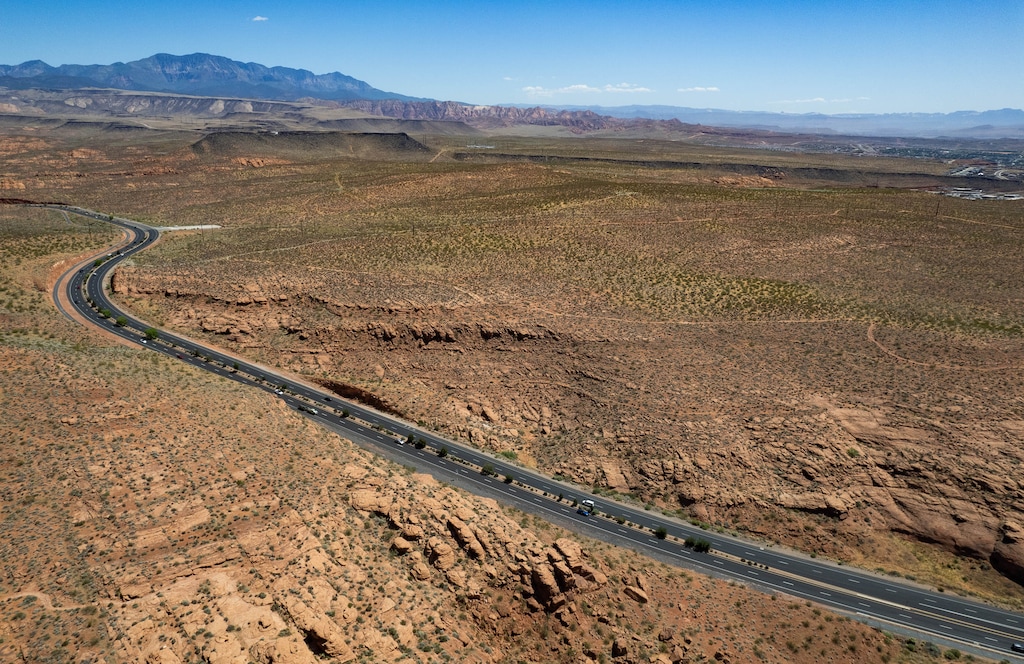
(Chris Caldwell | Special to The Tribune) Staking on the Red Cliffs Desert Reserve, where the proposed Northern Corridor is to be built, Tuesday, Feb. 3, 2026.
St. George Mayor Jimmie Hughes said he is “super disappointed” by the lawsuit. “It’s absolutely crucial that this road goes through,” he added.
The latest lawsuit continues a long saga over the polarizing highway in Washington County that was first proposed in 2006. The federal government first approved the right-of-way at the end of President Donald Trump’s first term in 2021. Environmental groups — including the same ones that are suing this week – sued over the project. The Biden administration later overturned the approval and proposed upgrading existing roads to ease traffic in the growing region.
The lawsuit, filed by Advocates for the West, claims that federal agencies’ approval of the highway through the national conservation area violates the act that created the conservation area and various other laws, such as the Endangered Species Act and the National Environmental Policy Act.
It also argues that the federal government violated the Land and Water Conservation Fund Act, because it previously used those funds to purchase state and private property within the conservation area. Some of those lands would be paved over by the Northern Corridor, said Kya Marienfeld, wildlands attorney with the Southern Utah Wilderness Alliance.
“We have a lot of the same claims, because the federal agencies haven’t fixed any of the issues and the mistakes that they made back in 2021,” Andrew Hursh, staff attorney with Advocates for the West, said. “There was a reason we went to court the first time around. There was a reason that the federal agencies sought remand and pulled their decisions ... and terminated the right-of-way.”
The only difference between then and now is the federal government “decided to reopen the box and change their mind again and reapprove the decision,” Hursh added.
Hursh said that it also appears UDOT is moving faster on the highway this time around, so the groups that sued may pursue a preliminary injunction to temporarily suspend progress on the highway until a ruling is made.
UDOT’s spokesperson, John Gleason, told The Tribune that the department will move through the legal proceedings and determine how that affects its plans.
“This is an important project,” he added, “and we’ve studied the issue for years and feel that this is the right decision going forward.”
A spokesperson for the BLM told The Tribune that the agency does not “have a comment due to the ongoing litigation.”
Washington County “is confident that the federal agencies have complied with all laws and regulations to manage public lands consistent with the law and the public interest,” Jerry Jaeger, county attorney, said in a statement Thursday.
Washington County Commissioner Adam Snow told The Tribune that the Biden administration’s reversal of the highway was “wholly political.” Environmental groups expressed similar sentiments about the Trump administration’s recent reapproval.
“This is narrow-minded, short-term thinking, and the BLM has clearly caved to local and state political pressure with this decision,” said Chris Krupp, Public Lands Attorney for WildEarth Guardians, one of the plaintiffs in the lawsuit.
(Chris Caldwell | Special to The Tribune) The Red Cliffs Desert Reserve, where the proposed Northern Corridor is to be built, Tuesday, Feb. 3, 2026.
Washington County leaders have said the highway is necessary to alleviate current and projected traffic in the growing county.
“Everybody knows the need for the relief of traffic congestion downtown,” Hughes said. “This has been a long planned route ... and really there’s been a lot of compromise that’s been done and progress made on even setting aside more area for for the desert tortoise habitat and open space and recreation.”
The approval of the Northern Corridor triggers the addition of over 6,800 acres of land in the greater Moe’s Valley area, including popular recreation areas and desert tortoise habitat, to the Red Cliffs Desert Reserve.
The addition of this area, called Zone 6, will “create and maintain genetic diversity for the desert tortoise,” Faith Jolley, spokesperson for the Division of Wildlife Resources, wrote in an email to The Tribune.
The desert tortoise is struggling, though. Drought, habitat fragmentation and wildfires have put pressure on the threatened Mojave desert tortoise, according to the Fish and Wildlife Service.