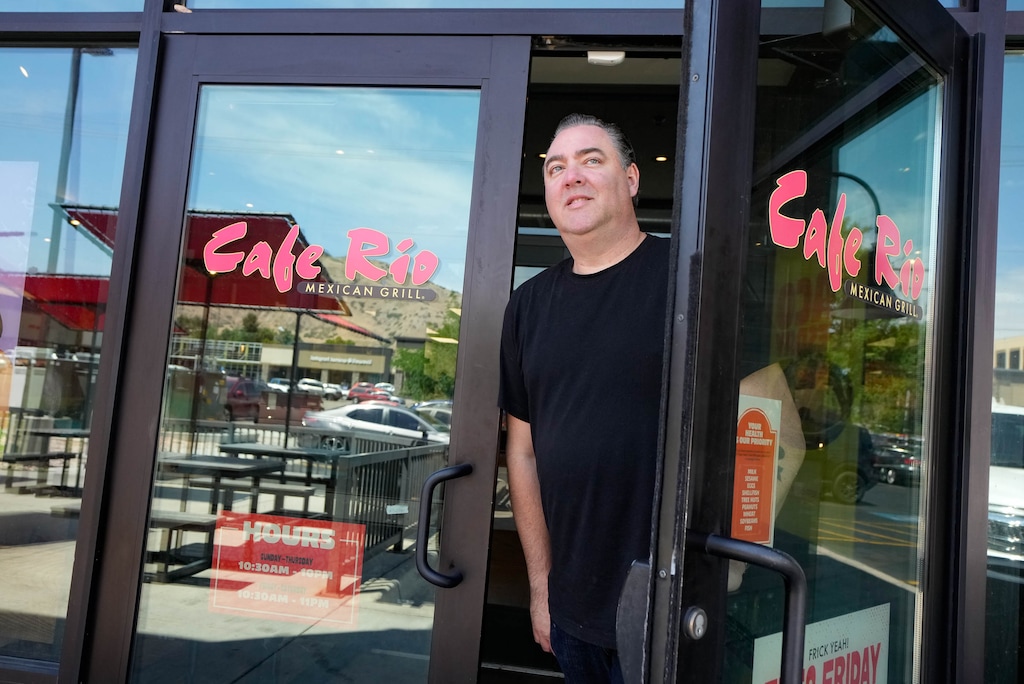
 Kolbie Peterson
New Cafe Rio CEO Mike Burns knows what people have been saying about the Utah-born Mexican chain.
“So bad now, and they used to be good,” one Redditor said a few years ago.
More recently, a commenter on Instagram said, “Sadly, my favorite does not exist anymore. Even though it was a Cafe Rio classic, you got rid of the medium sauce.”
Burns said he has scrolled the “bazillion” Reddit threads about Cafe Rio and read the Instagram and Facebook comments. He acknowledges that the food “slipped a bit,” and that something got lost in translation for Cafe Rio as the company grew to nearly 150 locations nationwide.
“We’re not broken, but we’re just not the same as we were when we started,” he said. “... Anytime something changes hands and changes hands, [it’s] like the telephone game, right?”
Among the feedback from diners, Burns said the “common theme” was “you’ve taken my stuff away,” or “you’ve changed my Rio.”
“So we’re bringing all that stuff back,” he said.
This week, Cafe Rio brought back the beloved medium sauce and the cilantro-lime vinaigrette that people were vocal about when they were taken off the menu in April. The fideo Mexican pasta is coming back on Fridays.
(Francisco Kjolseth | The Salt Lake Tribune) A sweet pork barbacoa salad at Cafe Rio is pictured on Tuesday, July 21, 2026.
And, most significantly, Cafe Rio has returned to its original recipe for its sweet pork barbacoa, taking a protein that had become wet and stringy back to its rich, saucy beginnings.
It’s all part of an effort, Burns said, to tell Utah customers, “All right, guys, we heard you.”
‘A monster to run’
Cafe Rio started as a single Mexican restaurant in St. George in 1997, founded by Utah native Steve Stanley and his wife, Patricia Stanley.
Steve Stanley came up with many of Cafe Rio’s recipes — inspired by the Rio Grande region, southern Texas and New Mexico — including the original recipe for the sweet pork barbacoa.
Cafe Rio quickly grew in popularity in St. George, with long lines constantly out the door.
(Francisco Kjolseth | The Salt Lake Tribune) Cafe Rio’s VP of Operations Chris Reading, sits for a portrait on Tuesday, July 21, 2026. The chain that started in Utah is bringing back items that they had taken off the menu, and bringing back the old recipe for the sweet barbacoa pork.
On “Fideo Fridays,” employees would make a huge pot of the pasta, said Chris Reading, who’s now vice president of operations for Cafe Rio.
During the St. George Marathon, they’d have to make seven of those huge pots “to handle all the runners that were coming in to carb up. It was crazy,” Reading said. He said the St. George location would make $25,000 to $30,000 in sales the weekend of the marathon.
Even though “it was never meant to be a chain,” Burns said, Cafe Rio began opening other stores throughout Utah; those early locations were in Provo, South Jordan, Fort Union, Millcreek, Bountiful and Layton.
(Francisco Kjolseth | The Salt Lake Tribune) Yorley Rojas prepares tortillas at Cafe Rio in Salt Lake City on Tuesday, July 21, 2026.
Reading ran the original Provo location for a time, and said the lines would go out the door and down the sidewalk starting at 10:30 a.m.
“It was a monster to run,” he said.
“We had these gigantic tilt skillets [where] you could put like 200 pounds of pork in there and cook it, and it was five-hour cook time, and it would just go all night long,” Reading added. “... The amount of food that you went through was just amazing.”
In comes private equity
In 2004, private equity firm KarpReilly invested in Cafe Rio, and then in 2017, Freeman Spogli acquired a majority interest in the company and partnered with Cafe Rio to “support its next phase of growth.”
Since that partnership, Cafe Rio has grown to almost 150 restaurants across 11 states: Arizona, California, Colorado, Idaho, Maryland, Montana, Nevada, Utah, Virginia, Washington, and Wyoming.
Critics have said that Cafe Rio’s quality went down once the private equity firms came along. But Burns disagrees.
“I don’t think it was the private equity group that changed anything,” he said. “I think we just grew really fast.”
(Francisco Kjolseth | The Salt Lake Tribune) Jackie Crynes tries the Cafe Rio fries on Tuesday, July 21, 2026. Cafe Rio staff prepare customer orders in Salt Lake City on Tuesday, July 21, 2026. The chain that started in Utah is bringing back items that they had taken off the menu, and bringing back the old recipe for the sweet barbacoa pork.
“I think over the years we’ve just relied on, ‘Well, we’re Cafe Rio, people are just going to keep coming to us,’” Burns added. “At some point we took our eye off the ball.”
Cafe Rio had a great 2019, Burns said, but then COVID-19 hit in 2020 and “the wheels kind of fell off a little bit.”
In the past, Burns said, Cafe Rio’s business had been about 75% dine-in and about 25% to-go. But during the pandemic, that split was more like 50-50.
To keep food fresh longer for delivery orders, Burns said the chain had to tinker with some of the recipes. They also changed the recipe for the sweet pork, resulting in meat that was “overworked,” he said.
Another beef online commenters often have is they say Cafe Rio’s portion sizes have gotten smaller.
(Francisco Kjolseth | The Salt Lake Tribune) Cafe Rio staff prepare customer orders in Salt Lake City on Tuesday, July 21, 2026.
Burns said the portion sizes haven’t shrunk, but “I think sometimes our operations isn’t as tight as it should be,” he said. “You just might get less by accident, especially during a busy lunch period. ... My scoop and your scoop might be two different scoop sizes.”
“If anything, we try to err on the side of more,” he said.
Burns said Cafe Rio is purposefully halting any new growth for the next year to year and a half. The company has had a lot of interest from people wanting to franchise, Burns said, but has turned them down.
“We want to make sure that what we’ve got here works,” he said. “... This gives us 12 to 18 months to level-set, and then we’ll start to grow.”
A Utah-grown restaurant
A phrase Burns used a lot during the interview for this article is that Cafe Rio is now “coming back to its roots.”
That process involves playing up Cafe Rio’s Utah origins.
For the first time, Cafe Rio is going to have its own float in the Days of ’47 parade, featuring giant foam versions of a cup of queso and an enchilada-style burrito. A new menu item will also be released on Pioneer Day.
Since Burns took his post as Cafe Rio’s CEO on May 5, he has encouraged management to revive the company’s old practice of investing in local sports teams, churches and other community groups.
“Whatever’s in your community, go be part of that community,” Burns said he told them.
The company may have lost its way for a time. But Burns said he feels “really good about the spot we’re about to be in.”
Cafe Rio needs to “remember who we were, remember how proud we are to be from here,” he said.
(Francisco Kjolseth | The Salt Lake Tribune) Cafe Rio staff prepare customer orders in Salt Lake City on Tuesday, July 21, 2026.