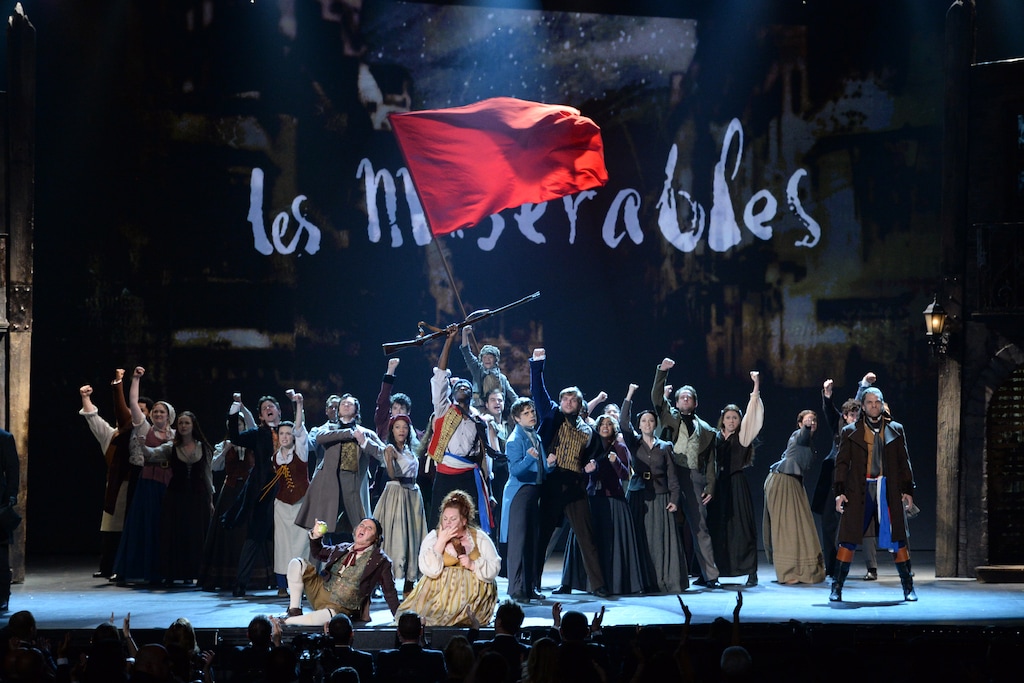
New York • Those highly emotional, belt-loving French denizens of “Les Misérables” never stay silent for long.
Starting July 23, “Les Misérables: The Arena Concert Spectacular” took up residence at Radio City Music Hall through Aug. 9. Three days later, Hudson Valley Shakespeare will open its fully staged take upstate, through Sept. 27. A national tour of “Les Miz,” as the show is known, was in Boston last month; productions are currently running at the Phoenix Theater Company in Arizona and the Tuacahn Amphitheater in Utah.
Not bad for a show that requires a large cast and a running time of almost three hours, during which many of the most compelling characters meet tragic ends, and which deals with 19th-century revolutionaries and their foes.
Jenn Thompson, who is directing the Hudson Valley Shakespeare staging, has an explanation for the show’s unlikely success. “As epic as it is — big ideas and barricades and battles — it’s a very personal story,” she said in a video interview. “It’s really about human contact and connection, and how and who you open your heart to, and what we owe each other.”
Here are a few things to keep in mind as “Les Misérables,” 10 years after its last Broadway revival came to an end, roars back in seemingly every town.
The Origin Story
“Les Misérables” started off in France in 1980 as a concept album by Alain Boublil and Claude-Michel Schönberg, then achieved world domination via an extensively retooled English-language version. It has spawned such standards as “I Dreamed a Dream,” “One Day More,” “On My Own” and “Bring Him Home.” The monumental tale has been running in London since 1985, and it has had three Broadway productions since 1987, as well as a starry film adaptation in 2012. The show’s native country took longer to warm up to it, but “Les Miz” seems to finally be at home in France, and this fall, Ladislas Chollat’s hit French-language production from 2024 is returning to the Théâtre du Châtelet in Paris.
The Intricate Plot
Set mostly between 1815 and 1832, “Les Misérables” is often summed up as the conflict between the noble escaped parolee Jean Valjean and the obsessive, inflexible police inspector Javert. The actors in those roles usually get top billing. But there is a lot more to the show, with crucial plots about the persecuted Fantine and her daughter, Cosette, as well as the love triangle between Cosette, the dashing Marius and Éponine — herself the daughter of Fantine and Cosette’s tormentors. Boublil and Schönberg had strung together a series of tableaux, which the British production’s team (led by the two Frenchmen, lead producer Cameron Mackintosh, and directors Trevor Nunn and John Caird) then retooled and streamlined into a more narratively satisfying structure.
“Every single person is drawn to something so different about the story,” said Samantha Barks, who has portrayed Éponine onstage and in the movie, and takes on Fantine at Radio City. “Almost every time I watch the show or come to the show, it feels like I’ve remembered it incorrectly because another thing hits me so deeply.”
“There is something for everybody to connect to,” she added, “but it won’t necessarily be the same thing as the person you’re sat next to. In fact it definitely won’t.”
(Leavitt Wells | Tuacahn Amphitheatre) David Toole plays Jean Valjean in Tuacahn Amphitheatre's 2026 production of "Les Misérables."
The Literary Inspiration
The show is based on a doorstop of a book by Victor Hugo that came out in 1862, and it’s easier to grasp its scope and lasting influence when you understand the author’s towering role in French culture. Hugo wrote fiction, poems, plays and articles, and was an excellent draughtsman as well. You may know his novel “The Hunchback of Notre-Dame” (1831), most likely through one of its adaptations, including an animated Disney movie (1996) with songs by Alan Menken and Stephen Schwartz, and the French musical “Notre Dame de Paris” (1998).
But Hugo’s ticket to posterity was “Les Misérables,” an action-packed page-turner with a vision sustained by his political beliefs. Hugo was the epitome of the “artiste engagé,” supporting, among other causes, voting rights, freedom of the press and a unified Europe, and arguing against the death penalty.
No, Not That Revolution
A common misconception is that the musical is about the French Revolution of 1789. But the scenes of uprising and bloodshed are actually set during the rebellion of June 1832, in which supporters of the Republic took to the barricades against the monarchy, only to be brutally repressed.
“Les Miz” embraces activism while being cleareyed about moral ambiguity and the cost of justice, both personal and political. While period stagings are most common (including for the “Arena Spectacular”), Liesl Tommy’s modern-dress production for Dallas Theater Center (2014) underlined the show’s evergreen themes. As costume designer Jacob A. Climber said: “I also enjoyed the berets, because they’re French and a Che Guevara reference. They’re very punk-rock, these revolutionaries.”
And of course, it’s hard to not think of the anniversary of the Declaration of Independence right now. “What this skirmish is about is trying to uphold the ideals of the revolution that was 40 years before it,” Thompson said of the 1832 events. “I think that is particularly fitting in our 250th anniversary: We are in a big struggle to be upholding the ideals, as imperfect as they were, that were laid out when we became a country, which is sort of, no tyrants, no kings. What does that mean? And we’re still in that struggle now.”
The Concert Transformation
Largely sung-through, “Les Miz” translates remarkably well to the concert format: The only thing bigger than the story is the score, which includes some of the most unabashedly grand and passionate numbers in the musical theater canon. James Powell, who directed the “Arena Spectacular” with Jean-Pierre van der Spuy, praised Mackintosh for insisting on casting performers who have previously done the show in a theatrical setting. “It is the actor that provides the context,” Powell said. “We don’t have scene changes, we don’t have moving scenery, so it’s them that inhabit the story, and unless they played it in that context, it’s hard for them to draw on that.”
Still, expectations for a wow factor are high when a production has “spectacular” in its title. To deliver that, there are up to 34 people onstage at Radio City, and they are backed by a 26-person orchestra. And while there aren’t many props, video screens and dramatic lighting help build and sustain the mood.
The Offstage Adaptations
Captures of various concert versions are available on most major streaming platforms, along with Tom Hooper’s movie of the musical, headed by Hugh Jackman and Russell Crowe. As for Hugo’s novel, it has been adapted many, many times — a new French movie is due this fall, starring Vincent Lindon as Valjean and Tahar Rahim as Javert. Among the versions available for home audiences in the United States, the American movie from 1935, pitting Fredric March’s Valjean against Charles Laughton’s Javert, is available on several platforms, while Prime Video has Robert Hossein’s excellent French language film (1982) with Lino Ventura and Michel Bouquet. Andrew Davies’ mini-series for the BBC (2018), with Dominic West and David Oyelowo, makes the most of its extended running time and can be found on major platforms.
Ladj Ly’s Academy Award nominee “Les Misérables,” from 2019 (available with Prime Video), is not an adaptation of the book, but the title wasn’t picked randomly: The film’s description of social injustice and violence in a Parisian suburb is very much in keeping with Hugo’s activist spirit.
This article originally appeared in The New York Times.