 Sean P. Means
Prolific Utah artist Pilar Pobil and her husband, Walter Smith, first moved into their Avenues home in 1960. Over the decades, according to her daughter, Monica Pasqual, “the house itself became a work of art.”
The cozy, colorful home — known as “Casa Pilar” — is where the Spanish-born Pobil lived until her death in November 2024 at age 98. Within its walls, she raised three children, created her paintings and sculpture, fostered a community that gathered at her garden-party events, and became a mentor to generations of Utah artists.
Now, with her mother’s 100th birthday approaching in October, Pasqual is mounting a fundraising campaign to keep the house at 8th Avenue and E Street in the family — and make it a permanent museum for Pobil’s acclaimed artwork, as well as an event venue for artists and musicians.
(Trent Nelson | The Salt Lake Tribune) A portrait of the late painter Pilar Pobil, in her home Casa Pilar, in Salt Lake City on Thursday, July 9, 2026.
The campaign, on the crowdfunding site GoFundMe, aims to raise money as a “bridge” to pay expenses on the house until the family can reestablish a nonprofit foundation, also called Casa Pilar. (The original Pilar Pobil Legacy Foundation, which provided scholarships to first-generation writers and artists, ceased operations in early 2024.) The campaign has raised more than $30,000 in pledges as of Tuesday, working toward a first milestone of $50,000 and an overall goal of $200,000.
If the fundraising campaign doesn’t work, Pasqual said she and her sister, Maggie de Cerda (who lives in Spain), may have to sell the house and the art inside it.
“We’ve got to do something,” Pasqual said. “We have to figure this out.”
(Trent Nelson | The Salt Lake Tribune) Casa Pilar, the home of the late painter Pilar Pobil, in Salt Lake City on Thursday, July 9, 2026.
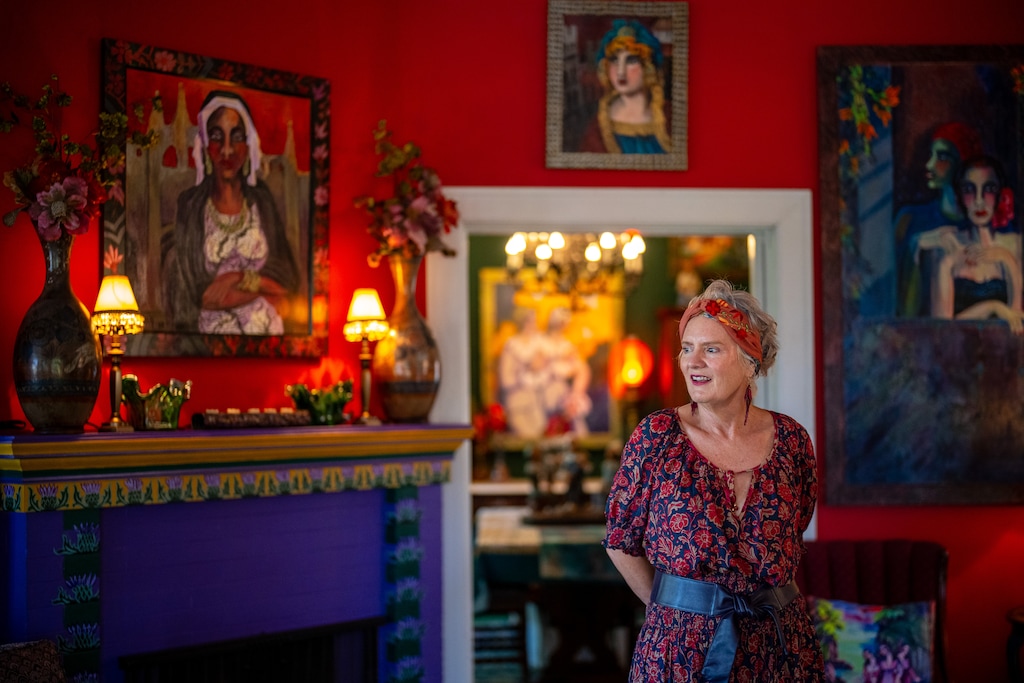
The walls of the living room are filled with Pobil’s paintings, reflecting the artist’s vibrant, Expressionist style inspired by the colors of Spain and Mexico. Her clay sculptures sit atop tables and hang from different surfaces.
Pobil also painted designs on the fireplace, stairs and other fixtures. The archway to the dining room features flowers; electrical boxes by the kitchen look like houses, and the cables leading to them resemble snakes.
“She had an idea that she would never paint something that she already considered beautiful,” Pasqual said, pointing to an antique secretary desk Pobil left untouched. “If something was not that special, she would make it special.”
(Trent Nelson | The Salt Lake Tribune) Painted electrical boxes in Casa Pilar, the home of the late painter Pilar Pobil, in Salt Lake City on Thursday, July 9, 2026.
Life in Casa Pilar
Shortly after her parents moved in, Pasqual was born just a block away at LDS Hospital — but just barely.
“My dad had to bring the car to the back door, drive over, and while he was signing in, I guess I was born on a stretcher,” said Pasqual, who’s now 65.
Growing up in the Smith/Pobil house, Pasqual said, “we always had music.” Walter Smith played piano, which influenced Pasqual, who herself is a recording artist; up until 2020, she had been a touring musician, but she returned to Utah that year to become her mother’s caregiver after Pasqual’s brother, Luis Smith, died from COVID-19.
(Trent Nelson | The Salt Lake Tribune) Casa Pilar, the home of the late painter Pilar Pobil, in Salt Lake City on Thursday, July 9, 2026.
(Trent Nelson | The Salt Lake Tribune) The home of the late painter Pilar Pobil, in Salt Lake City on Thursday, July 9, 2026.
Pasqual was 12 or 13 years old, she said, when Pobil started sculpting. Within a few months, Pobil had her first gallery show, the daughter said. Soon after, the Utah Museum of Fine Arts bought a 23-piece Nativity set Pobil had made. (The Nativity set is now at the Utah Cultural Celebration Center in West Valley City, which displays it every Christmas. The center also named a gallery after Pobil in 2024.)
Pobil took up painting around the time Pasqual left home for the San Francisco Bay Area, where she launched her music career. When the daughter came home for holidays and summer visits, she saw Pobil’s art “emerging. … Like, it just took off.”
Throughout the ′90s, Pasqual said, Pobil cared for her husband, who died in 1999. From then on, “she was nonstop — it was all dedicated to art at that point," Pasqual said, “and the community.”
(Trent Nelson | The Salt Lake Tribune) Casa Pilar, the home of the late painter Pilar Pobil, in Salt Lake City on Thursday, July 9, 2026.
At her annual “Art in Pilar’s Garden” events, a select group of local artists were able to show their work to visitors in the home’s backyard, surrounded by food, wine and music.
“It was always meant to be art for the people, not like a stuffy event,” Pasqual said. “People come here, and they end up hanging out for hours.” When Pobil was able, she even cooked Spanish food for everyone, Pasqual said.
The daughter organized the 34th annual event in June, spotlighting eight artists ranging in age from their 20s to their 80s. Some 400 people attended, Pasqual said, with proceeds from ticket sales going toward the Casa Pilar effort.
(Trent Nelson | The Salt Lake Tribune) "Lucy" at the bottom of the stairs in Casa Pilar, the home of the late painter Pilar Pobil, in Salt Lake City on Thursday, July 9, 2026.
‘They feel inspired when they come here’
In a basement room of the home sits one of Pobil’s most extensive exhibitions, called “Burial Chamber.” According to the arts magazine 15 Bytes, Pobil first created it in 2007 for an exhibition at the Utah Cultural Celebration Center, then reconstructed it in her home in 2013.
“Burial Chamber” features several tables, each filled with items and artwork that symbolize different parts of Pobil’s life. One table features fabric and a sewing machine, representing her work as a seamstress when she first came to Salt Lake City; another holds kitchen gear, a nod to the cookbook she wrote, “My Kitchen Table.” Still another is a nod to her gardening skills.
(Trent Nelson | The Salt Lake Tribune) Monica Pasqual in the art exhibit "Burial Chamber," at Casa Pilar, the home of her late mother, painter Pilar Pobil, in Salt Lake City on Thursday, July 9, 2026.
(Trent Nelson | The Salt Lake Tribune) Part of the art exhibit "Burial Chamber," at Casa Pilar, the home of the late painter Pilar Pobil, in Salt Lake City on Thursday, July 9, 2026.
Pobil added to the chamber over the years; one table holds a tribute to her son, Luis Smith, and includes Pobil’s portrait of him working as a river guide.
The chamber’s centerpiece is along the back wall: a self-portrait of Pobil, depicting her as a girl at her grandparents’ home in Mallorca, titled: “I Was Born From the Sea With a Paint Brush in My Hand.”
Flanking the portrait are shelves loaded with framed photos of friends and family. In front of that display, atop a table, lays a sword; Pasqual said it was used in the Battle of Trafalgar in 1805, when Britain’s Royal Navy defeated the French and Spanish navies, then handed down in Pobil’s family for generations.
Next to the sword sits the last item added to the burial chamber: an urn, containing Pobil’s ashes.
“That spirit is here,” Pasqual said. “People feel it, they feel her, and they feel inspired when they come here.”
(Trent Nelson | The Salt Lake Tribune) A self-portrait in the art exhibit "Burial Chamber," at Casa Pilar, the home of the late painter Pilar Pobil, in Salt Lake City on Thursday, July 9, 2026.
Note to readers • Pilar Pobil is one of the artists featured in the new Salt Lake Art Museum, which is celebrating its grand opening on Pioneer Day, July 24. The museum is in the historic B’Nai Israel Temple building, at 249 S. 400 East, Salt Lake City. The ribbon-cutting is at 3:30 p.m., and the museum will remain open until 8 p.m. A guided tour of Pobil’s exhibition, “The Beautiful Land of My Reality,” starts at 6 p.m. Admission is free; donations will be accepted.