 Palak Jayswal
Over the past few years, the trajectory of folk-pop artist Noah Kahan’s career has been nothing short of astronomical. Since the release of his 2022 album, “Stick Season,” the honest and witty musician has barely had a moment to breathe.
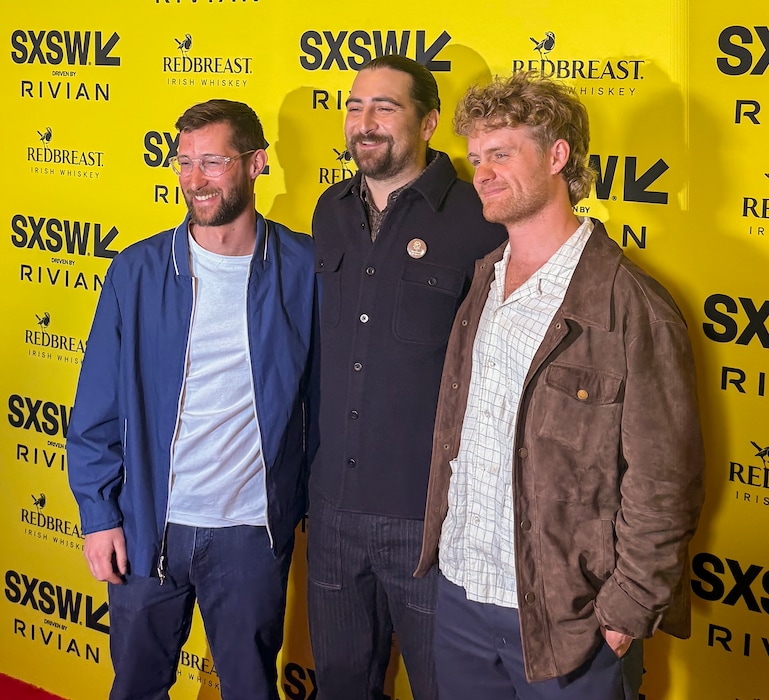
“Out of Body,” a new Netflix documentary, captures the tail end of that meteoric rise, and it wouldn’t have been possible without two Utah-based filmmakers — and childhood friends of Kahan — Asher Brown and Henry Allison.
The friends are from an area called Upper Valley, a collection of towns around the Connecticut River. Allison is from a small farming town in Vermont. Brown is from a similar small town in New Hampshire and Kahan lived in both Strafford, Vermont and Hanover, New Hampshire.
The trio all went to the same multi-state public high school in Hanover.
Brown and Allison moved to Utah in 2020 after graduating from college. They were looking for a new place where they could explore their film dreams.
But a hometown relationship, first forged on the soccer pitch, allowed the co-producers, part of the “core four” filming team (alongside director Nick Sweeney and producer Samantha Mustari), a front row seat to creating an intimate and vulnerable film about Kahan.
“Having the built-in trust of knowing each other for a long time was really helpful for integrating in,” Allison said.
One example: Brown is in the opening scene of the trailer, where he asks Kahan what he does after a show, just after he’s finished performing.
“Occasionally, I’ll check Twitter to see what the response to the show was,” Kahan said. “And if it’s not good, I barricade myself in my room and order Taco Bell.”
When Brown asks what he does if the response is good, Kahan responds confidently, “Barricade myself in the room and order Taco Bell.”
“Noah’s comfortable having just Asher backstage with him in his dressing room with no one else in a vulnerable moment,” Allison said. “It helped us get into the story quickly, without having to do this sort of slow trust-building process.”
The roots
Back in high school, Brown said Kahan “kept the music thing a little bit quiet,” but he remembers when Kahan performed at a school assembly.
“It was an electric moment,” Brown said. “I remember after that, he was like, ‘I’m gonna do this.’”
Brown originally reached out to Kahan and his team with the idea for a documentary and the team was immediately receptive.
“Noah basically is touring for two and a half years straight, which is a really intense experience for everyone,” Allison said, “They were recognizing this is unique. This isn’t something that happens very often. There’s been huge growth, huge change, and it would be a cool moment to document.”
So Brown, Allison and the film team spent nine months working on the film, which recently debuted at South by Southwest. They joined Kahan as he reached the climax of his “We’ll All Be Here Forever” tour, which had stops at Madison Square Garden, Fenway Park, and even in West Valley City.
(Henry Allison) Henry Allison, Noah Kahan and Asher Brown filming for the "Out of Body" documentary.
Allison’s favorite moment from making the film is when they worked on a series of portraits of people from the Upper Valley. A farmer, high school kids, an artist.
It captures “what it is to be from that place, and what, you know, what are the struggles and the joys of, like, growing up in rural Vermont, rural New England.”
But the documentary doesn’t solely capture these momentous moments.
“The story very much is about the come down of this whole ‘Stick Season’ [journey] and really rebuilding and picking up some of the pieces, having the conversations that [Kahan] wasn’t able to have because he’s in this crazy flurry,” Brown said.
It’s also a look at the places and things that made Kahan. On the tour, his stage transformed into a replica of his mother’s living room. His songs are full of lyrics that distill what it means to be a New Englander, to live with generational trauma and reflect on mental health.
It also captures the artistic journey Kahan has been on: being inspired, creating art, having it be well received and trying to chase that, while losing yourself, and then coming back to your roots.
Kahan’s family is a part of the documentary — a credit to Brown and Allison.
“The family’s involvement was a big question mark,” Brown said. “The fact that they remember us playing soccer was a very big help. We were filming and Noah’s mom saw my mom at the plant nursery.”
Utah nods
Utah fans might recognize a few of the filming spots. There’s a scene of Kahan and his sister Sasha at Blood’s Lake. There’s another scene where Kahan is writing music in Park City’s Prospector Park, and a brief cameo at Salt Lake International airport in a montage sequence.
RadicalMedia is the production company for the Kahan film, but Brown and Allison are partners at Brown Barn Studios, a Salt Lake City-based storytelling and film production company that specializes in short documentaries.
As the friends prepare for the streaming world to take in their documentary, Brown recalls his favorite moment of filming — capturing the sold-out shows at Fenway Park, a “mythical place” for New Englanders.
Brown trailed behind Kahan as he walked through the Red Sox players’ dugout.
“I remember we walked through that place a couple of times, and I remember Henry being like, ‘No one gets to see this,’” Brown said.
The first time they did it, it was just Kahan, walking into the stadium for the first time as the show was getting set up.
“You could really feel him soaking it in,” Brown said. “Then later that night, he’s in his Fenway garb, and there’s 39,000 people waiting for him. So in a span of a day, you just get to see this amazing arc, and that, to me, is something I’ll never forget.”
And later that night, when Kahan went to the B stage, they followed him up the steps of the Green Monster ladder. When Brown looked out, he saw the streets outside the stadium filled with people who didn’t get tickets, but were still there to listen to Kahan sing.
“To be able to be in the stands and then realize that the whole block around was filled with people was a pretty magical moment,” Brown said.
“Out of Body” will stream on Netflix on Monday.
(Netflix) Musician Noah Kahan for his Netflix documentary "Out of Body."