 Sean P. Means
Usually when the University of Utah hosts scholars to speak, it doesn’t involve musical numbers and an inflatable shark costume.
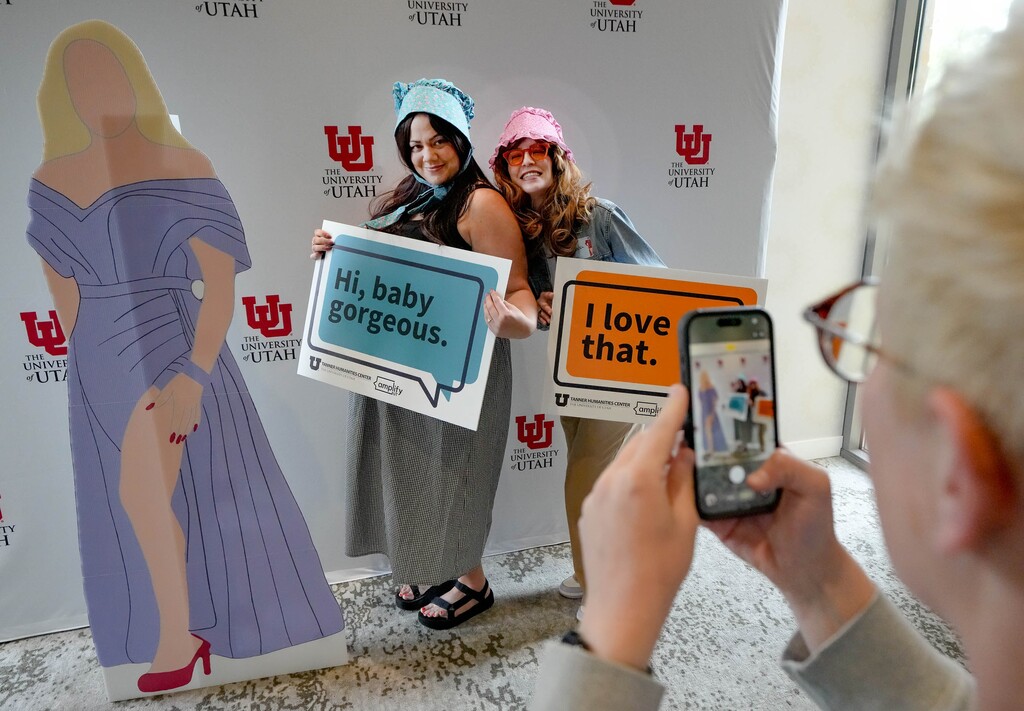
But that’s exactly what happened Friday, when the U.’s Tanner Humanities Center presented an academic symposium all about “The Real Housewives of Salt Lake City.”
Scott Black, the center’s director, told those gathered at the Eccles Alumni House that for months, people kept asking why the symposium had been in the works.
“It’s clear that ‘The Real Housewives of Salt Lake City’ matters to us,” he said to the crowd of about 250.
In a series of presentations, speakers dissected the cast members’ interactions, their fashion choices, their religious practices, and even how their occasional hostility towards each other mirrors the cannibalistic behaviors of Mormon crickets.
Crystal Rudds, an assistant professor of English at the University of Utah, said she had “the most fun” in her “entire career” at the event. (Rudds presented a talk about how A.I.-generated baby parodies of “The Real Housewives” may mask the more nefarious aspects of A.I.-produced video.)
Organizers said they reached out to cast members but were told they were busy filming Season 7. Britani Bateman, a “friend” of the “Real Housewives” featured on the last two seasons, welcomed attendees through a video message.
Throughout the day, the gathered speakers described the show as:
A reflection of Utah
“A caricature of what our state is has existed for so long, and we have tried to fight that, or said, ‘Believe what you want. It’s awesome here,’” said Ail Vallarta, host of the City Cast Salt Lake podcast.
“The irony to me, that I fully embrace about these women, is that their caricatures of themselves are busting up the caricature of Utah,” Vallarta said. “It’s like they are performing, they are hyping it up.”
Vallarta cited one episode, in which cast member Heather Gay hosted a lunch where she encouraged everyone to wear bonnets and engage in pioneer-era crafts.
“They’re sort of archiving Utah’s history,” Vallarta said. “They’re creating this living archive of all the quirky things about our state, via these quirky women.”
A piece of Utah culture
As public art program manager for the Salt Lake City Arts Council, Renato Olmedo-Gonzalez said he oversees projects that are considered “high culture,” such as the recent 10-day installation “symphony” about the Great Salt Lake.
“And then I go home and watch the Housewives,” Olmedo-Gonzalez said. “To me, those two things are not in conflict. … They’re [both] about performance, identity, storytelling, spectacle and power, just with different budgets and different production.”
(Francisco Kjolseth | The Salt Lake Tribune) A symposium at the University of Utah Tanner Humanities Center asks about the societal impact of “The Real Housewives of Salt Lake City,” on Friday, April 10, 2026.
A litmus test about religion
Much like “mommy bloggers,” the show’s cast members rise and fall in popularity depending on how authentic they seem to their followers — by “showing the messy side of their lives and being imperfect,” said Emily January, an associate professor of English at Weber State University.
Much of the authenticity on “Real Housewives,” January said, is how the cast talks about their relationship with The Church of Jesus Christ of Latter-day Saints.
Gay and Whitney Rose, for example, grew up in the church and left. Then there’s Lisa Barlow, who helped found her alcohol brand Vida Tequila and calls herself “Mormon 2.0.”
“We see authenticity in Heather’s journey with Mormonism, which is why Lisa’s insistence on being a Mormon without obeying the rules rubs Heather and audiences the wrong way,” January said.
“Lifelong Mormons tend to define Mormonism differently than Lisa does,” January said. “Younger generations, who have been rejecting the rigidity of the church structure in recent years, might relate to Lisa’s claims more.”
(Francisco Kjolseth | The Salt Lake Tribune) Salty Hoes podcasters Claire Adams and Melissa Hardy, from left, join University of Utah psychology professor Jordan Rullo as they answer questions during a symposium at the U's Tanner Humanities Center on the societal impact of "The Real Housewives of Salt Lake City," Friday, April 10, 2026.
A magnet for celebrities
The Salt Lake City version of “The Real Housewives” in particular has exploded into pop culture in ways other casts have not, said Giovanna Grant, a junior studying literature and media at Westminster University.
“It’s not just the Bravo show any more,” Grant said. “When you have people like Jennifer Lawrence, Julia Roberts or Ayo Edebiri talking about it — or John Oliver, my personal favorite, calling the women ‘the most magnificent monsters on television’ — you realize it’s crossed over into something much bigger.”
A prompt for connection
Victoria Gonzalez, an attorney who recaps reality TV for X96’s “Radio From Hell” show, grew up in West Jordan and now lives in Chicago. She described a moment when she went to the gym wearing her “Bad Mormon” sweatshirt — a promotional item for Gay’s first book — and the man at the front desk asked about it.
“He’s like, ‘Oh my God,’ and for the next 30 minutes we stood there talking” about the show, she said.
(Francisco Kjolseth | The Salt Lake Tribune) TV reporter Ben Winslow, wearing a pioneer-style bonnet, was emcee for a symposium at the University of Utah Tanner Humanities Center that explored the societal impact of "The Real Housewives of Salt Lake City," on Friday, April 10, 2026.
A case study in couples communication
One of the most engaging presentations at Friday’s symposium came from Jordan Rullo, a clinical health psychologist who teaches at the University of Utah.
Rullo works as a couples therapist, and used clips from the show to demonstrate things couples should never do in a disagreement — from attacking someone’s character to belittling the other person.
She found fewer examples of the cast members engaging in positive behaviors, she said, but singled out two moments from the most recent season: one where Bronwyn Newport took accountability for an erroneous claim that she bought an expensive necklace, and another where Gay complimented the other cast members for what their friendships have added to her life.
An example of cult cinema
Alexandra Docherty, a grad student at the University of Toronto, made her first-ever visit to Utah to present a case for categorizing “The Real Housewives of Salt Lake City” as cult cinema, on the level of “The Rocky Horror Picture Show.”
Instead of shouting back at the screen, Docherty said, fans of “Real Housewives” watch from the couch or at viewing parties and communicate over Reddit threads and other social media.
Even the symposium itself, she added, is an example of how “RHOSLC” has become more than a show.
“We watch cult media in ritualistic ways, through community, fellowship, live events, dedication to the media object, declarations of rebellion and alternative canonization,” Docherty said.