 Gordon Monson
When Devon Dampier first arrived at Utah, transferring from New Mexico prior to last season, his then-head coach was fired up about the possibilities the quarterback brought with him.
He had the attributes and the talent Kyle Whittingham had always valued in a QB, namely Dampier’s ability to hurt opponents in multiple ways. The defensive-minded former Ute coach may not have been any kind of quarterback whisperer — some might claim he was, at least now and again, more a quarterback screamer, not the soothing type of mentor who could deftly massage a QB in proper development — but he recognized the sort of player that caused noise to rattle around inside his defensive brain. And he figured Dampier was a good bet to rattle the brains of opposing coaches.
There were questions, though. Could he do that — what he did for the Lobos — against better competition? Could he dodge a regular dose of bigger, quicker Big 12 monsters intending on planting his diminutive frame into the turf when he ran? Could he complete enough passes to be efficient in the “throw” game?
Whittingham thought he could.
I asked a close associate of the coach what his evaluation was. He said he knew Dampier could run, knew he could pass to a minimum standard — that part was still hovering a bit — but the one uncertainty remaining was this: “When the game is on the line, when a score is necessary, can this kid lead an offense down the field for a win?”
Um. As the games have gone by, that uncertainty has been made rock-solid certain.
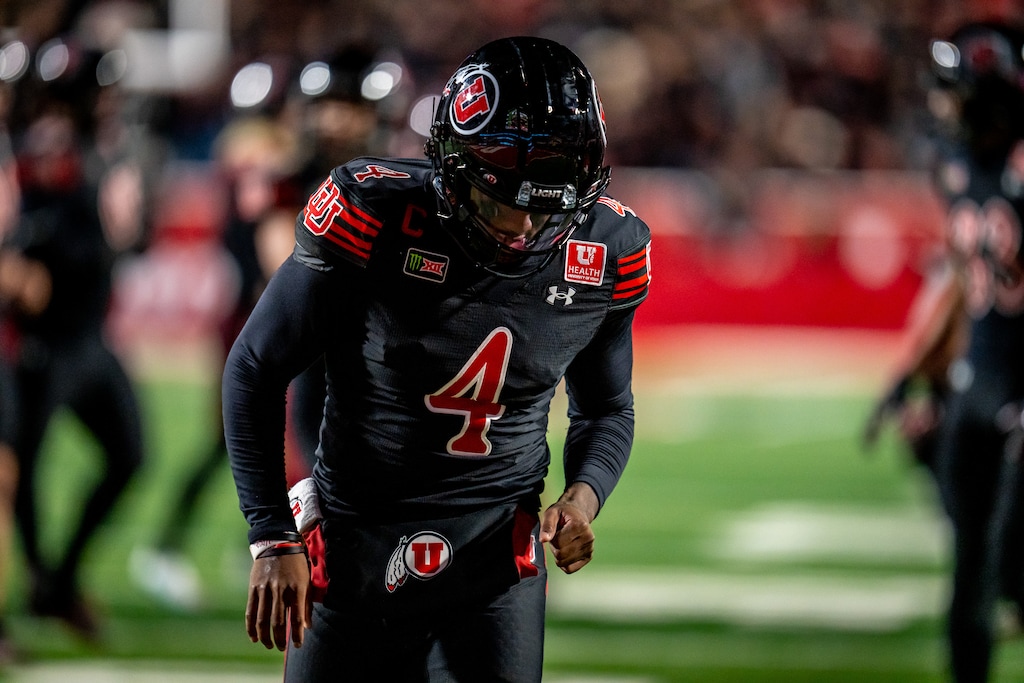
(Trent Nelson | The Salt Lake Tribune) Utah Utes quarterback Devon Dampier (4) as Utah hosts Houston, NCAA football at Rice-Eccles Stadium in Salt Lake City on Saturday, Oct. 24, 2026.
Not only has Dampier established himself as one of the best, most versatile quarterbacks in the Big 12, he’s soared to a position across college football as one of the best QBs, one of the best leaders anywhere.
By the time he took over, Morgan Scalley, another defensive-minded coach, was wholly aware of the problems Dampier had caused — and would continue to cause — opposing defensive coordinators. That’s one of the reasons he connected with the quarterback the way he did all of last year, and especially after Dampier’s performance in the Vegas Bowl against Nebraska. You could have been a football fool and not missed the obvious ability and acumen of a 5-foot-10 man who could be darn near everything anyone could want — not just as a quarterback, but as a team leader.
He rolled up 458 yards of offense and accounted for five touchdowns, running and pitching, in that 44-22 win over Nebraska. He did it the same way he’s winning games this time around — on the ground, through the air, and, most significantly, in the minds of his teammates. He threw for 310 yards and ran for 148 in the bowl game with three TDs coming via his legs, two via his arm.
Dampier has a tendency here and there to toss a wild, unwise throw into the ionosphere and for that ball to get picked. He’s not exactly Joe Burrow with his accuracy, not Josh Allen with his arm strength. The dude’s not perfect. But what he is is a constant threat to stir his team physically, mentally, emotionally — come what may — to victory.
Anybody who wants to argue the point can look at the record: 9-and-oh. It’s a team game, we get it, but of all the Utes, who’s the one most responsible for those wins?
You-Know-Who.
(Trent Nelson | The Salt Lake Tribune) Utah Utes quarterback Devon Dampier (4) celebrates a touchdown as Utah hosts BYU, NCAA football at Rice-Eccles Stadium in Salt Lake City on Saturday, Nov. 7,
All you had to do was listen to Dampier’s teammates after the win over BYU. One by one, they talked about their quarterback as though he was the finest general in the army — their general, their army — a gifted, confident, unselfish commander in whom they had supreme appreciation and belief.
Offensive teammates sang his praises; defensive ‘mates did the same, as did Scalley, who called Dampier “a warrior.”
“All he cares about is winning,” said safety Nate Ritchie.
Minutes after that game, as the Utes were still celebrating, it was Dampier who said that win was “a game,” not “the game.” Dampier reminded all on hand that there was business yet ahead, a sentiment happily backed by Scalley.
During the second half of that rivalry game, I thought about the remaining question Whittingham’s associate had asked so long ago. The highly ranked Utes, with so much on the line, entered the half trailing 20-14. As the defense held up its end of the deal in the third and fourth quarters, Dampier led Utah to two decisive touchdowns.
There are those who firmly figure Dampier deserves to be straight in the race for the Heisman Trophy. As a Heisman voter, I’d seriously consider him for that honor, depending on what happens next. As he said it himself, there is work remaining, including a potentially stiff challenge at Arizona this weekend.
But there’s something wonderfully rewarding in watching a college player do the unusual — not only fulfill his own promise and answer questions that were asked about him way back at the beginning, but also wrap his arms and his mind around his team in such an effective and authentic manner, and to see his team reciprocate by doing the same to him.