 Jason Batacao
Colton Swan’s summer mornings as a teenager started at 3:30 a.m., when his grandfather, Bill Swan, called him to get out on the pasture.
He’d pull on his clothes, boots and, of course, a cowboy hat, and head out into the darkness of his family’s 100,000-acre cattle ranch in Three Creek, Idaho, a community west of Rogerson.
Swan would climb onto a four-wheeler and sputter over to his barn only to ditch the iron steed for a new ride.
This one had four legs. It was his “wrangle horse.”
“I had to drive them into the corral so the cowboys could catch their horses and go out and do their jobs right during the day,” Swan said with his raspy voice, recounting the memories.
And that was just the start of what could be a 12-hour — sometimes longer — day on the ranch.
One moment, he’d be fixing a picket fence along the thousands of acres of his grandparents’ ranch. The next, he’d be bucking hay onto the flatbed of a well-used pickup truck. He’d brand cattle and rope steers.
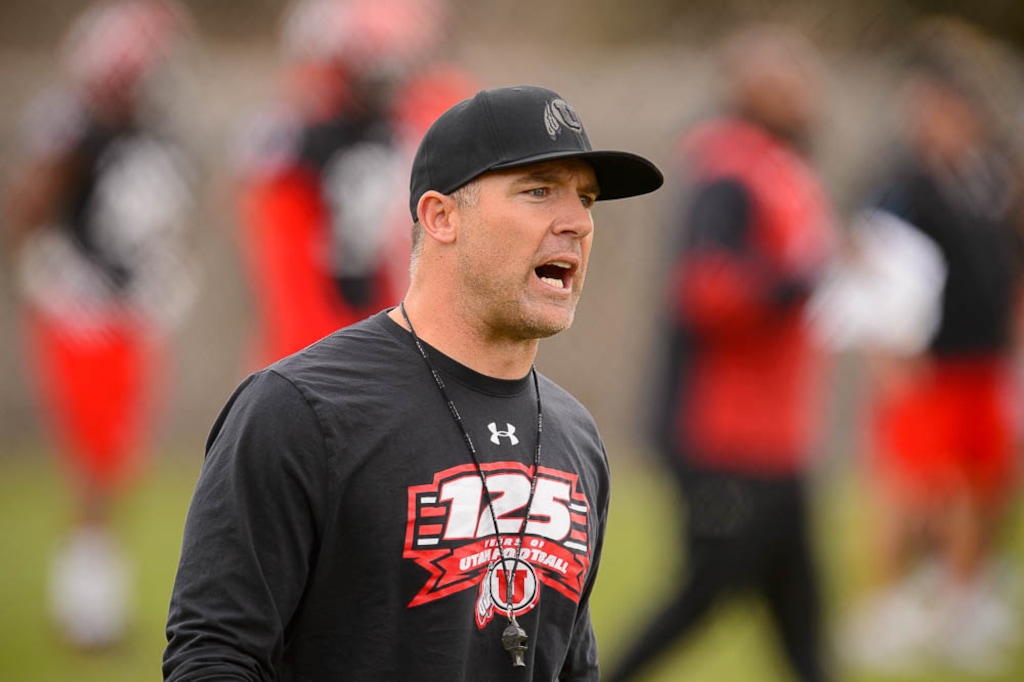
Nowadays, as Utah’s defensive coordinator, Swan sticks to a similar routine.
His ranch in Morgan is much smaller than the one in Idaho, but he still does much of what he did as a young ranch hand.
Before his mind turns to attacking offensive schemes, Swan wakes at 4:30 a.m. to feed his horses, turn on the irrigation sprinklers and fix a few fences on horseback.
The football coach is still a cowboy.
(via Marlene Swan) Utah defensive coordinator Colton Swan grew up on a cattle ranch in Idaho.
‘Learned a lot of stick-to-itiveness’
John Swan, Colton’s father, opens up with a joke in his Idaho drawl when describing the genesis of the now-sold Swan family ranch.
“This ranch is a little bit different from ranches in Texas and Oklahoma,” John said, snickering. “It’s on a lot of open public land.’’
During the cold months, the family would feed the cattle with bales of hay. By spring, they’d move them to the desert land managed by the Bureau of Land Management in northern Nevada for calving season, a two- to three-month window when the cows give birth.
For several days, John and his sons would truck roughly 50 miles through the fields until they reached the herd, moseying around.
“As the calves are born, we’d brand them, and that takes several days,” John said. “My sons learned a lot of stick-to-itiveness from being a cowboy. It’s hard work.”
In the Swan family, there have always been two ways of life: footballing and cowboying.
Colton’s grandfather played quarterback at the University of Utah. His father played football at Utah State. His brothers Shay and Biff played college ball at Boise State and at Utah State, respectively.
To the Swans, football and ranching went hand in hand.
(via Marlene Swan) Utah defensive coordinator Colton Swan played high school football in Idaho.
“Putting myself in tough situations made me calloused,” Colton Swan said. “If you are a calloused individual, you’re accustomed to that hard work.
“That translates to football.”
Many of his life lessons came as a ranch hand.
During the summers, he’d live in the basement of his grandfather’s house and work hours in the dead heat.
“Later in life, you would freaking give your left leg to do it all over again,” Colton said.
There wasn’t much else to do. The closest town was an hour-and-a-half away. To get by on groceries, the family had to be prepared to stock up for a week or more.
“They don’t even call it a town where the ranch is. It’s on a creek,” Colton said, pronouncing it “crick,” his Western accent as dry as sagebrush.
As teenagers, Colton and his brother Shay would try to tame young colts to call their own.
“I used to think if I could get on a 3-year-old colt that’s never been ridden — even if it has a really good chance of bucking me off and planting me on my head — I could do other things,” Shay said.
On branding days, Colton and Shay would ride in the truck with 30- or 40-year-old cowboys, horses in tow, hearing stories about the Old West.
“A lot of the teaching and whatnot came from those older ranch hands,” Shay said. “They’d tell you stories the whole way out, and they tell you stories the whole way back.”
But Marlene, the Swan matriarch, said the lessons from the ranch started long before that.
When Shay was 6 and Colton was 5, the brothers used toy ropes to pull around young lambs.
Their little bodies barely made the nearly 100-pound sheep move.
“You just gave them a rope, and they just started roping,” John said.
Colton never stopped.
(via Marlene Swan) Utah defensive coordinator Colton Swan grew up on a cattle ranch in Idaho.
‘A rough sport’
Colton was a junior in high school when he first picked up steer wrestling.
He first did it in a practice pen, where he chased a steer 30 mph on a “perfectly good horse” before jumping from the saddle onto the back of the animal and wrestling it by its horns into the mud.
All the while, he was thinking: Holy crap, this is crazy.
Just like that, the rodeo had him hooked — sometimes literally (more on that later).
“I said, ‘The rodeo? That’s what you want to do?’” said Marlene, remembering her reaction.
Swan started with team roping and tie-down roping with his older brother Shay.
Before long, he was competing in steer wrestling — the ultimate test.
To get started, Colton borrowed an older stallion named Booger, a professional steer-wrestling horse belonging to a friend.
“We didn’t have an excess of money,” Marlene said. “He did so well that he started beating his friend on that same horse.”
That didn’t sit particularly well with his friend.
Colton wasn’t allowed to use that horse ever again, so his family finally decided it was time to buy him his own.
That’s how Betus — named after Pittsburgh Steelers Hall of Fame running back Jerome Bettis — came into his life. John and Marlene bought it from world champion steer wrestler Mike Smith.
(via Marlene Swan) Utah defensive coordinator Colton Swan grew up on a cattle ranch in Idaho.
“Colton just did great,” Marlene said. “He was really good, and he went to state and did really well in state. And he lost by a half of a second going to nationals in bulldogging.”
The steers got the better of him sometimes, too.
One time, at a Fourth of July rodeo in Hailey, Idaho, Swan jumped off his horse after a steer. The animal immediately froze and reared its head back.
“Normally, I can catch the horns when they do that,” Colton said. “Well, that horn missed my left hand — it went right into my mouth.”
Colton was pummeled into the ground, a few broken teeth rolling around in his mouth. He remembers sucking on them like pieces of Halloween hard candy, collecting them for the dentist later.
“You have to find a way to just grit your teeth or, in my case, chew them,” he said.
Colton ultimately planned on going to Weber State on a rodeo scholarship before he walked onto the Wildcats football team in 2001.
That’s when he chose football.
He figured the rodeo would always be there. Football, though, wouldn’t last forever.
“I’m 45 years old, and I’m still rodeoing,” Swan said. “Whereas, if I went to play football right now, there’s no way in hell I could do it.”
Coaching it, though? Well, he’s happy to be doing that, sharing some of the same life lessons with his players that he learned on the ranch.
(via Marlene Swan) Utah defensive coordinator Colton Swan grew up on a cattle ranch in Idaho.
‘Horse rodeo people’
Nowadays, Colton’s life is largely focused on football, but the cowboy is still there.
Just this spring, he and his brothers Shay and Biff spent the offseason riding horseback and fixing fences on Swan’s ranch in Morgan.
“We are horse rodeo people,” Colton said. “When I’m not working on football, I’m up on my property up in Morgan. I’m building fences, I’m riding horses, I’m team roping, and I’m constantly staying active in agricultural life.”
He’s passed that on to his kids, too.
During a recent press conference, Colton pulled up a picture of his young daughter getting “scorpioned” by a sheep — bucked or thrown off its back and sent face-first into the ground.
“I like that way of life,” Colton said, “I don’t know if my kids like that way of life right now. But I hope that they will eventually look back and appreciate, hopefully, me and what I was able to provide for them.”
As he did in his younger days on the ranch, Colton makes his kids do chores around the barn and pastures.
His son feeds the horses. His daughter fills up the water buckets.
Football might take the cowboy out of Colton for several months of the year, but he always finds his way back — to the pastures, on horseback, doing the things he once did as an unruly teenager.
“I don’t really know any different,” Colton said. “It’s just kind of a way of life for me, and I like that way of life.”
(via Marlene Swan) Utah defensive coordinator Colton Swan grew up on a cattle ranch in Idaho.