 Gordon Monson
The question tossed around after a recent Utah Mammoth morning skate by a nosy visitor was this: Now that they’ve qualified for the Stanley Cup playoffs, playing some darn fine hockey en route, are the Mammoth steeled and tough enough to succeed in those intense, pressure-packed, fired-up, ultra-charged postseason games?
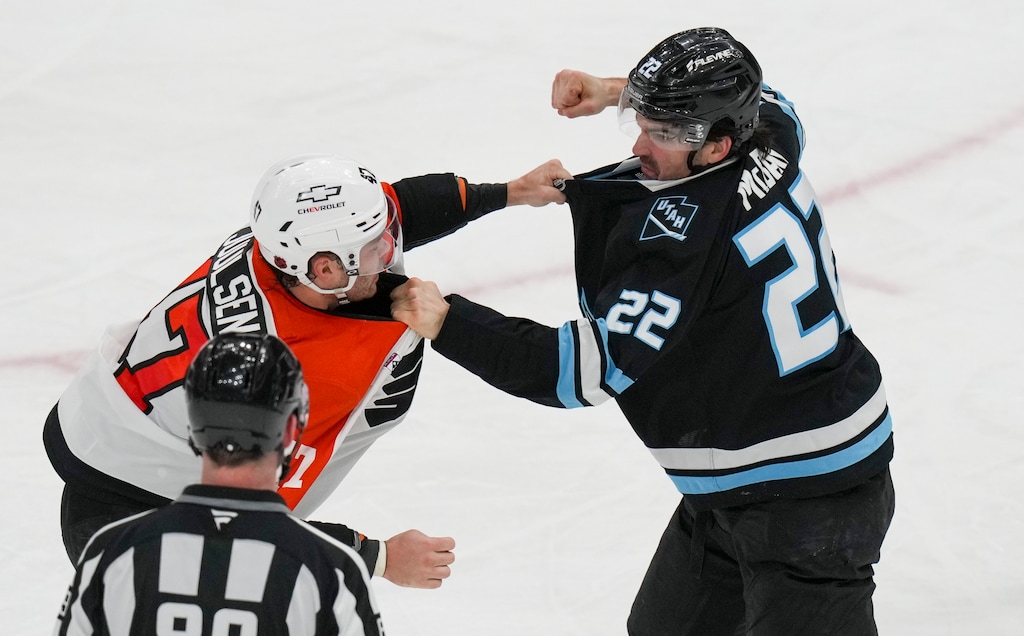
Three questions followed: How leathery tough does a team have to be to advance in the playoffs? The Mammoth skate fast, they are skilled and aggressive, sometimes polite and pretty. They work together, all organized and they’re young and yet improving. In such a setting, where does rugged meet refined? How do the Mammoth stack up at policing and enforcing their glossy brand of hockey, and by policing and enforcing, we mean … tight checking, slamming opponents into the boards and punching them in the mouth, when need be?
Coach Andre Tourigny says his team, at this stage, needs no thorough reinvention and renovation. It has to be who they are, the best version of who they are, but … who are they exactly?
“We’re a team that will fight for each other and stand up for each other,” he says. “We care about each other. That’s who we are.”
That’s who they’ll have to be to survive and succeed in the race for Lord Stanley’s Cup. They’ll also have to be … good.
A man who knows all about that race is Ian Cole, a wise and wily defenseman who in his past has won a couple of Stanley Cups with Pittsburgh and participated in what seems like a thousand playoff games. He says playoff hockey requires a bit of a clenched jaw and sometimes a clenched fist, but not a clenched brain. He puts it like this:
“Playoffs are a battle of wills, a war of attrition. It comes down to who’s gonna stick with it the longest, just keep going, keep going, keep going. You have to be careful not to show the opponent that you can be rattled. If there’s one guy who’s doing egregious things, maybe you go after him, but, in my experience, the way you win is you just keep doing the right things over and over. You don’t get deterred by anything. Yeah, you’ve got to be physical and you’ve got to take physicality, too.”
If we back this whole thing up, we can start with a couple of concessions. The first is that professional hockey, especially in North America, has featured elements of play from the physical straight to the pugilistic for more than a century now. Whether fans love that more violent aspect of the game or hate it — and proponents and opponents can be found in either direction — it’s baked into hockey, certainly into the NHL brand. The second is that fighting among NHL players has been in a general decline over the past couple of decades, although there has been evidence of a scattered resurgence.
The Mammoth haven’t really messed with an excessive measure of that this season, but they have more than dabbled in it. They rank 11th overall in penalty minutes this season, and they’ve been hit with 19 majors. Compare that with the Tampa Bay Lightning, who total, at last count, 45 majors. Fourteen of the league’s 32 teams have drawn more major penalties than the Mammoth. Last season, the Mammoth, as a team, were third in total fights, weighing in at 29 of them.
It’s a far cry from the old days, when fighting in the NHL was nearly as much a part of the action as deft puck handling and hot goaltending. Many hockey lovers embraced it, extracurriculars like, say, Marty McSorley or Bob Probert grabbing an opponent’s sweater, pulling it over his head, bear-hugging him before administering a pummeling. Going back way further, the great Gordie Howe was known to create space for his personal skill wizardry by knocking heads around. Even in the mix of exciting, high-scoring hockey games, when two bruisers squared off on the ice, the roar of the crowd was louder than at any other time.
(Trent Nelson | The Salt Lake Tribune) The Mammoth will get their first chance to scrap in the Stanley Cup playoffs.
I got acquainted with NHL hockey during the Stanley Cup-winning seasons of the Broadstreet Bullies, also known as the Philadelphia Flyers, in 1973-74 and 1974-75, back when Dave “The Hammer” Schultz was busy shielding Bobby Clarke from ruffians by way of his thrown punches with oh-so-bad intentions aimed at … well, anybody. It was a more jab-hook-and-roundhouse game at that time, as it had and has been in previous and subsequent seasons. As mentioned, penalty minutes for fighting have lessened, at least somewhat, in these days, these years.
Rules have been abridged through the seasons, but, unlike other pro team sports in the United States and overseas, fighting is still permitted in the NHL. Those who advocate for that say, while there is an entertainment component to it, there’s also useful logic, in that players keep the game cleaner by insisting on doing the scrubbing among themselves. Offenders might end up in the box, but, unless it gets crazy — and at times it does — their stay there often is for five minutes, as opposed to being automatically ejected and suspended, as is frequently the case in the NFL, the NBA, and MLB.
But, as shown by the more rugged style of the Florida Panthers in their back-to-back Stanley Cup triumphs last season and the season before, physical hockey, including doses of timely dropping of the gloves, has seemed to have its place.
Playoff hockey sometimes is permitted by officials to be more of the let-‘em-play, let-‘em-get-after-it variety, and the Mammoth players, even the ones who’ve never before experienced playing in playoff games, say they are aware and prepared to face that.
“You can tell it’s a lot faster, more physical,” says center Logan Cooley.
“It’s a little more physical, but this is why you play, to be here,” forward Dylan Guenther says. “You don’t want to get overwhelmed by it.”
Center Alexander Kerfoot is fully clued in on the deal from his past playoff appearances, and while he says, “There are still fights, a lot of physicality because teams are amped up and excited,” he also adds, “You’ve got to be physical, but it’s important not to give other teams opportunities. There’s a time and place for everything, but you don’t want to lose momentum for your team or give the other team an extra power play where they can capitalize.”
Says defenseman Sean Durzi: “The games are emotional, filled with passion. For us, it’s using our passion in the right way.”
“Sometimes,” defenseman Dmitri Simashev says, “you need to fight. A good fight at the right time can be important for a team.”
Cole, the old vet, sums up the conversation here with this bit of sagacity, freely stated and shared for himself and his teammates to keep firmly in mind: “It’s hard to win in the playoffs. It is more physical, but, technically, it’s the same game. It’s hockey. It’s just that everything is more important. Everything matters so, so much.”