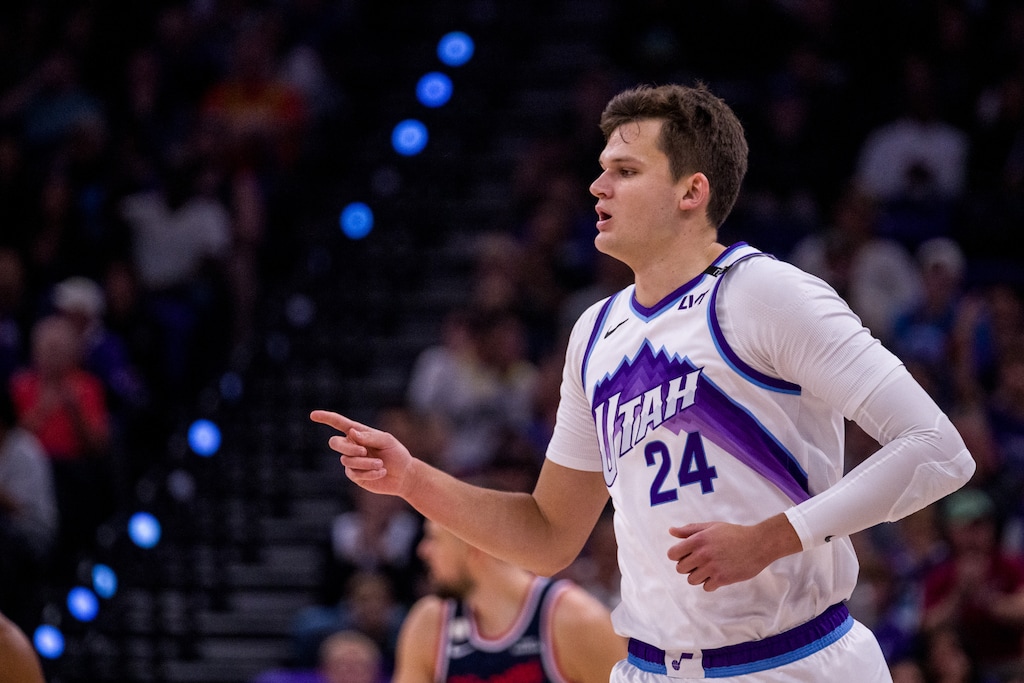
Utah Jazz center Walker Kessler is at odds with the team’s front office over the current handling of his restricted free agency, league sources told The Athletic.
Kessler, the 24-year-old who was taken 22nd overall out of Auburn by the Memphis Grizzlies before his rights were traded to the Minnesota Timberwolves and eventually the Jazz in 2022, was already known to be frustrated by Utah’s choice not to offer him an extension last summer. And now, with the Jazz choosing to leverage the realities of restricted free agency against him as a way to minimize his market, sources say he is strongly considering the prospect of a basketball future outside Utah.
Yet, as is always the case with restricted free agents, it’s never quite that simple. Kessler can either strike a deal with the Jazz, sign an offer sheet with another team (starting on July 1) that Utah could match, find a suitable sign-and-trade option for both parties or sign the qualifying offer (worth $14.6 million) for next season as a pathway to unrestricted free agency next summer. Whatever route he ultimately takes, this much is clear: Kessler is currently disenchanted with the Jazz franchise.
After four seasons in Utah, where he became one of the game’s best young big men before a torn left labrum cost him all but five games last season, Kessler must now decide how to handle the biggest business decision of his young career. He remains one of the most coveted rim-protecting talents in the league, with teams like the Los Angeles Lakers, Indiana Pacers, Atlanta Hawks, Washington Wizards, Toronto Raptors and New York Knicks having made significant pushes to acquire him in the past.
League sources say the Pacers pursued Kessler at the February trade deadline before pivoting to the deal for Ivica Zubac that netted the Clippers two first-round picks and one second-rounder (in addition to Bennedict Mathurin and Isaiah Jackson). That context alone speaks volumes about Kessler’s value on the open market.
The growing strain between Kessler and the front office comes at an ironic time for the Jazz, who have been unable to get top draft prospect Darryn Peterson in for a workout despite having the No. 2 pick. It’s a deja vu scenario from a year ago, when Ace Bailey did the same when they had the No. 5 pick (though they later took Bailey anyway). League sources say Kessler, meanwhile, has long wanted to remain in Utah but is extremely disappointed with the way his situation is being handled. What’s more, there has long been an expectation that he would be a long-term priority and part of the solution after the Jazz spent recent years in rebuilding mode under the direction of owner Ryan Smith.
From Utah’s perspective, however, the reality is that they already have a combined $95 million committed to big men Lauri Markkanen and Jaren Jackson Jr. for next season alone and are clearly trying to be prudent with Kessler’s contract. Yet, as I wrote late last month, the ascension of San Antonio Spurs phenom Victor Wembanyama has made players like Kessler more valuable.
The Jazz, in fact, were highlighted by a rival executive as one of the few teams (along with the champion New York Knicks) with the big-man depth to combat what Wembanyama brings to the table. At this rate, though, it remains to be seen if that will be the case when next season rolls around.
This article originally appeared in The Athletic.