 Gordon Monson
A question that has reared up again over the past couple of weeks centers on Kalani Sitake’s general unwillingness to promote his own football team at the expense of others by running up the score.
Or, put another way, by scoring as many points as his team is capable of scoring, whether judges are watching or not watching.
Is that what any coach of any team should do for his own benefit, for the benefit of his players and his team’s fans, given the way college football has leaned on appearances to evaluate the quality of teams and, just as significantly, to dole out postseason opportunity? Or is the only goal to win, whatever the margin might be?
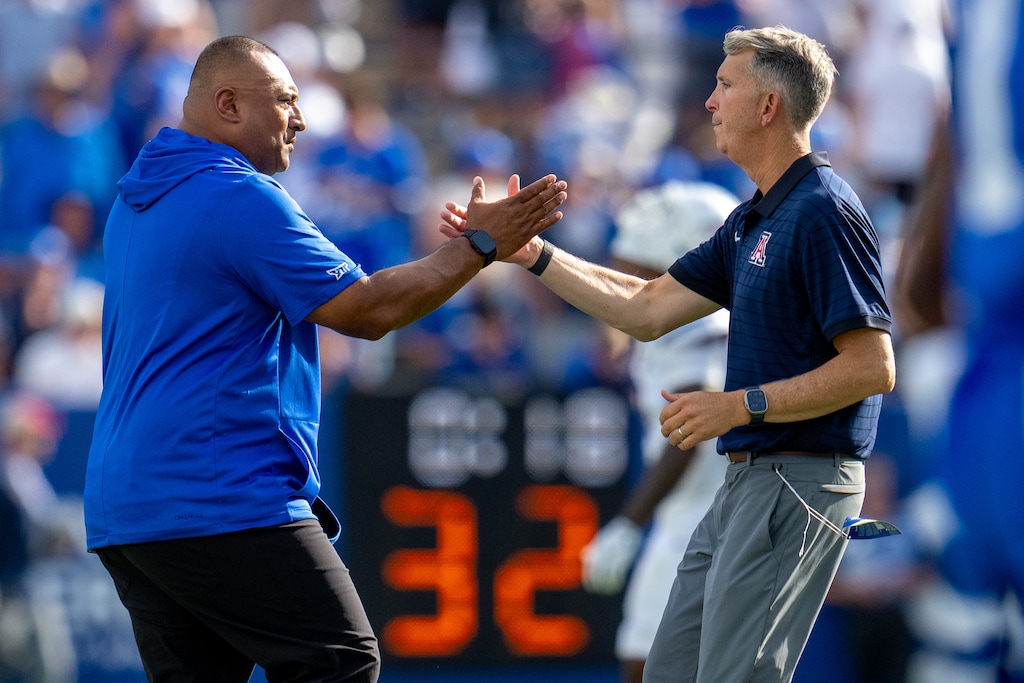
Sitake’s disinclination to max out points revealed itself in different ways and for different reasons against Arizona and Colorado State. BYU beat the conference-foe Wildcats 28-17, and that number could have been 35-17 had the Cougars gone ahead and scored a late touchdown. Instead, the offense was ordered to hit the brakes and take a knee.
Against Colorado State, BYU was rolling in the second half, up 38-7, its offensive line carving up the Rams’ defensive front, enabling running backs like LJ Martin to hit those holes and roam freely for large chunks of yardage. Martin scored three touchdowns, averaged 11.7 yards a carry and could have continued to do so straight on through to the end. But BYU coaches planted him on the bench in the second half, as they also did quarterback Bear Bachmeier and a bevy of other frontline players — on offense and defense.
As a result, CSU won the fourth quarter, 16-3, and the final score beaming into the Fort Collins night and posted on sports sites around the country was 41-23.
Sitake had his reasons for doing what he did in both of those outcomes. He’s never been of a mind to embarrass anyone, any team. Especially teams coached by friends of his. Sitake, it seems, has a lot of friends and is looking to make more. That’s part of what went into the Arizona situation.
There were other motives for what happened against Colorado State, reasons such as wanting to shield his starters from unnecessary hits and giving his 2s and 3s a chance to develop in live action. The problem with that was that those 2s and 3s got sloppy, committing penalties and yielding yardage and points in a way his top guys would not have, allowing the winning margin to narrow.
Maybe that preservation and extra experience will come into positive focus as the season moves on. Injuries might be avoided, and when they’re not, certain sections of the second unit can more readily come to the rescue. Smart.
Football is a violent game in which individual players, regardless of position, are vulnerable to some degree and at some level on every single play. If the game’s already in the bank, what’s the use of messing with breaks and bruises and blown ligaments? Gone With the Bend is a movie nobody in blue or any other color wants to see.
On the other hand, those who didn’t actually watch the Arizona and CSU games, which is most of the voters in polls and likely CFP committee members, go ahead and judge the strength of the Cougars solely on the final score. It’s one of the stupid aspects of college football.
Only gamblers — and perhaps some fans — care about point differentials in the NFL. Otherwise, as long as teams there win, all is good. If a pro team goes, say, 16-1 or 15-2, coaches and players couldn’t care less about the margins of victory.
But that’s something the fractured vastness of college football has never been able to completely shake. Too much opinion strong-arms the game and determines who gets postseason opportunity and who doesn’t. It’s always been that way and remains that way, still. That’s not charming tradition; it’s just an unfortunate truth.
And it’s tradition and truth that slams into Sitake’s way of thinking.
So, on account of that, does the coach owe it to his players and to his program and to his fans to turn his guys loose on whoever’s on the other side of the line of scrimmage, on the other side of the field? Opportunity might be hanging in the balance.
The counter to that is this: If his team wins every game, there will be no question as to whether the Cougars get in or are left out. Winning every game or even every game but one is a steep standard for BYU, especially when those sizing his team up have regional and conference biases against his team. Some programs more easily get away with close games and even losses.
Nobody should know that better than BYU, considering how, despite stellar records, it has been left on the edge of the playoff dance floor without the privilege of being asked to actually dance. Which is to say, it didn’t look good enough to be included.
Thinking about that isn’t vanity. It’s reality.
Even gentleman-coach LaVell Edwards, Sitake’s mentor and primary role model, wasn’t above pouring on the points. Ask UTEP about that, all the way back when the Cougars beat the Miners, 83-7. No way was BYU, in deference to others, going to leave its own hair undone or shred its own evening gown in a pageant that never fully rewarded congeniality.
If the runway required running up the score, that was an ugly crown the Cougars were — and may now have to be — willing to wear.