College football bumped and skidded from the unusual to the ridiculous to the preposterous late on Saturday night in Tucson, in BYU’s game against Arizona.
It was a game that featured the remnants of a hurricane — rain, thunder, lightning, bluster, a 70-minute weather delay — and a typhoon of turnovers, mistakes, scoring streaks, scoring droughts, and two overtime periods. It was a contest that for the Cougars was split up and carved into bits and pieces of hope and despair, encouragement and discouragement, and everything in between.
After the final play, an Arizona pass that fell incomplete, beyond the outstretched arms of its intended target in the end zone, a pass meant to tie the count and slice up the game some more, an exasperated Kalani Sitake looked into a camera and said: “I’m glad we got the win. I’ll take it any way I can get it, but we shouldn’t make it so interesting next time.”
Au contraire. Next time, against the Utes, it’s likely to be all of that and more, mostly because Utah is better than the Wildcats.
Either way, Sitake breathed out some air and added: “It’s never easy.”
He got that right.
And he added one more thing: “We’re committed to learning and getting better.”
The Cougars most certainly will have to do and be that — in a hurry.
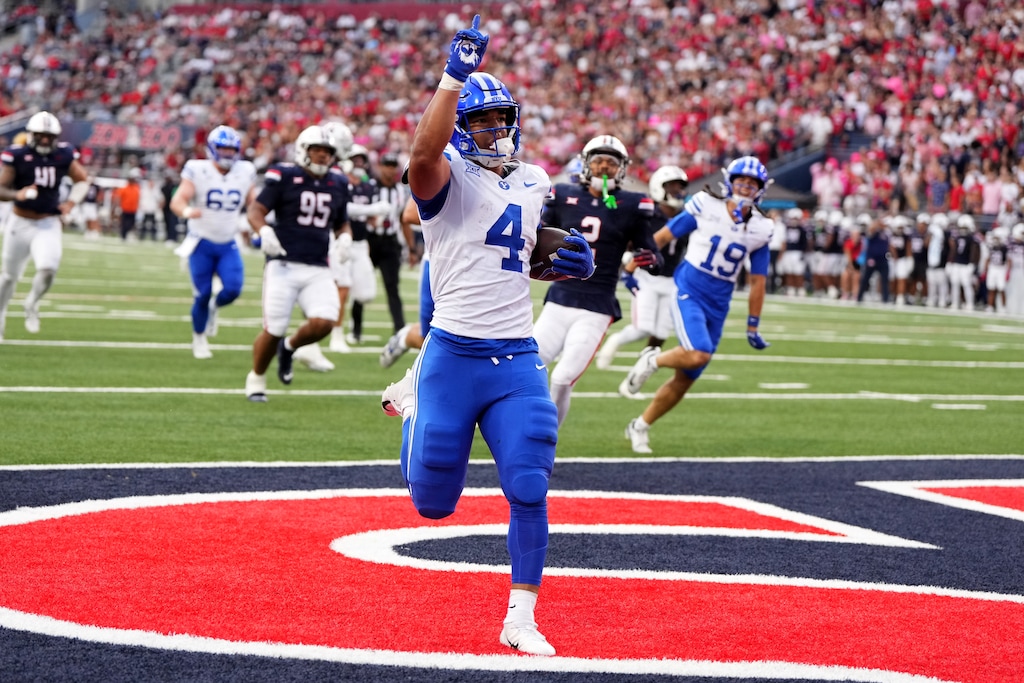
(Rick Scuteri | AP) BYU quarterback Bear Bachmeier dives for a touchdown in the second overtime against Arizona during an NCAA college football game, Saturday, Oct. 11, 2025, in Tucson, Ariz.
Not only do they face Utah this coming week, thereafter they play Iowa State and Texas Tech on the road, and Cincinnati, too. If they take the positives from Saturday night and do away with the negatives, they might have a shot at continuing an unbeaten streak this season that now has reached six games. If the negatives prevail, they could lose all four of those difficult matchups.
Leaning a whisker away from defeat on this occasion, they won by the count of 33-27. They scored the first 14 points of the game, then yielded 24 straight to the Wildcats, then scratched back to level the numbers with 19 seconds remaining, and then survived double-overtime, getting a touchdown when they desperately needed it, and preventing Arizona’s on that last play, when they also needed that. So it went.
The rain that swept in, after BYU took its early lead, brought to mind the scene in the classic film “Caddyshack,” the famous exchange between the bishop and Carl Spackler. As the precipitation poured out of the sky and lightning flashed, the theme music from another film, “The Ten Commandments,” playing in the background, not sure whether he should continue on with his round, the bishop said to caddie Carl, “What do you think, fella?” Spackler famously responded back to him: “I’d keep playing. I don’t think the heavy stuff’s gonna come down for quite a while.”
The heavy stuff already was coming down.
“You’re right,” the bishop said. “Anyway, the good Lord would never disrupt the best game of my life.”
Um, yes he would, just as play was also interrupted on Saturday night by the aforementioned lightning delay at Arizona Stadium. The Cougars know it, having started their game against the Wildcats about as well as a game could be started. They scored on consecutive drives, the first one 66 yards, the second 95 yards. They could run at will, pass if they felt like it, and they did both, going up by those two touchdowns, easy and early.
Then came the delay, and BYU seemed during that stretch to have forgotten how to play football. It was sort of an indictment on both players and Cougar coaches, who should have had the ability and the acumen to make whatever adjustments were necessary to go on hitting the throttle through the next three quarters. Instead, it was the Wildcats who managed to do that.
Arizona soared back, having scored one TD before the delay, then blitzing forward to score two more, plus a field goal. For the Cougars’ part, they stumbled, bumbled and fumbled around. There had been questions raised in the run-up to this game, observers wondering how BYU would fare against a higher-quality opponent on the road, seeing as most of its previous opponents hadn’t blown anyone away with their performances, their talent, or their records.
Two specific questions arose. The first centered on freshman quarterback Bear Bachmeier. He had shown well in recent outings, but what would he do on the road against 4-1 Arizona, a team that hadn’t allowed a passing touchdown all season long? Would the 19-year-old seize up or would he shine? The second focused on the defense. How would it play without its leader, the injured Jack Kelly?
The answers, as it turned out, were mixed.
Bachmeier completed 12 of 29 passes for 172 yards and a touchdown. He threw two interceptions and gagged up a fumble, all of which made his team’s designs on winning considerably more complicated. But he also rushed 22 times for 89 yards and 2 touchdowns, including the last game-winner at the end. He ran again and again, and as he did so, you had to wonder how much of a beating, absorbing so many hits, can even a big, strong, youthful QB take? He’ll definitely be sore in the hours and days ahead.
Sitake was pleased with the good, bothered by the bad. He said his quarterback would live and learn: “I can do without him throwing interceptions and fumbling the ball,” he said. “But he’s tough.”
Tough enough to have guided the offensive half of his team back from the Cougars’ 10-point deficit to send the thing into extra periods and ultimately to win it there.
As for the defense, that also was a blend of proper and improper play. There were blown assignments, missed tackles, yards and touchdowns yielded. All told, Arizona gained 383 yards against BYU’s 430, and led for much of the game. Conversely, the defense stood firm when it appeared as though BYU was on the verge of collapse. Already trailing in the second half, it overcame some questionable calls to keep the Wildcats from building their advantage beyond what it was.
And there was the notable and memorable final stand, after BYU scored on a Bachmeier run in the second overtime, giving it a six-point lead following the failure of the required 2-point try. Arizona conjured a number of short runs, then a couple of incompletions that ended its chances and saved victory for the Cougars.
The conclusions to take from where BYU sits at this juncture are as mixed as their performance was on this night. The Cougars were capable enough to take the lead, vulnerable enough to lose it, and strong and strong-minded enough to fight back in someone else’s building when it looked as though they would lose.
Sitake would take the win, as he said, any way he could get it. But some of his team’s upcoming opponents, including the Utes on Saturday evening at LaVell’s Place, are confident and capable enough to hand BYU a loss, especially if the Cougars give them extra opportunities to do so. Even if they don’t, the big game, the rivalry game, is bound to be what Sitake doesn’t want it to be — “interesting” — either by the competitiveness it provides or the pain it inflicts.