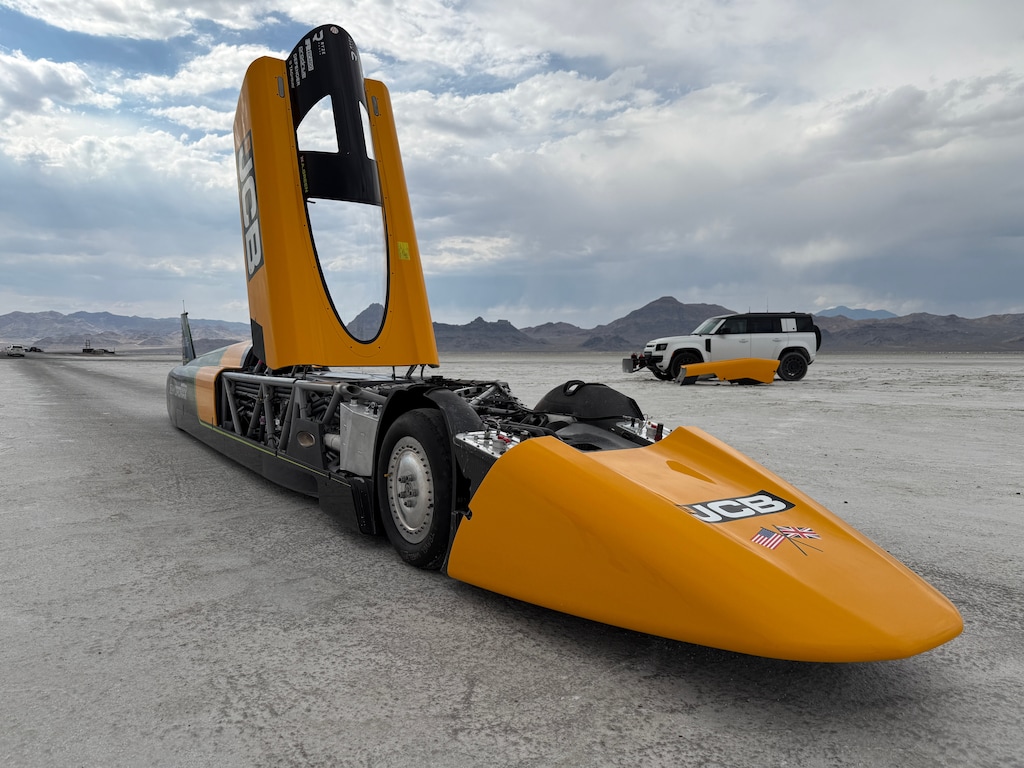
The fastest driver on Earth has set another record.
Andy Green, 64, the only person to break the sound barrier on land, set a record for the fastest land speed in a hydrogen-fueled internal-combustion vehicle Tuesday, at 406.320 mph (653.909 kilometers per hour). The record, set at the Bonneville Salt Flats, was confirmed by the Fédération Internationale de l’Automobile, the governing body for motorsports.
“The ground comes at you very, very quickly,” Green, a former pilot for the Royal Air Force, said in a phone interview Wednesday. “You’re driving five or six times as fast as on the interstate. Everything happens very quickly.”
Green was driving a JCB Hydromax — which looks more like a rocket on wheels than a car — “the fastest hydrogen-powered vehicle of any kind in history,” according to JCB, the British machinery company that manufactured it. Beyond setting a land-speed record, the company is hoping to use hydrogen engines in the products it builds, Green said.
No plumes of smoke were produced by this speed record: Hydrogen powers the vehicle and water comes out of the exhaust.
“This is as zero-carbon as it gets,” Green said.
Mohammed Ben Sulayem, the FIA president, called the record a “historic milestone” in a statement. The previous land-speed record for a hydrogen combustion vehicle was 185.5 mph, and was set in 2004 by the BMW H2R vehicle, according to FIA.
Green set the record on a 12-mile track on the Bonneville Salt Flats, a 30,000-acre expanse of hard, white salt crust on the Great Salt Lake Basin in Utah.
“You can physically see the curvature of the earth,” Green said. “This smooth surface is so long.”
How does it feel to be in a vehicle going 400 mph? Loud, and with heavy vibrations, Green said. As he accelerated, he looked farther in the distance, and the markers along the course came at him faster and faster, he said. Around him, there was nothing but white salt. The track seemed to get narrower. All of this is happening as he was sandwiched between two roaring engines in a cockpit that was built to fit his 6-foot-3-inch frame.
It takes about 72 seconds to get from 50 mph to 400 mph, Green said.
The Bonneville Salt Flats have been the site of speed races since 1912. Once part of a large prehistoric lake that covered a third of the state, the flats are composed mostly of table salt, according to the U.S. Department of the Interior’s Bureau of Land Management.
Green said Wednesday that he had considered himself to be retired from speed racing — until JCB called. In October 1997, he broke the sound barrier on land in the Black Rock Desert of Nevada, driving a jet-powered car at an average speed of 763.035 mph over two runs. That vehicle was powered by two Rolls-Royce engines from a Phantom fighter jet.
That run broke the overall land-speed record set in 1983 by Richard Noble, a British entrepreneur, who traveled at 633.4 mph with a jet-powered car.
The JCB Hydromax was not built to rival the 1997 record, according to FIA, but rather to set a new fastest speed for a hydrogen vehicle. But, the organization said in a statement, “it has laid down an important marker in the world of motor sport and beyond.”
This article originally appeared in The New York Times.