 Gordon Monson
My dad liked football and basketball and hockey, too. But, man, he loved baseball. He threw the wickedest knuckleball I ever tried to hit or even catch. But he taught me as a kid to do both, the way fathers do for the luckiest of young sons and daughters.
Every Father’s Day, in my mind’s eye, I see that ball blowing in the wind, moving up and down and all around as it tumbles toward me. Puts a grin on my face.
It’s one of many memories — inside and out of sports — I have of my father, some of them happy, some of them not so much. Maybe you can relate, if you’re lucky and I hope you are, with your dad. If your father’s still alive, cherish the time you have together. For me, after all these years, there’s leftover laughter and tears.
For instance, and please forgive me for getting personal here, I hit him with a car once. More accurately, I crushed his legs between the bumpers of two cars, but I’ll get to that in a minute.
Leon Allen Monson was/is my dad. My middle name was supposed to be the same as his, carrying on a tradition, except that my mom mistakenly spelled it “Alan” on my birth records, so that’s the way it stayed.
Dad typically signed his name “L.A. Monson,” which I, as a youngster, thought was kind of cool.
He was a big man, at about 6-foot-5, 290 pounds, who was intimidating to my friends and, quite frankly, to me, too. Not that he ever got physical in any way, other than the one time when I was a toddler he gave me a pants-down spanking straight in front of my sisters, a bit of discipline for which I’ve only just recently forgiven him.
Dad was strict, a responsible individual who expected those around him — especially family members — to be responsible as well. Problem was, as a kid, I was a goofball, a knucklehead. My careless early behavior must have been a disappointment for him, but … I just couldn’t be 25 when I was half that age. Growing up took some time.
He was smart, and he wanted me to be smart, just like him. Turned out, in those early years, I was a less-than-attentive student, a smart-ass, and that likely drove him crazy. I admired my dad, but I wasn’t much like him. He was a scientist, and I hated math and science. He had earned advanced degrees in chemical engineering and metallurgy, having taught at the University of Wisconsin before moving to Delaware, where he settled into a lab at a place called “The Experimental Station,” a huge DuPont complex of exploration, innovation and invention.
I was more into hanging out with friends, watching cartoons, and dreaming of playing shortstop for the Philadelphia Phillies or quarterback for the Green Bay Packers. Dad actually coached my Little League baseball team, known as the mighty Fairfax Falcons. He seemed to enjoy doing that, teaching kids to do what he could do.
And he was proud of my athletic endeavors and successes.
While he was all over me to get good grades, showing little patience, and he eventually got that message through to me by the time I was in high school, it was a rough road through the middle school years. One time in seventh grade, when we got report cards on paper to take home, I made a poor attempt to change an “F” to a “B” with a No. 2 lead pencil on the printed-out card, and let’s just say that was an error in judgment on my part.
He was an open-minded but spiritual man who was called as an LDS bishop when he was in his 30s. It was a huge responsibility for him, as he had work, a wife, five kids, and now a congregation to look after, but … yeah, responsibility was his thing. I remember people I did not know sending him notes of appreciation for his tireless service. He spent his professional hours seeking empirical proof for his equations and conclusions and his spiritual hours seeking guidance from God.
When I was born, I arrived three months premature, surprising Mom and Dad. I weighed just a couple of pounds and the doctors informed my parents in certain terms to prepare for bad news, that I would not live to see the outside of the hospital. That happened on a Sunday morning, so my father went directly to our ward (congregation) and asked the folks to fast and pray for me and my mom. Well, miracles of miracles, we both survived. Not bad for way back in 1957. And I figure that only happened because of the combination of good doctoring and my dad’s faith in the heavens above. The nurses and physicians were shocked when I started to thrive in an incubator and, in time, was released to go home to my family. According to Latter-day Saint doctrine, if I had died as a newborn, I would have gone straight to heaven, without question or complication. Instead, I lived and now I’ll have to answer for all my unrepented sins. I used to give Dad the business over that little detail.
He was tough on me for my reckless early behaviors, for breaking some of his rules — and breaking one of his windows — but, as the years went by, I came to appreciate and respect his point of view. When I was about 11, I was supposedly helping him with yard work, cutting the grass and clipping some bushes. At one point, he saw me throw some clippers from one part of the lawn to another. He told me not to do that. When he wasn’t looking, I chucked the same clippers from the front of the yard to the front steps, which was all good until it wasn’t. I overshot the steps and the clippers smashed into a window on the front of our house, shattering it into a hundred shards of glass.
Uh-oh. What should I do? I did the only thing I could. I ran away.
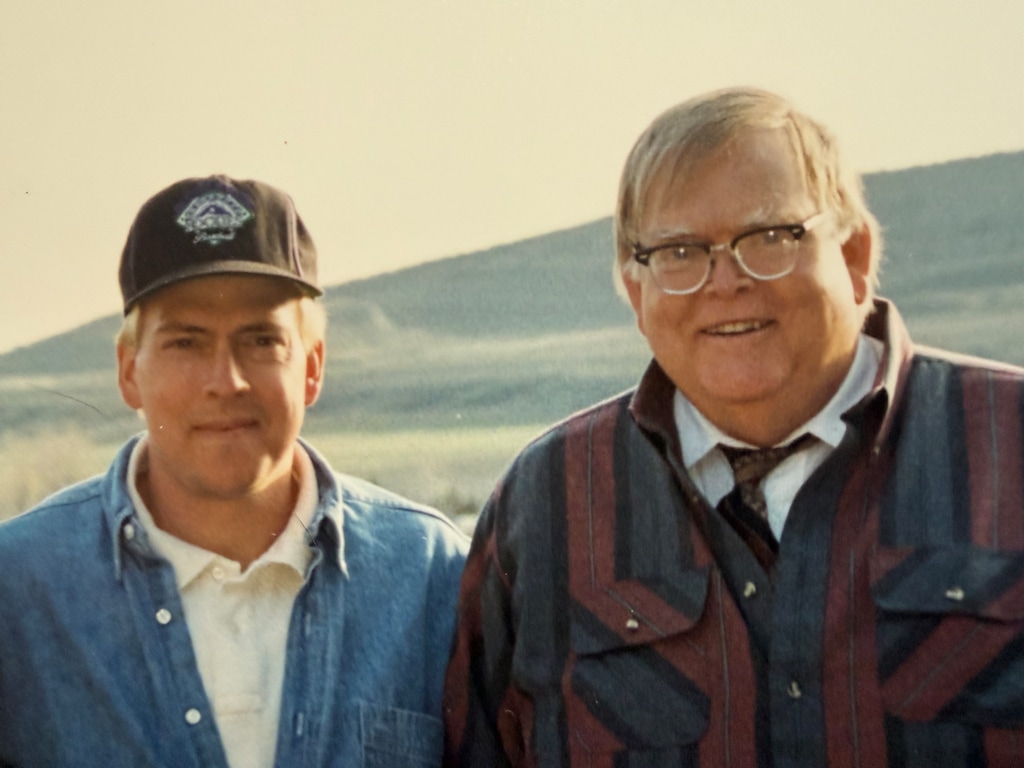
(Courtesy Gordon Monson) Salt Lake Tribune columnist Gordon Monson with his father, Leon Allen Monson, who died in 2001.
That lasted for about three hours, until I grew tired of being out in the cold and having nowhere to rest my weary head. When I finally gave up and went home, Dad was nowhere in sight. I sat on the floor in the den, playing the old board game Uncle Wiggly with my sisters, when a long dark profile stood in the doorway. It was You-Know-Who. He subsequently grounded me from watching TV for a month. I considered that cruel and unusual punishment, but somehow I endured. I remember sitting outside the TV den on the floor in the hallway as the entire family watched a movie together — minus me.
I lived and learned, my mom, bless her heart, often softening the emotional blows.
I once got into a dirt-bomb fight on the front steps of my elementary school with some buddies, and when the K-9 patrol showed up and hauled my carcass back home, Dad got angry — to the point where the officer started making excuses for me. When I went inside, my mom broke up laughing, saying, “All the things I did wrong when I was a kid, and you got busted for a dirt-bomb fight.” I love that woman.
Dad took us boating and camping — a lot, and we traveled the country as a family. He taught me about geography, geology, animals, giving me an appreciation for mountains, lakes and all kinds of landscapes. We visited remarkable places, from the Grand Canyon to the Chesapeake Bay. He once talked me into flying in a small plane up and over Canyonlands National Park, taking off and landing on a dirt runway. When we visited Yellowstone National Park when I was about 6, Dad said he had to keep his eye on me because I wanted to feed the wandering grizzlies the remnants of my peanut butter and jelly sandwich.
One Saturday, the family went on a boating excursion at Elk Neck State Park in Maryland. As we traveled down the highway, our boat being towed behind our vehicle, the left rear tire blew out, causing the car and everybody in it to swerve all over the road. As the trailer the boat was on swung around to the side of the car, the boat flipped off the trailer and landed in the middle of the road. I remember my dad getting out of the car, surveying the situation and, displaying notable self control, saying, “Great balls afire.” That’s all he said. “Great balls afire.” Not a single swear word came out of his mouth.
On another occasion, when I was sitting in an idling family sedan in our driveway, my father pulled his truck behind the car. For some strange reason I still cannot explain, with my dad standing between the two vehicles, I shifted the car into reverse and before I could hit the brakes, it jumped backward, pinning Dad between the bumpers. Fifty-plus years later, I still can hear his scream as his legs were trapped. I pulled the car forward and sat in shock.
My mom came running out to help him hobble into the house.
I couldn’t believe what I had just done, or understand why I had done it. Rather emotional, I, too, went into the house, a corner of it, to try to process the whole thing. Then, Dad called me into my parents’ bedroom, where, as I wept and apologized, he wrapped his bear-sized arms around me and told me that everything would be OK.
I’ll never forget that. Never.
He made me feel all right, even as he was in immense pain.
I was too clueless to know how long it would take him to recover from that injury. It wasn’t until I was a full-grown adult that I realized that he walked with a limp, pretty much for the rest of his life, but he never brought up that moment of his son’s stupidity.
As the years blew by, Dad got older and I loved being around him. I took him on a Jeep trip, just the two of us, through southern Utah a handful of years before he passed in 2001. A fond, fond memory. He was so interesting to talk to and since his death, I can’t tell you the number of times I wished he was around to ask him about some perplexing issue or to fix some problem or to answer some question. My mom said Dad was the most intelligent, most capable man she ever knew.
Now, when people from the old days — and there have been more than a few — tell me that I remind them of my father, I take it as the highest of compliments. I do not remember so much the bare-assed spanking. What I do remember is that magnificent tumbling knuckleball and the feeling of those bear-sized arms wrapped around me. Wrapped around me, still.