facebook-pixel

Conner Mantz’s phone couldn’t handle his record-breaking marathon

Utah native shatters the American record in Chicago but says he can go even faster.
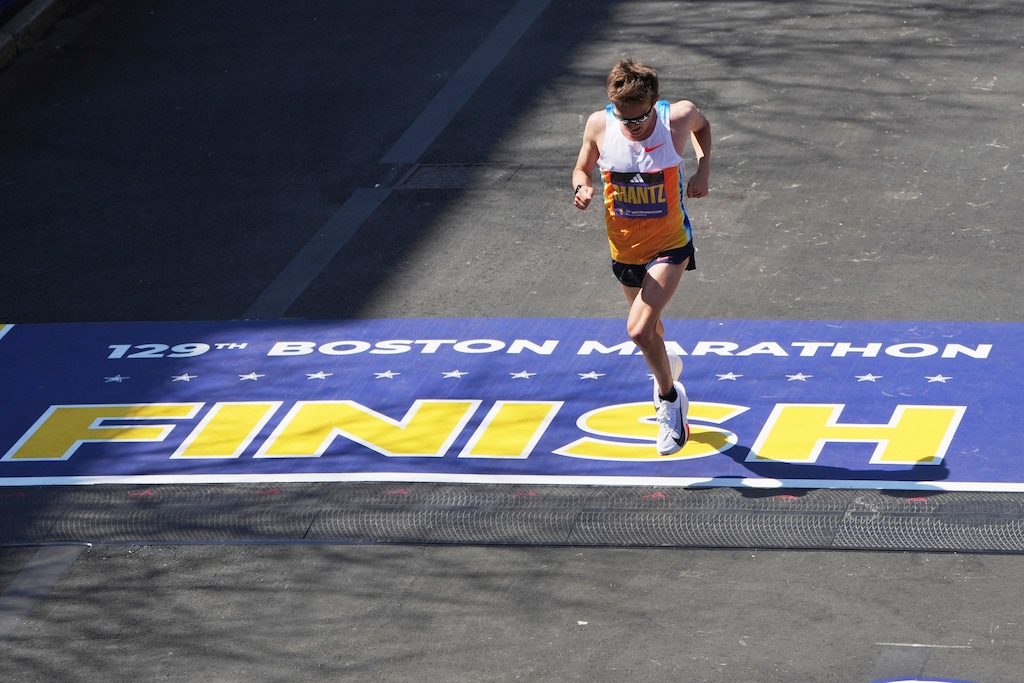
(Charles Krupa | AP) Conner Mantz, of the United States, crosses the finish line in fourth place during the Boston Marathon on April 21, 2025. Mantz broke a 23-year-old American marathon record in Chicago in October.

Conner Mantz’s phone is, almost literally, blowing up. It will no longer let him use the keyboard, and refuses to alert him to a phone call.

“I don’t know if it’s just all the texts?” he wondered Tuesday morning, on a rare occasion where, with the help of his car console, he got a call to go through.

It’s no wonder Mantz’s phone, like his legs and lungs, is feeling overworked. During the Chicago Marathon last Sunday, the Utah native shattered the 23-year-old American men’s marathon record. His time of 2 hours, 4 minutes, 43 seconds on the 26.2-mile course smashed the previous best mark, held by Khalid Khannouchi by a solid 55 seconds.

Mantz’s average time per mile was 4:45. That likely barely outpaced the rate at which he received congratulatory messages.

Khannouchi set his record of 2:05:38 in 2002, two years after the Morocco-born runner became an American citizen. He was waiting for Mantz at the finish line, where he wrapped the Fairfield native in a big hug.

“What took you so long? Khannouchi asked during a post-race interview.

(Landon Southwick | REP) Conner Mantz, left, and Clayton Young of Utah celebrate with their BYU and pro coach Ed Eyestone at the U.S. Olympic Marathon Trials in Orlando, Fla., on Saturday, Feb. 3, 2024. Mantz won and Young took second to claim the nation's two guaranteed berths in the Paris 2024 marathon.

Mantz later pointed out that the feat didn’t actually take him that long in running years. He made his marathon debut at the 2022 Chicago Marathon, when he was also the top American with a time of 2:08:16. He’s slowly chipped away at that time in the three years since. Along the way, he nudged out fellow BYU alum and training partner Clayton Young to win the United States Olympic Marathon Trials (2:09:05), and he was the top American at the Paris 2024 Olympics (eighth, 2:08:12).

Not until this year, however, did he start lopping minutes off his time. At the Boston Marathon in April, he ran the second-fastest American time in race history in 2:05:08. That time didn’t replace Khannouchi’s record because of a technicality: Boston is a point-to-point race, and the record must be set on a loop course. Still, Mantz said, it boosted his confidence that he could surpass the mark that he’d carried in the back of his mind since he began running long distances.

In June, when he was selected as part of the Chicago Marathon field, Mantz broadcast his intentions.

“It doesn’t feel like a stretch,” he told race organizers, according to LetsRun.com, “to say I can run 2:05:30 on a looped, flat course.”

Mantz spent the final three months before the race in Park City, rather than at his home in Mapleton, to give him an altitude advantage. He said he thought that helped Sunday, as did a brush with Khannouchi two days before the race. Shortly after Mantz made his bold prediction, Khannouchi promised he’d be at the finish line to pass the proverbial baton.

“He was very excited. He was very encouraging, like, ‘I think you can get this record. I’m excited for you to get this record,’” Mantz said. “He had high expectations for me and that was nice. You want to be raised up by people you look up to.”

Now Mantz is the one being held up as the country’s best — though not by everyone. Racing insiders are now debating whether, despite running a faster marathon than anyone else in North America (former Southern Utah University runner Cam Levins holds the Canadian record of 2:05:36), Mantz is actually the best American marathoner. Some argue that distinction belongs to someone like Ryan Hall or Galen Rupp. Hall, a former U.S. record holder in the half marathon, and Rupp, a three-time Olympian, both peaked before the influx of carbon-plated running shoes, which have been shown to shave up to 5% off of a runner’s time.

Ed Eyestone, who coaches both Mantz and the BYU men’s cross country team, said he thinks the scuttlebutt is good for the sport. And he feels secure with where Mantz is standing among other U.S. runners.

“(He) posted the best time ever run by an American,” Eyestone said, “and we’ll hang our hat on that.”

Mantz, however, isn’t ready to let this record, or at least this time, stand. Before the end of the year, he’ll race in the USA Track and Field Cross Country Championships with the goal of representing the U.S. in the world championships in January in Florida. And the Los Angeles Olympics are only a couple of years away.

Plus, even running the fastest time ever by an American didn’t get Mantz onto the podium Sunday. He finished fourth behind Jacob Kiplimo of Uganda and Amos Kipruto and Alex Masai of Kenya, respectively. Kiplimo, running just his second career marathon, ran the second-fastest marathon time ever (02:02:23).

Mantz said he believes he has a faster time inside him. He thinks he’ll need to find it if he wants to hold onto his American crown.

“In the sport as a whole, you can’t expect to keep a record that long,” he said. “I want to keep raising the record and getting it faster and improve. But somebody could break it in the next year, you never know.”

Eyestone certainly thinks Mantz can cut down his time. Eyestone was in the booth for NBC on Sunday, and less than a minute after Mantz crossed the finish line, the coach was making his own predictions.

“Next goal: sub-2:04:00, I’m sure,” Eyestone said with a chuckle, noting that Mantz was closing in on the top three runners in the final stretch. “But we’re going to enjoy this one.”

Before Mantz begins pursuing those faster times, he’s got another kind of catching up to do. He admitted he has “a huge to-do list around the house” to get through.

First, though, he might want to get his phone fixed.