Even at 90 mph, with one eye on the terrain ahead of him and another on a scroll that serves as his map, Skyler Howes has seen some pretty extraordinary things while racing a motorcycle through the Saudi Arabian desert.
He’s seen a camel tuck and roll when it tripped while running with a pack through a rocky wash. He’s seen grasshoppers so big he thought they were birds — until one splatted onto his goggles. He’s seen the contorted remnants of the bike of one of the world’s best off-road riders minutes after a fatal crash.
What left the St. George man’s mouth most agape, however, was seeing his name atop the leaderboard for the Dakar Rally last week.
“I still actually don’t have the words to, like, [describe] what it feels like to actually have led the Dakar Rally,” Howes told The Salt Lake Tribune on Friday during the rest day that marks the midpoint of the off-road race. “And as a privateer, nonetheless.”

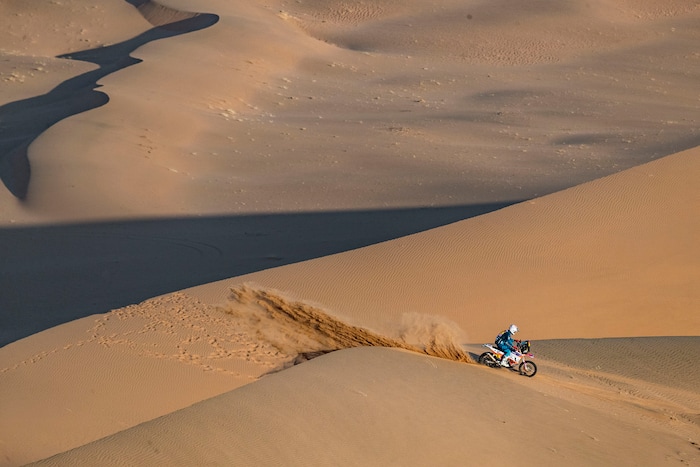
(Photo courtesy of BAS Trucks Dakar Racing Team) Skyler Howes of St. George races through Saudi Arabia during the third stage of the Dakar Rally on Jan. 5, 2021. Howes took the overall lead on Stage 3 and is believed to be one of the first privateers to lead the standings in more than 30 years.


Though little known in the United States, the Dakar Rally holds sway as one of the most-watched sporting events in the world. Consider it a revved-up, off-road version of the Tour de France with a 4,751-mile route divided into 12 point-to-point stage races. Daily broadcasts air on 70 networks in 190 countries and reach about 35 million people.
It is also perhaps the most dangerous. Since its inception as the Paris-Dakar Rally in 1978, when the route stretched between France and Senegal, 30 participants have died during the event. All but eight have been on motorcycles. Other divisions include ATVs, dune buggies, cars and trucks.
Howes, 28, has witnessed the perils first-hand. In 2019, his first year to receive an invitation to the Dakar Rally, he was forced to drop out during the sixth stage after twice dislocating his shoulder. Last year, he came upon the wreckage of the fatal crash of veteran Portuguese racer Paulo Goncalves minutes after it happened. On Thursday, he could watch video clips of Kevin Benavides breaking his nose and GPS system in a crash before the Argentinian pushed on to win Stage 5.
“It’s the most difficult, most dangerous, biggest motor sport event in the world,” said Salt Lake City’s Nathan Rafferty.
Rafferty, the president and CEO of Ski Utah, in 2019 became the first Utahn and 32nd American to complete the Dakar Rally, then held in Peru. Last year, in the race’s debut in Saudi Arabia, Ricky Brabec became the first American to win.
“Depending on the year, about half the bikes don’t finish,” Rafferty added, “either broken bike or broken body.”
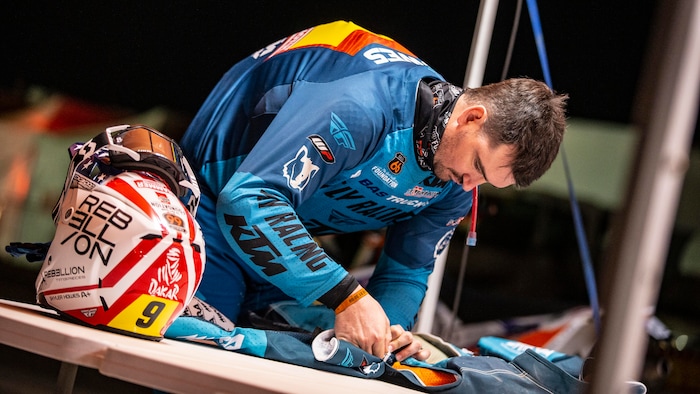
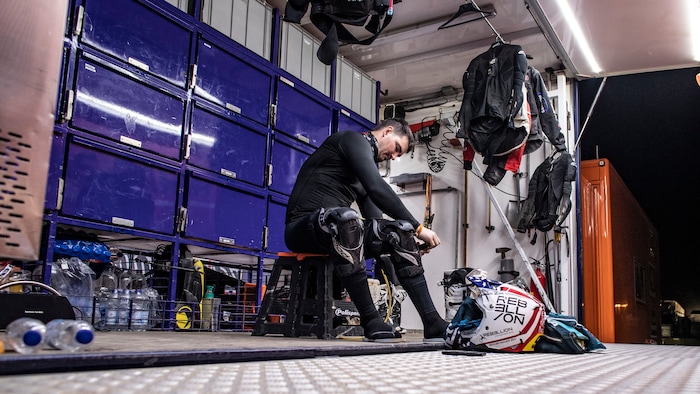
(Photo courtesy of Ishaan Bhataiya/BAS Trucks Dakar Racing Team) Skyler Howes of St. George prepares his gear prior to racing a motorcycle through the dunes of Saudi Arabia during an early stage of the Dakar Rally in January 2021. Howes took the overall lead on Stage 3 and is believed to be one of the first privateers to lead the standings in more than 30 years.
Yet Howes paid dearly to be part of the mayhem.
Though most competitors are amateurs, the upper echelon of the Dakar Rally tends to be dominated by riders sponsored by major manufacturers of off-road vehicles. KTM, Honda, Husqvarna and Yamaha all develop motorcycles specifically to withstand the rigors of the rally. Then they hire the best drivers and mechanics and pay their entry and expenses in an attempt to ensure themselves bragging rights at the finish.
But sometimes someone like Howes comes along and throws a wrench in the cogs.
A “privateer” in rally parlance, Howes has put everything he owns on the line for the opportunity to race. He sold all his possessions — save for a mountain bike and his bed — so he could cobble together the $100,000 he estimates the race will cost him. That covers his entry, rental of one of KTM’s specialty bikes, a team of mechanics (split among four other riders), flights, gear and all the freeze-dried breakfasts, mystery-meat dinners and sand he can eat.
“My biggest challenge was getting here in the first place, trying to find the money and that kind of stuff that was actually really, really, really stressful to try and figure out,” Howes said. “So now that I’m here, I’m actually in a good spot mentally and having a lot of fun.”
Howes adopted a similar enjoy-the-moment attitude for last year’s Dakar Rally after rolling to the start already saddled with several disadvantages. He had broken his back four months prior and was on bed rest for three of them. Plus, he was riding a stock dirt bike, one not built to withstand the high speeds, grind and impact of the rally. Not only was it dangerous to ride, especially as its parts began to wear, it also put him at about a 15 mph disadvantage on the high-speed straightaways compared to the factory riders.
Nevertheless, he managed to land ninth overall and first among privateers.
“I figured, ‘Yeah, OK, I got a top-10 on my own with no support, now’s the time maybe a company will step up and I’ll get a factory sponsorship,’ and nothing came,” Howes said. “So definitely a little bummed out with that, yeah. But I figured since I had the momentum going, I couldn’t stop and I needed to come back and, you know, either try and do it again or do better.”
Armed with a healthy body and better bike, he has.
After popping into the top 10 just once last year, Howes breached that barrier twice in his first three races this year. He surprised even himself with his performance both because he did not expect to do well in the early, dune-filled stages and because it led to his No. 1 overall ranking. He said he has been told he is the first privateer to lead the overall since factory racers began overtaking the race in the late 1980s.
“If that’s true, that’s pretty sick,” he said. “I’m super, super stoked on that.”
Howes’ goal is to be back in the top spot when the race finishes Friday in Jeddah on the shore of the Red Sea. He made a major leap toward that goal Sunday, placing a career-best third in Stage 7. He’s currently sitting in seventh overall with five of the 12 stages remaining, but he’s feeling optimistic. Those stages will be chock-full of rocks and riverbeds, terrain he said he excels on thanks to his Utah-based training. Plus, the challenge of path finding at high speeds while using a map that basically consists of GPS points and landmarks, like “turn left at the dead camel,” has proven to be the great equalizer. So far, not a single stage winner has finished better than 14th on the subsequent stage.
Howes is also being realistic. Anything from a rock to a blown tire could take him out of the running. If that happens and he’s done enough to draw the attention of a factory team, though, he’ll consider this venture a success. If he hasn’t, it’ll still be an extraordinary endeavor — one he’s taking in at 90 mph.
“There’s a sense of adventure to it that you don’t get anywhere else or with any other type of racing,” he said. “And there’s so much stuff that happens in one day that it kind of gives me a year of stories to tell.
“It’s an incredible experience.”