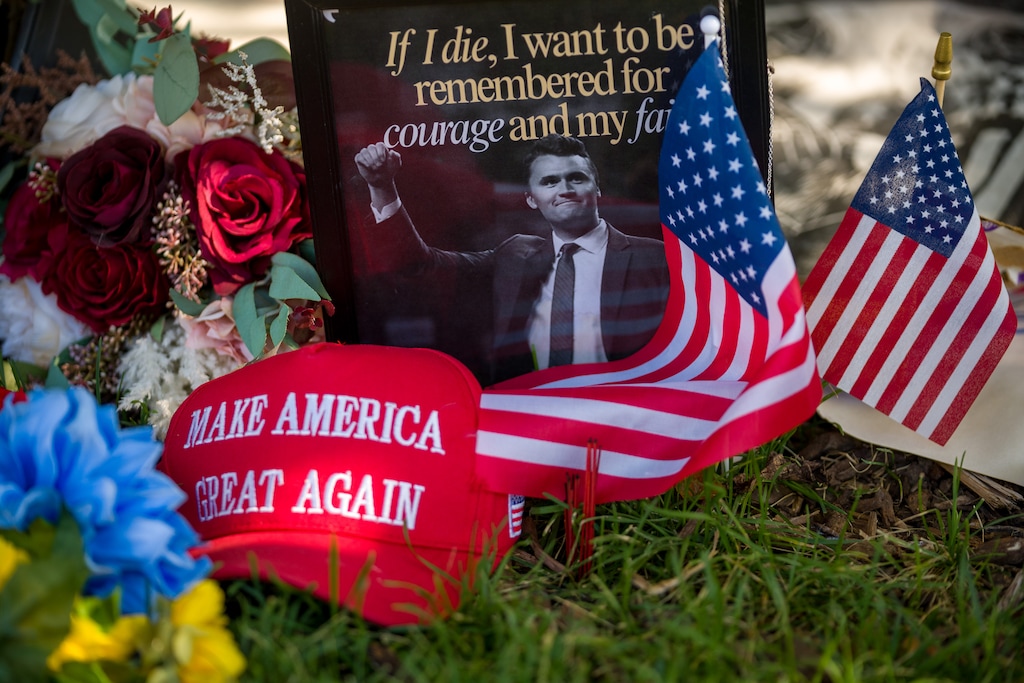
As I drove through Tennessee and Georgia on a recent summer road trip, I passed a billboard for a Trump Superstore with a cutout of Charlie Kirk haphazardly pasted onto it. Kirk’s photo was crooked, as if a fan glued it up in the dark. The peeling paper had weathered; lush kudzu draped over one corner.
A year after Kirk’s death, President Donald Trump has lost approval ratings and some of his shine, and a few miles later I passed a giant red sign announcing the Trump Superstore is going out of business. Everything is 50% off.
It was kind of sad as far as tributes go and nothing like the sleek signage with inspiring imagery memorializing Kirk as an “American Christian Patriot” that once popped up across the South. But then, a lot about Charlie Kirk — his origin story, legacy and usefulness to the evangelical patriarchy is just that — kind of sad.
Charlie Kirk was selected and groomed by tea party businessman Bill Montgomery as a role model for young men. “Inspired, Montgomery went up to him after his speech and told him, as only a man 50 years senior can say, that he needed to delay college to pursue a higher calling,” The Atlantic reported, adding that Montgomery recalled urging him to “start an organization to reach out to young people with your message.”
Charlie Kirk, the podcast bro amplified by major organizations to galvanize young men to Make America Great Again, was funded by major Republican donors.
Charlie Kirk, married to Erika, father of two, urging young recruits to “get married” and “have kids,” was the poster boy for breeding little Christian patriots. Those quotes are on billboards, too. If there was more to Kirk than what he stood for, we aren’t going to hear about it from those in charge of his memory now.
When I was a 19-year-old girl in the evangelical patriarchy, I would have prayed with deep yearning to be picked by a youth group darling like Charlie. When I was a young mother just a few years later — a tradwife and die-hard Republican — I would have taken that exit on the highway to score some Kirk merch while it was still on sale.
As often happens when a celebrity dies, the person is smoothed into one heroic dimension. Nuance, quirks, inconvenient truths and complications fade until they vanish. Charlie Kirk’s death, though, was immediately claimed by MAGA evangelicals and political leaders, who had incentive to canonize him fast. Kirk believers were charged with keeping the flame alive. Supporting and following his widow and remaining loyal to the cause he served were necessary — biblical patriarchy beneath the Trump presidency. One of the easiest identifiers of being a Kirk believer is a white T-shirt with “FREEDOM” emblazoned in black across the chest. You don’t even have to say Kirk’s name to affiliate with his fandom.
In this world, freedom means not autonomy but submission to the Christian patriarchy: Men lead, women follow. Life in the evangelical patriarchy flattens men and women into paper dolls. Role models are tools representing the aspirational uniformity the patriarchy wants: one kind of man, one kind of woman, serving in very distinct roles. The rules are simple and so are the prescribed solutions to life’s complex problems. Humans, though, are messy.
By the time I was 33, an exhausted wife and mother of four, the shine had worn off my life, too. The reality of living objectified as a tradwife in the Christian patriarchy was crushing me. I’d banked enough lived experience with those strict gender roles to see how they manifested into isolation and abuse; nothing looked like it did on paper.
“Get married” and “have kids” didn’t mean our relations were healthy or even that my children were alive — I’d been pregnant nine times in 10 years, with four miscarriages and one infant death. We’d shifted through four churches in search of ideological purity, leaving a trail of broken community behind. Reality is what softened and matured my strident views. I can’t help but wonder, if Charlie Kirk had made it to 33, whether he might have evolved, too.
He was only 31 when he was killed. It’s not a conspiracy theory to imagine what would have happened if Kirk had come out swinging against the Iran war. Or doubled down on the Epstein files. What if he sounded like Tucker Carlson musing about calling for Trump’s impeachment, or Marjorie Taylor Greene or Candace Owens and other disaffected Trump supporters now? Kirk could have helped disband MAGA — which is the opposite of the mission he was chosen for and funded to represent. This would have tarnished his sparkling purpose.
The uncomfortable truth is that Charlie is of more value to the patriarchy as a simple hero than he ever would have been as a complex human being — one who might have changed his mind in 2026. A dead, sainted hero is never disloyal. Continuing to name highways after him is useful to the original narrative, and so is keeping his flat hero image alive for as long as possible.
And, of course, there is still Erika. As the new figurehead at Turning Point USA, she continues to work hard to attract young girls to the TPUSA lifestyle, making Charlie’s memory useful for recruitment. Her recent conference included women willing to surrender their right to vote, “have more babies than they could afford” and marry men like Charlie.
But Erika is also a flattened avatar; her job seems to be making grief look pretty while she promotes biblical womanhood. Ironically, she’s doing so not by staying home with her children but by standing on stage and speaking — two things Charlie’s brand of patriarchy opposes for women. She’s made up — both with cosmetics and unreliable narratives about her history, status and intentions — and apparently few people know the fullness of her story.
I worry about what happens when ideals are marketed to young people without reality checks. What “it’s really like” to live in what’s sold as “biblical roles” is relevant to the decision-making process, and yet influencer campaigns gloss over or skip those full-fleshed realities. Teenage girls in my evangelical extended family are ardent Kirk fans, both Erika and Charlie. They share the stylized honorarium memes and buy the T-shirts. They haven’t traveled the same highways I have; they don’t see the peeling old billboards or clearance sales. I worry that they’ll donate their youth to a cause without understanding the true cost and consequence of a patriarchal movement that consumes young people and then moves on.
People aren’t objects, avatars or paper dolls. We are not just tools for a patriarchal agenda, either as breeders, soldiers or patriots. A year after Charlie Kirk’s death, I’m going to allow him to be messy and imperfect, as we all are. I like to imagine that one day, Charlie Kirk would have discovered his religious trauma, caused by grooming, objectification, a foreclosed future and the pressure to shine up the harsh realities of the idealism he was paid to promote. Maybe he would have deconstructed his previous beliefs and grown into a well-rounded human being after all, instead of living and dying as a paper poster boy for the patriarchy.
Note to readers • Tia Levings is the author of The New York Times bestseller, “A Well-Trained Wife: My Escape from Christian Patriarchy,” and “I Belong to Me: A Survivor’s Guide to Recovery and Hope after Religious Trauma.” The views expressed in this commentary do not necessarily reflect those of Religion News Service.