 Gordon Monson
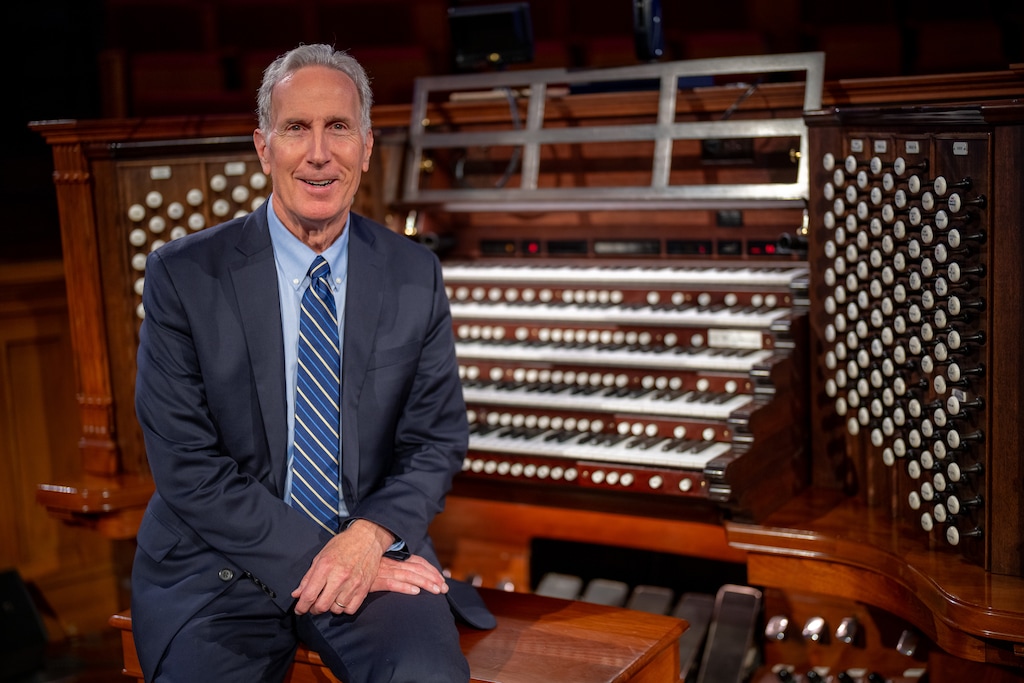
Next time you see the distinguished gentleman with the properly coiffed silver hair, dressed in suit and tie at the organ, hitting keys and pumping pedals alongside The Tabernacle Choir at Temple Square, picture in your mind’s eye something else.
Someone else.
Picture musicians Eric Clapton and Jimi Hendrix of the 1960s or Billy Preston and Don Henley of the 1970s.
That’s what Tabernacle Choir organist Rick Elliott looked like back in the day, complete with, as he calls it, “a big, big Afro,” often decked out in a sloppy T-shirt and bell-bottomed jeans. He played in rock bands by the names of Apricot Brandy and Orange Wedge, busting out covers of songs like “Takin’ Care of Business” by Bachman-Turner Overdrive and “Roundabout” by Yes. He played other hits, too, songs ranging from “Sympathy for the Devil” by the Rolling Stones — “We played a lot of Stones,” he says — to “Hey, Jude” by the Beatles to “Play That Funky Music” by Wild Cherry.
Elliott worked his craft on weekends and then, later, nearly every night of the week, whenever and however he and his bandmates could get a gig, mostly at bars and dingy, smoke-filled, rough-edged nightclubs, some situated hard against old steel mills, others stuck somewhere between desperation and despair, all in the Baltimore and Philadelphia metro areas.
“The Seagull Inn was the club I remember the most,” he says. “I played there a lot.”
Elliott played the clubs and hung out in them to check out other bands and hear their versions of the songs he played, taking in the whole scene.
He saw drinks poured, punches thrown, biker gangs gathered, all as he hammered out keyboard riffs, singing backup to lead vocalists straining for their notes, making music of one sort or another soar into sometimes crowded confines, sometimes empty spaces. It didn’t matter to him, just leave your tips in the jar.
(Richard Elliott) Richard Elliott, far left, with the band Apricot Brandy.
On one occasion, members of a motorcycle gang known as “The Pagans” thundered up to a joint where Elliott’s band was laying down cute little pop and disco songs.
Uh-oh.
“They were pretty nasty,” he says.
They were displeased with the melodic renditions presented and barked out demands for something different.
“Our bass player was a tough guy, a welder during the daytime,” Elliott says. “He showed them our song list, and they [were placated] by progressive rock, so we played everything we knew, and they suddenly were on our side. They were bringing us food and everything. That was a lesson to me how music can really reach people.”
All kinds of people. As Pope Leo XIV puts it: “Music fosters communion. It helps unite our hearts to overcome differences between people and bring everyone together.”
Indeed, there’s a song for every soul.
The police showed up “regularly” when those souls got out of hand, although, Elliott says, “I never feared for my own safety,” even when one scoundrel planned a scheme to steal the band’s equipment. Members were tipped off, and the guitars, drums, keyboard and amps were secured.
The organist was young then, in his early 20s, going to school and just trying to figure out his place in the world. He knew he loved music. He had been influenced by his parents, both musicians. His dad, a World War II veteran who fought in the Battle of the Bulge and ended up an electrical engineer building ships at Baltimore’s storied shipyards, played the acoustic guitar and harmonica, and his mom, whose familial predecessors were tavern owners, was a piano player.
“Music was central to everything we did,” he says.
From ‘awful’ and ‘fun’ to faith and fulfillment
At age 15, Elliott already had mastered the piano and organ enough to play at a Lutheran church, the church where his family worshipped, earning a little cash on the side. Encouraged, he thought he might one day move to Los Angeles or New York to be a professional musician, maybe to play in studio sessions or on movie soundtracks or in commercials. Meantime, the Lutheran church and, later, the aforementioned bars and clubs called his name.
“I just wanted to get my feet wet,” he says, “and see what it was like to play full time.”
What it was like for him was a combination of “awful” and “fun.”
“I liked giving people an escape from their problems, but I didn’t feel like I was helping in any permanent way,” he says. “In the rock world, I was having fun, meeting and connecting with people, making music in a fun way, but I didn’t feel like that was where I belonged.”
As he says it, “pounding the pavement,” riding that vibe, coming home smelling like cigarette smoke and beer, discouraged him from that pursuit.
Instead, he earned music degrees, eventually graduating from the Curtis Institute of Music in Philadelphia, specializing in the organ, and the Eastman School of Music in Rochester, New York, one of the top organ programs in the country.
Nearly 50 years on, Elliott is now doing what he believes is more lasting, what he’s done for the past three-plus decades, playing “Come, Come, Ye Saints,” “Amazing Grace” and other heavenly tunes on Tab Choir tours and at General Conferences of The Church of Jesus Christ of Latter-day Saints. He joined the faith when he was introduced to it by friends at 23, deciding after a year to go on a church mission. He went to Argentina, where his mission president heard his gift and immediately directed him to play — to play a lot — at various mission and church functions.
When he returned home, after completing his musical arts doctorate, he was hired as a professor at church-owned Brigham Young University. A few years later, he found himself sitting full time on the bench in front of one of the world’s most renowned organs, accompanying the famed choir that sings at the foot of its enormous pipes.
All good.
Filling that role has been inspiring, he says, traveling the globe, filling concert halls and places of worship with sublime sounds. After all these years, he still gets a tad nervous before performances, but once he’s dialed in, there’s just him, the massive organ and the musical talents all around.
Strangely enough, as famous as the Salt Lake Tabernacle is for its stellar acoustics, Elliott explains, where the organ is located, when he accompanies singing and the pipes are ringing out, he cannot hear those sounds promptly “because you’re hearing reflections, not getting a direct line of sound. … It’s the worst seat in the house.”
(Trent Nelson | The Salt Lake Tribune) Richard Elliott, principal organist of The Tabernacle Choir at Temple Square, works the keyboards of the famed organ.
He laughs it off, but it is a challenge. “It’s kind of a jumble. … Sometimes you can’t even tell if you’re playing the right notes.”
If he ever plays the wrong note, which happens from time to time, Elliott says he’s learned to cover for it, “playing the same wrong note a second time so people think it was meant to be.”
The ‘Lord’s organist’
(Rick Egan | The Salt Lake Tribune) Richard Elliott chats with the crowd before he performs at a Christmas concert in 2024.
Those are not the only challenges Elliott has faced. In 2008, while on a camping trip, he severely tore the bicep tendon in his left arm, nearly ending his career. Surgery saved it, more than enough for Elliott to go on, at times performing solo concerts. This fall, he plans to travel for recitals in Washington, West Virginia, Ohio, Florida and Louisiana. His principal role, though, is with the choir.
Playing with such an accomplished troupe is a bit different than his experience alongside Apricot Brandy and Orange Wedge.
Mike Leavitt, Utah’s former governor and the choir’s president, says Elliott is the group’s “Renaissance man.”
“He never stops surprising me,” Leavitt says. “He has a mind for music like Bach, but he also knows science, sports, rock music and about any other topic you’re interested in. Maybe what distinguishes Rick the most is his never-ending kindness and unpretentious manner.”
Singers in the choir join in the praise-fest.
Soprano Heather Daybell calls the 69-year-old Elliott “the Lord’s organist.”
“He’s one of a kind,” she says. “When we sing and he plays, it feels comfortable. It feels like perfect harmony. He’s the most talented musician on the stage, in the whole organization. [Conductor] Mack Wilberg is hard to match, but he’s the real deal.”
Elliott sends the compliments back, especially to those who give words to his notes: “[They’re] amazing. They have joys and sorrows, some go through incredible trials, and they’re singing from their faith, but also their pain and their joy. When that’s all mixed together, it’s electrifying. When it clicks, you really feel that.”
Not only does he feel it, but he also looks the part. He exudes humility and spirituality, but he hasn’t thrown away his rock, pop and heavy metal of years gone by. Good music, after all, is good music. Those tracks still pulse out of his loudspeakers at his Salt Lake City home, just as they did when the teenage Elliott fell hard for records by the Beatles — “Abbey Road,” “Let It Be,” “Magical Mystery Tour,” “Sergeant Pepper’s” — and a thousand others by a thousand other artists.
“I wore those records out,” he says.
Just the other day, he kicked back and listened to an old album by English progressive rock supergroup Emerson, Lake & Palmer.
Lennon or McCartney?
(Trent Nelson | The Salt Lake Tribune) Rick Elliott plans to travel for recitals in Washington, West Virginia, Ohio, Florida and Louisiana this fall.
Elliott sits during an interview with me on the bench at the Tabernacle organ, turning and playing short renditions of Deep Purple’s “Smoke On the Water” and Queen’s “We Will Rock You,” all as he tells his story, making plain his passion for and journey through swaths of expansive musicality. After he plays “Danny Boy,” he shies away not at all from his spoken appreciation for the talents of everyone from Led Zeppelin to Louis Armstrong, from Beethoven to the Bangles.
Still, it’s a bit startling, pleasantly so, to hear songs, say, from the era of Iron Butterfly’s “In-A-Gadda-Da-Vida” emanating from the keys of that historic organ, flowing through those pipes, ricocheting off the acoustic walls and ceiling of the Tabernacle, expanses that more typically bounce around the reverent voices of angels. But cool it is, really cool.
Not sure if God is a fan of classic rock, but Elliott’s abilities make it seem as though it might be so. I regret not asking him to play “Stairway to Heaven,” a truly missed journalistic opportunity.
But I do ask him an important question every musician of his era must answer: Which Beatle does he prefer, John Lennon or Paul McCartney?
“Lennon,” he says, “...[but] they were a great team.”
He adds that he hopes to visit the famous studios at Abbey Road in London some day, and when he does, he’ll lope over the nearby crosswalk featured so famously by the Beatles on the cover of their album of the same name.
“Yeah,” he says. “I’ll have to do that.”
Everyone should do that.
(The Church of Jesus Christ of Latter-day Saints) The Tabernacle Choir and Orchestra at Temple Square perform inside the Cathedral of Toluca in Mexico in 2023.
So it is that Rick Elliott clipped his Afro, swapped out his casual garb for a suit and a tie, left behind his bands that rocked bars and clubs and soothed biker gangs, hammering those keys at dives like the Seagull Inn, and now plays his celestial tunes in giant cathedrals and halls with The Tabernacle Choir at Temple Square.
But to him, the music is the same, as is his appreciation of it.
(Trent Nelson | The Salt Lake Tribune) Gordon Monson interviews Richard Elliott at the Salt Lake Tabernacle.
(Francisco Kjolseth | The Salt Lake Tribune) Tribune columnist Gordon Monson.