 Peggy Fletcher Stack
 David Noyce
There was a time in the 1960s when writer W. Cleon Skousen, who died in 2006 at 92, was a widely known and controversial conservative figure in The Church of Jesus Christ of Latter-day Saints.
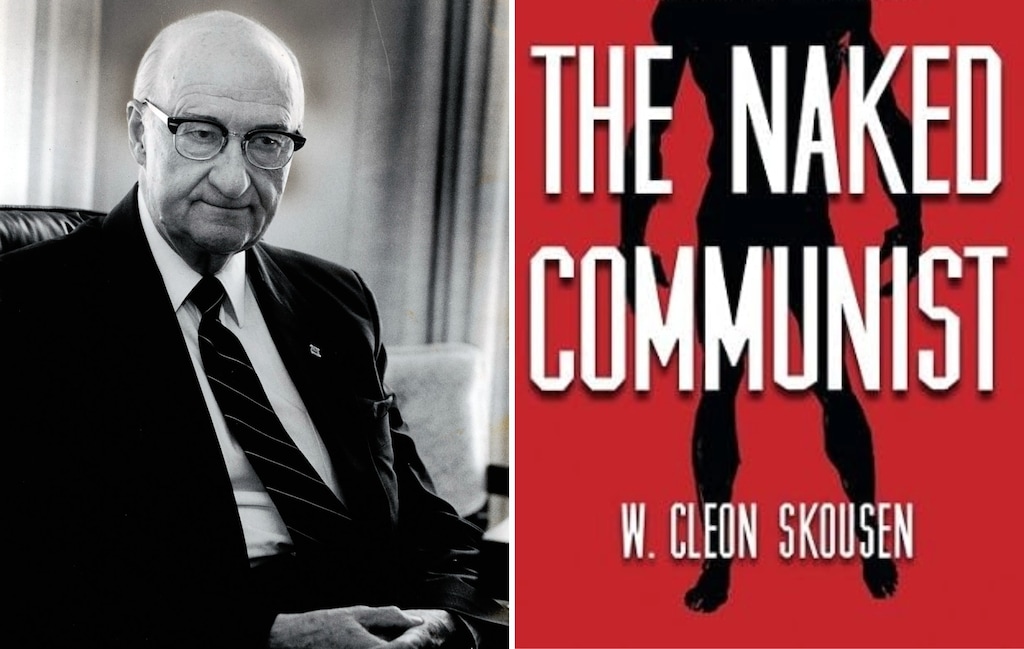
Skousen was a popular speaker, teacher and author whose books about scriptures reflected a literal nonmodernist approach to the Bible. He was a zealous anti-communist who freely mixed his Mormonism with his political views. He worked for a time as a special agent for the FBI and later as Salt Lake City’s police chief. His books — including “The First 2,000 Years” and “The Naked Communist” — became ubiquitous in Latter-day Saint homes as members grappled with the Cold War and predictions of an imminent apocalypse.
Here are edited excerpts from The Salt Lake Tribune’s “Mormon Land” podcast in which historian Benjamin Park, who is working on a biography of Skousen, discusses the writer’s early beginnings and why his works are finding an unexpected audience among President Donald Trump’s supporters today.
(Benjamin E. Park) Historian Benjamin E. Park is writing a biography of Cleon Skousen.
Briefly summarize Cleon Skousen’s career arc and how he came to be so influential.
W. Cleon Skousen and his family often joke that he had seven different careers, and that really captures his eclectic trajectory. He was raised in different Mormon communities in Canada and California, and even Mexico. He graduated from a junior college in Southern California, went on to get his law degree from George Washington University, was hired by the FBI, and spent a decade and a half as a special agent in the agency’s communications. Then he was hired at Brigham Young University to run its fundraising initiative among alumni. He became a celebrity anti-communist, speaking to tens of thousands, if not hundreds of thousands of people a year, delivering hundreds of addresses.
He came back to BYU, became a professor of religion, where he taught an entire generation of young Latter-day Saints how to read the Book of Mormon before then founding an anti-communist institute, originally called the Freeman Institute, later changed to the National Center for Constitutional Studies. That really was the historical arm of the religious right coalition. Throughout all of this, he produced reams and reams of papers and many books that shaped not just the Latter-day Saint community but the broader American society writ large, and how they viewed threats like communism, as well as sacralized the Founding Fathers.
Are there modern politicians who have embraced Skousen’s views, and why have they?
(John Bazemore |AP) Ben Carson, shown speaking in 2020, has praised Cleon Skousen's writings.
A lot more than you might think. At Charlie Kirk’s funeral last September, Ben Carson, who was a 2016 GOP presidential candidate, said that there was a man before Charlie Kirk who made many of the same arguments as Charlie Kirk, a man named Cleon Skousen and whose book, “The Naked Communist,” exposed the Marxist ideas infiltrating our public sphere. That weekend, by the way, that book, initially published in 1958, became a bestseller on Amazon, which is just remarkable. His book “The 5000 Year Leap” became a New York Times bestseller in 2009, decades after that one was published, because it became a primary textbook for the tea party movement.
Why did Ben Carson compare Skousen to Charlie Kirk?
Ben Carson said that one of the great things that Charlie Kirk did was expose the Marxism that’s at the root of our public education and that these ideas of socialism have infiltrated and corrupted all the institutions that are crucial to American society. We need to root it out, and, according to Carson, it was Cleon Skousen who first identified all these problems back in the ’50s.
There’s also a larger trajectory that Skousen represents and that people like Charlie Kirk fulfill, namely, this idea of a conspiratorial notion that there are these mischievous, devious evil powers on the Earth trying to undermine freedom. Skousen offered a compelling theological, sociological framework through which to understand how the world operates and how to oppose all these dangers and threats. In many ways the same talking points that now dominate much of this anti-Marxist, what we would now call anti-woke, culture, really had its first expressions, or its popularizing expressions, through Cleon Skousen in the ’50s and ’60s.
There was a time, it seems, that every Latter-day Saint home had a copy of Skousen’s “The First 2000 Years,” often right alongside Bruce R. McConkie’s “Mormon Doctrine.” What was the appeal to members, and did it reflect any modern politics at the time?
(Wikimedia Commons) Charlton Heston portrays Moses in "The Ten Commandments." Cleon Skousen viewed Moses as the "first capitalist."
It reflected a lot of modern politics, not a lot of modern scholarship. I vividly remember visiting my grandparents’ ward [congregation] in rural Idaho and looking up to the podium to the teacher. And the two books she carried that day, while she was teaching on the Old Testament, were the Bible and “The First 2000 Years.” Not even the manual was necessary in this class. Those were the core texts. That signified how compelling that book is.
Skousen taught gospel doctrine, or Sunday school for adults, for several decades, and he wanted to make the scriptures come alive to its readers. He wanted modern readers to know that all the problems we’re facing today had already been identified and solved by these past biblical patriarchs, and so he offers this very compelling narrative that makes these old prophets — in the Old Testament all the way up to Abraham — very much like us. He digs into their psyche. He talks about how they are encountering the same types of dynamics that we do. He closes by saying that those prophets back then operate just like prophets today, and our problems are cyclical. And if we want to solve today’s modern issues, we need to turn to the past. Cain was the first socialist because he slew his brother Abel due to his lusting after his land. Moses was the first capitalist because he introduced a free market system for people who had been oppressed under Ramses.
Skousen denounces those who try to find a connection between the law of consecration and communitarian teachings in the scriptures and socialism today, saying that no, it’s all based on fundamentally different principles. Skousen taught generations of Latter-day Saints how to read the scriptures in a way that reaffirmed particular political principles, because he saw his political and religious visions used in a world where the answers to all those problems are the same.
So under Skousen, for instance, you could look to Moses or Abraham or Jacob to find answers to the immigration question.
Exactly. He argues that Moses foresaw the type of immigration policies that hard-liners create today. That there are no new problems under the sun.
How did Skousen’s religious literalism reflect his political ideology?
(The Church of Jesus Christ of Latter-day Saints) A family in South Africa reads the Holy Bible. Cleon Skousen took a literalist approach to scriptures.
If Skousen hated something as much as socialism, it was modern biblical scholarship — what he calls “this mysticism,” and then “this supernaturalism” — which he believed was trying to twist the words of the Bible to meet modern sensibilities. All of this modernist scholarship, he argued, is a distraction of God’s glory. When God penned the Bible in the form of the prophets, he was telling literal truth. There was a global flood. Adam lived until about 1,000 years old. There were literal curses placed on people that showed God’s power. Modern scholarship was taking us away from these fundamental truths.
That’s why “The First 2000 Years” was so compelling, because in many Latter-day Saints’ minds it cuts through the morass of all these disputed passages and academic meanings to a simple telling of God’s truth that matches the Bible stories of their childhood.
Doesn’t the church and BYU, its premier education institution, spend a lot of time on modern scholarship of scripture?
Yeah, I think one of the anxieties that drove Skousen to make this argument was that he believed that there were many Latter-day Saint leaders who were forfeiting it. In the 1930s, when he’s a student, apostles James Talmage and John Widtsoe offer more scientifically inclined ideas of interpretation that allow things like evolution, and there are plenty of Latter-day Saint educators and academics who are doing similarly.
What place would Skousen find in today’s political climate?
(Butch Dill | AP) Historian Benjamin Park doubts Cleon Skousen would be a MAGA disciple — despite the Latter-day Saint writer's conservative and conspiratorial writings.
There’d be quite a bit that Skousen would have to say about the current political climate, and not all of it would fit our contemporary political divide. He saw communism as just the latest iteration of this broader anti-liberty threat that dates back to Cain, when he slew Abel. He would say that that impulse to take one another’s gain and to have ill-gotten wealth and to socialize America are still a threat. He would probably be echoing a lot of this anti-woke culture. He would be denouncing Marxism’s intervention in schools and in scholarship.
Yet I don’t think his ideas fully mesh with today’s MAGA (Make America Great Again) movement because as much as he hated socialism, he also hated populism. He wanted a kind of hierarchical control. He always emphasized that America is a republic, not a democracy. I think the populism of today’s MAGA right would also startle him. I think he would see the insurrection at the Capitol in 2021, for instance, as a threat, because that would show mob rule taking over.
He always argued that, on the one hand, we have communism and socialism and state control, and on the other hand, we have anarchy, or our people’s rule. What we need is something in the middle now, and that’s why he always rejected the idea of being an extreme right.
What do you see as Skousen’s lasting legacy on the church and on society?
(Salt Lake Tribune archives) Ezra Taft Benson, like Cleon Skousen, had a lasting influence on the politics of Latter-day Saints.
There are two legacies we can point to — his scriptural hermeneutics, or how we interpret scriptures. He taught literally generations of Latter-day Saints on what questions to ask of the scriptures, how to move verse by verse.
Socially, he was one of the crucial voices (though not the only one) that helped move American society toward the right in American politics. In the mid-20th century, Mormons were much more diverse in their politics and Utah was a swing state. Mormonism was not synonymous with one particular political vision.
Skousen’s work was so successful, his ideas were so beloved by so many Latter-day Saints that he and [eventual church President Ezra Taft] Benson and others helped change that, creating these political alliances that are still very much in place today.
Note to readers • To hear the podcast, go to sltrib.com/podcasts/mormonland. To receive ad-free “Mormon Land” episodes, along with our complete newsletter and access to all Tribune religion content, support us at Patreon.com/mormonland.