 Tamarra Kemsley
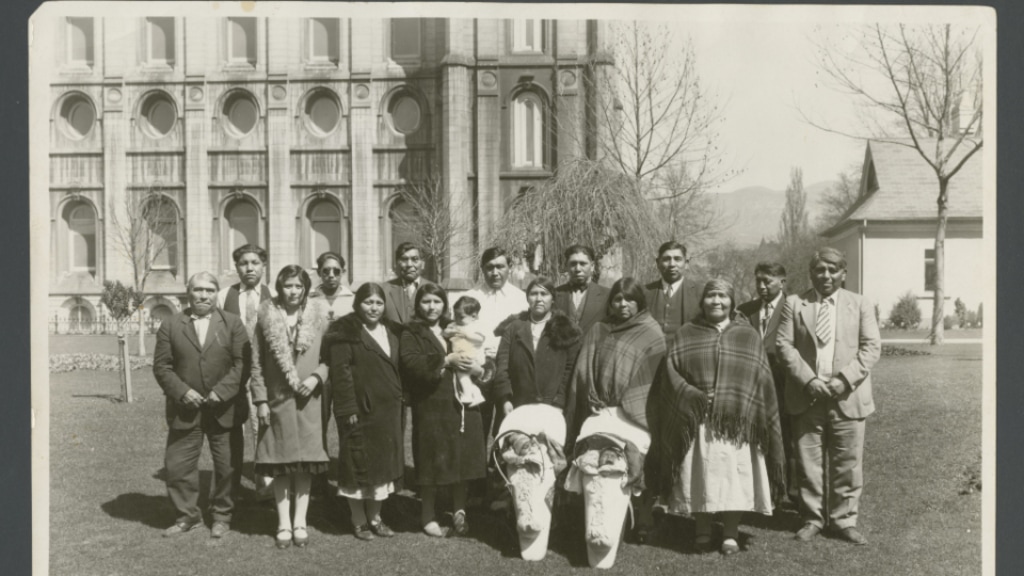
For more than 80 years, a congregation of Latter-day Saints assembled near what is now the border of Utah and Idaho for services unlike any other held before or since.
Yes, they sang hymns, offered sermons and met for Sunday school just like any other gathering of fellow church members. But they did so in a language their religious counterparts wouldn’t have understood. That is because the group, known as the Washakie Ward, was dedicated to serving the region’s Northwestern Shoshone.
(Church History Library) Circa 1910. In 1878, the Northwestern Shoshone Latter-day Saint converts began work on a one-room frame meetinghouse between the Bear and Malad rivers at what was known as Lemuel’s Garden. In 1881, the meetinghouse was moved north about 20 miles to what became Washakie, Utah. For the next several decades, it was used as a chapel for worship services, a schoolhouse, and a venue for other community events.
(Church History Library) In 1937, the Northwestern Shoshone Saints at Washakie, Utah, began work on a new modest brick chapel to replace the old frame meetinghouse. The new chapel was dedicated by apostle George Albert Smith in January 1939.
(The Church of Jesus Christ of Latter-day Saints) The Washakie chapel in northern Utah on April 20, 2026. This building was originally completed in 1939.
From 1880 to 1966, more than a thousand of these Indigenous members of The Church of Jesus Christ of Latter-day Saints found ways to blend their Native identities with the young faith. In doing so, they left behind thousands of records — photos, letters, maps, personal histories and more — now all publicly available for the first time through a digital database.
The database, according to a church news release, represents a collaboration between church historians and the Northwestern Band of the Shoshone Nation and builds on work done for the multivolume “Saints: The Story of the Church of Jesus Christ in the Latter Days.”
“The collaboration is something we’ve always wanted,” Brad Parry, vice chair of the nation, said in the release. “I think this is something that our ancestors have wanted.”
(The Church of Jesus Christ of Latter-day Saints) Brad Parry, vice chair of the Northwestern Band of the Shoshone Nation, at the tribe's headquarters in Ogden on April 20, 2026.
Work began on the project in 2023, growing to eventually include some 1,600 profiles of Northwestern Shoshone whose names appear in church records.
Among them is Sagwitch Timbimboo, a chief and survivor of the 1863 Bear River Massacre, in which the U.S. Army slaughtered hundreds of the tribe’s men, women and children.
(Church History Library) Circa 1880. Published with the caption “Se-go-witz and his Bride in her Rabbit-skin robe- -Utes,” this photograph by C. R. Savage has been traditionally identified as the prominent Northwestern Shoshone dai’gwahni’ or chief Sagwitch and his wife, Mo-yo-gah (Beahwoachee).
Rios Pacheco, a tribal elder and cultural adviser for the nation who was involved in the project, said the database is proof that even in the wake of “a great tragedy,” the survivors found a way to “gather and meet as…a community.”
(The Church of Jesus Christ of Latter-day Saints) Rios Pacheco, a tribal elder and cultural adviser for the Northwestern Band of the Shoshone Nation, at the Washakie Cemetery in northern Utah on April 20, 2026.
(The Church of Jesus Christ of Latter-day Saints) Rios Pacheco, a tribal elder and cultural adviser, was among the project's collaborators.
According to Parry, the ward was critical to the survival of the group’s identity.
“Without Washakie,” he said, “we don’t exist as a tribe.”
Within the small building’s walls, the congregants “passed on their history, culture and language to subsequent generations,” explained David Grua, a senior historian for the church.
(Church History Library) Moroni and Amy Hootchew Timbimboo pose for a photograph with their daughter Joanna on Sept. 15, 1913.
By allowing new generations unprecedented access to the stories of their ancestors, Pacheco said, the digital database keeps that work alive.
“I can’t talk to every youth, but those words will talk for me,” he said. “Those stories of our people will talk.”
Tamarra Kemsley has been a reporter at The Tribune since 2021 but has been covering religion and politics since 2019. Her work has appeared in Religion News Service, the New York Post, and Religion & Politics. She holds a bachelor’s degree in journalism from Brigham Young University and a master’s in Islamic studies from Hebrew University.