When Jensen Huang returned to the floor of his Silicon Valley headquarters on Monday, his employees greeted him with a standing ovation. The rank and file of Nvidia love Mr. Huang, who has made many of them wealthy. In the midst of this celebration, I imagine his top executives must have exchanged a few glances. They know all about Mr. Huang’s abusive treatment of staff members, his extramarital relationships and Nvidia’s funny business in Southeast Asia. But, in the end, I’m sure they clapped, too.
In the 11 days he was gone, Nvidia lost almost 30 percent of its value. Upon his return, Nvidia’s stock price recovered, adding almost a trillion dollars to the company’s market capitalization. They’re saying Jensen Huang is too big to fire. I say he’s the trillion-dollar man.
Mr. Huang still has a number of looming scandals. Nvidia is being investigated by Congress, the Justice Department, the Securities and Exchange Commission and its own corporate board. The U.S. intelligence community seems to have compromising intelligence on Mr. Huang; he’s reportedly had numerous affairs, including one with a married corporate executive at his company and another with a woman suspected of being a Chinese spy.
Reporters have produced detailed accounts of his scathing encounters with staff members, which include bodily threats and ritual humiliation. He is scheduled to have a closed-door interview with House committees next Tuesday and to testify before the Senate two days later. For another corporate executive, any one of these scandals would be a career-killer. For Mr. Huang, it’s Monday morning.
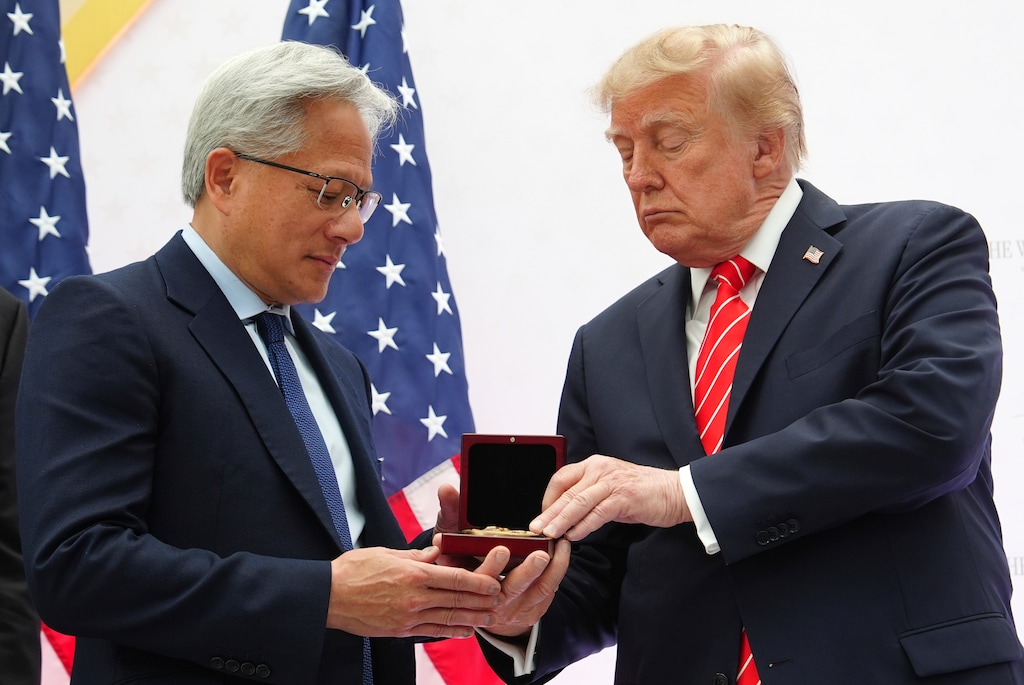
Mr. Huang’s invincibility derives from his close relationship with President Trump. Mr. Huang started cultivating this connection in 2025, when he and his wife, Lori, visited Mar-a-Lago. There, over dinner, he told Mr. Trump the compelling story of his rise from Denny’s waitstaff to semiconductor chief executive. In the course of writing Mr. Huang’s biography, I heard him tell this story many times. I never got tired of it — although I did notice the details change a bit at different tellings. The dazzled Mr. Trump fell hard for Mr. Huang. He also fell for Lori, whom on Monday he called a “fantastic woman” and “very supportive.”
By the beginning of this year, Mr. Trump and Mr. Huang were talking often on the phone. When Marco Rubio, the president’s secretary of state and national security adviser, shared intelligence details about Mr. Huang’s romantic relationship with Alice Huang and the belief that she was a Chinese intelligence asset, Mr. Trump pooh-poohed it. Instead, he offered Mr. Huang a ride with him on Air Force One to meet with China’s president, Xi Jinping. The intelligence findings were eventually published by The Times, causing a cascade of revelations about Mr. Huang’s misbehaviors. Twelve days ago, Nvidia’s board unanimously accepted Mr. Huang’s resignation. But in the interim, the A.I. economy cratered, and when Mr. Trump pushed for him to be reinstated, the board unanimously voted to take him back.
Mr. Trump had reason to act: Nvidia’s plummeting stock price posed a threat to the global economy. When Nvidia underperforms, it drags the entire market down with it. By contrast, when Nvidia succeeds, it feeds a sprawling portfolio of data centers and developers. Mr. Huang is Nvidia; and Nvidia is A.I.; and A.I. is the American economy. To an extraordinary extent, the success of our stock market relies on this single man.
I understand the board’s reasoning. It’s not the morality police. Its job is to make Nvidia’s stock price go up, and no one does that better than Mr. Huang. Several board members are themselves Nvidia billionaires, and some have been with Mr. Huang since Day 1. Also, what were they going to do — tell the president no?
And, it must be admitted, Mr. Huang truly is an irreplaceable businessman. He does the work of an entire C-suite. He is a manager, a thinker, a worker. He is a ruthless operations specialist, a customer relations whisperer, a talent scout and a strategic visionary. He can forecast the existence of new markets years in advance, and he can predict what the competitive dynamics of those markets will be once they come into being. In reporting on the growing humanoid robotics industry, I found that practically every such robot uses an Nvidia microchip for its brain — because Mr. Huang had directed Nvidia to start building these brains years before the robots existed.
Mr. Huang has many other talents. He is an accomplished public speaker — even though he has stage fright. He’s funny and charming and loves to tell jokes. He is an excellent draftsman and can draw, from memory, an elegant exploded diagram of one of his G.P.U.s. He can also label every part and tell you what it does, how much it costs and which of his Taiwanese suppliers he would pick up the phone to yell at if it were late. At 63, he retains a ton of energy and is surprisingly athletic. If Nvidia’s board had not rehired him, he could certainly have built a business to compete against the company.
In intervening to get Mr. Huang reinstated, Mr. Trump also played to the Main Street shareholder. Nvidia is one of the most popular stocks among retail investors, and its fame extends to unlikely places: While shooting clay pigeons in rural North Carolina earlier this year, I mentioned to a fellow shooter that I’d written a book about Nvidia. He pulled up his Robinhood account on his phone and walked me through his Nvidia trading history; then he yelled “pull” and nailed two targets in half a second. Such shareholders, I find, often have only a vague idea of what Nvidia makes. What they do know is that the stock should go up.
But if Mr. Trump’s reinstatement is good for average investors, it is terrible for the rule of law. Nvidia may have broken the law and must be thoroughly investigated. In 2022, the Biden administration announced restrictions on imports to China of Nvidia’s most advanced chips. Nvidia responded by joining with new partners in Southeast Asia. These so-called cloud partners received preferential treatment when Nvidia was allocating its most advanced microchips, which, given the supply-demand imbalance for Nvidia equipment in late 2023, was sort of like the partners being handed a license to print money. The partners, mostly based in Singapore, were supposed to install the Nvidia-powered hardware they received in data centers in Malaysia. Instead, investigators say, some skirted the export ban by reselling the equipment to China.
One cloud partner, Alan Wei Zhaolun, had accumulated enough money to buy a $40 million house. In February 2025, Mr. Zhaolun was arrested by the Singapore Police Force and accused of diverting his Nvidia chip allotment for resale to China. Singapore charged him with money laundering and fraud, and he could face up to 20 years in prison if convicted. He has pleaded not guilty. (Nvidia says it stopped doing business with Mr. Zhaolun before his arrest.)
Alice Huang’s company was also a Nvidia cloud partner — and she was Jensen’s romantic partner, too. In June 2025, the Singapore Police questioned her and seized her passport. They returned it in February 2026 and later cited a lack of cooperation from the U.S. Department of Justice. Ms. Huang was banned from Singapore and now is reported to be in China. The U.S. intelligence community assessed her to be a Chinese intelligence asset whose company was suspected of diverting chips to China. (China denies this.)
I would like to know why Nvidia designated these two as preferred customers. I would like to know what suspicions Nvidia had about these and other Singapore-based businesses and what they did to respond. I would like to know why Nvidia changed its accounting procedures after sales in Singapore grew to 22 percent of its revenue. But I fear I may never get the complete answer.
The U.S. Commerce Department, which was originally investigating alongside the Singapore Police Force, was transferred off the case after Nvidia’s general counsel, Tim Teter, directly emailed investigators and name-checked their boss. The Justice Department took over — and this, Singapore authorities say, was when their investigation into Alice Huang stalled. President Trump, with his endorsement of Mr. Huang, has signaled to Nvidia’s board that the F.B.I. will not find anything too damaging. I wonder how hard it’s really looking.
Mr. Huang’s reinstatement also sends a terrible signal regarding the fair treatment of women in the workplace. Mr. Huang had affairs with at least two subordinates: Kimberly Powell, a married health care executive at his company, and another woman, identified by Reuters, who remains anonymous. On Monday, The Wall Street Journal reported that Mr. Huang admitted to more affairs.
He will very likely face few repercussions for actions that would get anyone else in America fired. In fact, his romantic misadventures are being celebrated — on Monday, Mr. Trump posted a meme that riffed on the famous “Fight!” moment from his own assassination attempt, showing Mr. Huang with a bloody face and waving a red bra. The joke signals a return to “Mad Men” standards of behavior. The broader cultural implications for women are depressing to contemplate.
In an early draft of “The Thinking Machine,” my biography of Mr. Huang, I opined that he was one of the great men of history. I took that phrase out but I wish I’d left it in. Mr. Huang is as great as he is terrible.
He’s a titan of industry who reinvented the computer from the transistor up. He also betrayed his wife, his employees, his company and possibly his country. He’s a warm and charismatic jokester with a humble demeanor. He’s also a narcissist, an egomaniac and a manipulator — and when he gets in one of his moods, he behaves like a petty, insecure tyrant.
He’s a complicated figure, no question, and once the Democrats take office in January, they will go after him hard. But if I were on the board of Nvidia, and I were asking myself what to do, there’s also no question whom I’d choose.
Welcome back, Mr. Huang. We hardly missed you.
Stephen Witt is the author of “The Thinking Machine,” a biography of Jensen Huang. This article originally appeared in The New York Times.