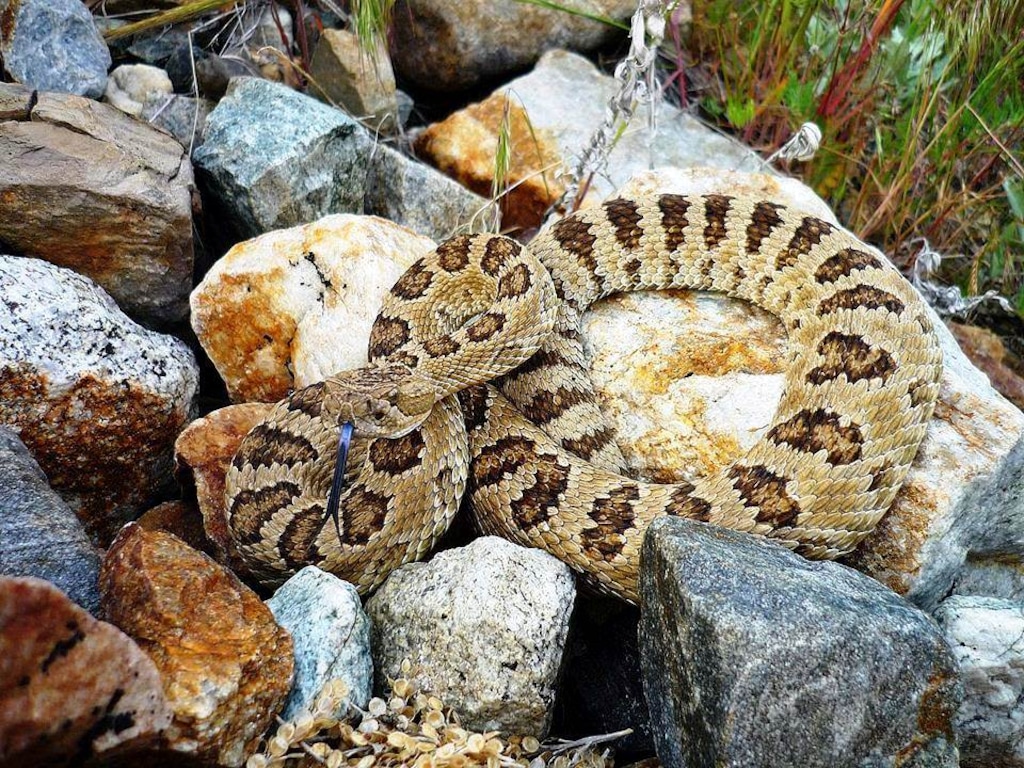
The lethargic snake lies sprawled in the shade of a warm concrete patio, as poised and relaxed as a bikini model on a sandy beach. Her black forked tongue waves slowly in the morning air, its twin tips tasting the fragrance of a summer breeze. Her corpulent belly is full of rodents after a successful night of hunting.
Cynthia spotted the lazy reptile from her kitchen window. This was a common occurrence in her east-bench neighborhood, and while she didn’t fear rattlesnakes, she also didn’t want one to overstay its welcome. But Great Basin rattlesnakes, like most snakes, are docile and reclusive creatures that want nothing to do with humans and are usually just passing through. Cynthia made sure her neighbors wouldn’t harm one or they’d have to answer to her.
Cynthia was one of my best customers.
As a snake relocator in Salt Lake City for many years, my team and I relocated dozens of these gentle serpents each year from residential yards at the request of homeowners, some of whom experienced great consternation upon finding a rattler in their yard. Others, like Cynthia, were thrilled that one was taking care of their rodent problem, although they would have preferred a harmless gopher snake instead.
Snakes are a fact of life in the West — as common as sandstone and sunsets — and since neither of our species is going anywhere, it’s important that we learn to get along.
Utah boasts more than 30 snake species, but the Great Basin rattlesnake is the only venomous species along the Wasatch Front. This makes identification easy. The rest are harmless serpents that should be welcome in anyone’s yard for the pest control benefits they provide. Killing snakes is illegal in Utah and most other places, attesting to their value in the environment.
I met hundreds of rattlesnakes over the years, and almost without exception, they were all glad to see me, because upon my approach, they would wag their tails like excited puppies. This reaction is for our benefit as well and theirs, and has earned rattlesnakes a reputation as the most courteous of all snakes.
It could be hard to convince homeowners that the snake that chose to spend quality time with them didn’t seek them out or mean them any harm. It was merely enacting a ritual as old as time, when, unlike the chicken that crossed the road, it could go where it pleased without having its motives questioned. There was no existential crisis; no ominous intent. It was just an introverted animal looking for a meal or a drink of water on a sweltering hot, bone-dry day. On the other hand, it may have simply been curious about these strange new surroundings.
Present day conflicts between snakes and humans are not instigated by the snakes. Instead, an invasion of modern-day humans has resulted in friction between man and beast. Human expansion has turned peaceful coexistence into a full-blown turf war where snakes are accused of trespassing on the very land where they evolved. Where once they could fulfill their rightful existence in nature’s grand plan, humans have imbued them with powers of malevolent intent and invoked hostility against them.
People fear snakes based on generations of superstition and misinformation, whereas snakes possess eons of evolutionary wisdom. Beyond the undeserved accusations of malicious evil (there are no evil animals), snakes are stealthy, sovereign beings on a sentient journey. They navigate landscapes with quiet certainty, simply fulfilling rituals written long before we paved over their ancient domain and called it progress.
A rattlesnake doesn’t wag its tail because it’s aggressive; it rhythmically warns, “I am here. Respect the boundary.” And maybe, just maybe, that’s a message we humans should heed more often — not only with snakes, but with everything else we’ve tried so hard to bulldoze out of existence.
Teach your children to respect snakes from a safe distance. If you hike or trail run with your dog, enroll it in a rattlesnake avoidance training class. Dogs are bitten when they rush up to sniff a snake, forcing the snake to defend itself. If you see a snake while you’re hiking, take its picture and let it go on its way. That’s all it wants to do.
Most snakes are harmless, and all snakes have an important job to do, controlling rodent populations and preventing the spread of several lethal diseases. This is their service to humanity.
The next time you meet a snake, respect its ancient lineage and its modern boundaries, because the only good snake is the one that remains alive at the end of the day to perform its vital role in the delicate dance of the wild, benefitting humanity while adding beauty and diversity to our world.
Snakes are truly our friends in low places.
(David E. Jensen) David E. Jensen is a freelance writer and the former owner of Wasatch Snake Removal in Salt Lake City.
David E. Jensen is a freelance writer and the former owner of Wasatch Snake Removal in Salt Lake City. His recently published memoir, “The Only Good Snake . . . Tales from a Rattlesnake Whisperer,” blends his firsthand field experience with myth‑busting insights about rattlesnakes. Dave has never met a snake he didn’t like, although a few of them weren’t too fond of him.
The Salt Lake Tribune is committed to creating a space where Utahns can share ideas, perspectives and solutions that move our state forward. We rely on your insight to do this. Find out how to share your opinion here, and email us at voices@sltrib.com.