 Robert Gehrke
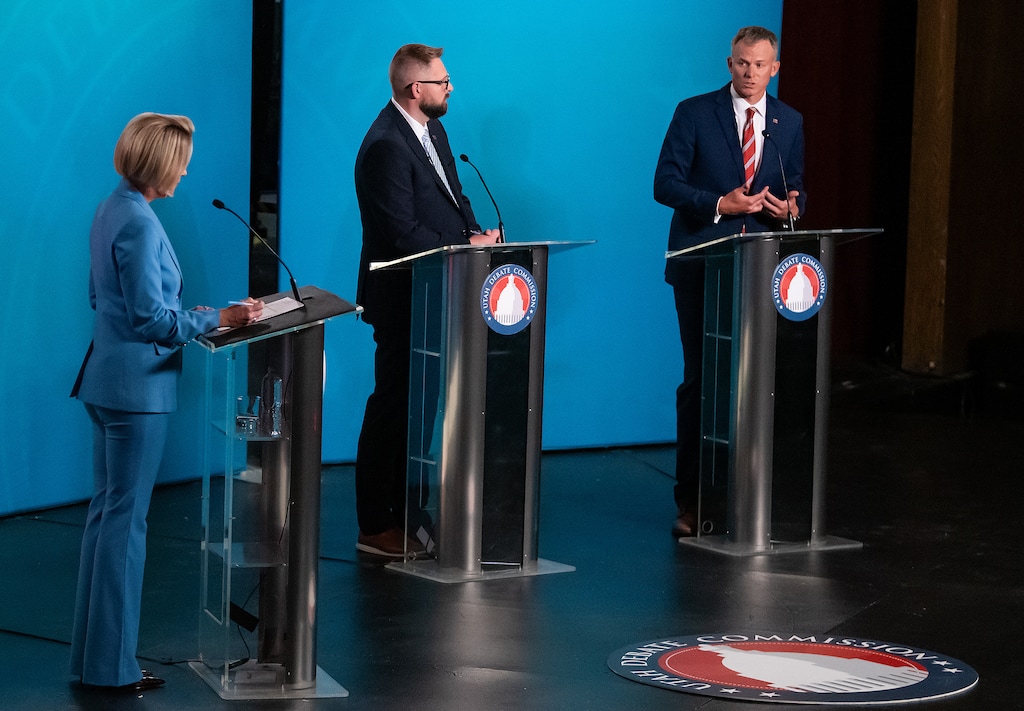
U.S. Rep. Blake Moore defended his record Tuesday night against Democrat Peter Crosby on issues ranging from data centers and preserving the Great Salt Lake to tariffs and solar power during the 2nd Congressional District debate.
Crosby, the challenger, said it is time to change the current path and said volunteers, rather than corporate donors, are fueling his campaign.
“I think the distinct difference between [Moore] and myself really is boiled down to [that] Blake Moore is fine with the path that we’re on. I’m not,” Crosby told reporters following the debate. “And if we’re going to have something different happen, we need different representation.”
Moore countered that, saying that for every issue raised during the evening, he has been involved in legislation to address the challenges at hand.
“Even in politically difficult or toxic or divisive times, I’m going to find a productive lane. I’ve been able to do that,” Moore said. “I know people have frustrations all the time with this, that, or the other, but we’ve got actual ideas, plans and substantive solutions in place that I’ve had a chance to deliver on.”
The contest could be Utah’s most competitive congressional race this year. A poll commissioned by the Utah Debate Commission showed Crosby trailing Moore by five percentage points, 35% to 30%.
An analysis of the district’s past voting trends by The Salt Lake Tribune shows the district favors Republicans by 33.5 percentage points.
Moore said he remains confident in the race.
“We’re confident where we are,” Moore told reporters. “We’re going to continue to drive the message home, and I look forward to an opportunity to continue a lot of the things that I’ve been working on.”
Crosby is a corporate analyst, consultant and adjunct professor in emergent and disruptive technology at Utah State University. Moore, who has served three terms in the House, is Utah’s only delegation member in congressional leadership, serving as the vice chair of the House Republican conference.
Moore faced a tough primary fight from his conservative flank against state Rep. Karianne Lisonbee, whom he defeated, 57% to 43%.
Three other candidates on the ballot — Independent American Party candidate Carlton Bowen, Libertarian candidate Daniel Cottam and unaffiliated candidate Robert Moesinger — did not qualify to participate in Tuesday’s debate.
Data centers
After the furor over the hyperscale data center complex known as Stratos approved in Box Elder County earlier this year, data center policy was front-and-center during Tuesday’s exchange.
Crosby said he demands full transparency on the impacts of data centers, their environmental effects and local control — something he said is “oftentimes being ignored because [of] external pressure coming from the top down, forcing a decision against the will of local residents.”
(Eli Lucero | Pool) Candidate for Utah's 2nd Congressional District, Democrat Peter Crosby participates in a debate at Utah State University, Tuesday, Oct.13, 2026, in Logan, Utah.
Moore said that the Box Elder County data center process taught him that the public has to be engaged and brought along. He said he learned about the proposed massive data center late in the process, as did the county commissioners. He cautioned investors that “those types of mistakes cannot be repeated.”
Water
Crosby called the preservation of the Great Salt Lake “an existential crisis, and I’m not fond of hyperbole.” He said his parents live near the lake and are “already breathing the dust storm.”
He said water policy should be kept at the local, not federal, level. “The State of Utah has to decide: Are we a state that grows to 10 million people?” he asked. “Are we a state that decides to fully invest in Silicon Slopes? Are we a state that decides to maintain local resiliency in agriculture? We can’t have all three.”
Moore said he is encouraged by President Donald Trump saying he wants to spend $1 billion on the Great Salt Lake, but recognizes that the reality may be more in the tens of millions of dollars. That money, he said, can be put to good use on state-driven projects that are shovel-ready.
(Eli Lucero | Pool) Candidate for Utah's 2nd Congressional District, Republican Blake Moore participates in a debate at Utah State University, Tuesday, Oct.13, 2026, in Logan, Utah.
“The lake needs water. It doesn’t need money. It needs water,” Crosby countered. “We can’t wait five or 10 years for another commission. No more bite-sized. We have to do this now.”
He suggested leasing water to divert it to the lake, eliminating invasive species that consume water and improving water infrastructure as paths to ensure the lake’s health.
Energy
Crosby criticized Moore for supporting Trump’s “Big Beautiful Bill,” which rolled back tax credits for solar power. Photovoltaic panels generated a third of the state’s electricity in May. In the process, Crosby said, it cost northern Utah more than a billion dollars in revenue and jobs.
“You can talk to every solar company in the entire state [about] how I went to bat for them,” Moore countered.
The congressman said he is attempting to “get an all-of-the-above energy approach where there’s a level playing field,” but added the solar companies knew he was willing to “create tough conversations and push back heavily in support of those organizations.”
Tariffs
Moore said that the tariffs on imports imposed by the president are “one of the toughest things that we’ve had to navigate this last 18 months.” He said there is a manufacturing plant in his district that needs the tariffs to compete, but others are hurt by the policy. He said he is advocating for his district.
“Every time Procter & Gamble has reached out to our office, we’ve gone and actually successfully been able to mitigate their issues,” Moore said of the company that employs more than 500 people in Box Elder County.
“Procter & Gamble, that’s great,” Crosby shot back. “But none of the small business owners seem to receive the same attention.”
(Eli Lucero | Pool) Candidates for Utah's 2nd Congressional District, Democrat Peter Crosby, left, and Republican Blake Moore participate in a debate at Utah State University, Tuesday, Oct.13, 2026, in Logan, Utah.
Crosby said Moore has voted to keep in place the tariffs that are hurting farmers, ranchers, small business owners and families. Tariffs, along with the war with Iran, he said, have cost the voters in the northern Utah district.
“If I’m interested in the welfare of everybody in my district,” Crosby said, “my priority should be to focus on policy that helps everyone as best as I can and does no harm first.”
Inflation
With gas and housing prices rising in Utah, the candidates were asked what they would do to make day-to-day living more affordable.
Moore pinned the increases on high gas and food prices. He touted a bill to streamline oil and gas permitting, claiming it would cut costs and reduce reliance on foreign oil.
“We have to do something substantive, and that permitting piece is the actual something that we can do right now,” Moore said. “And then, as the conflict in Iran, we push to draw this to an end, we have the chance to maybe remove that issue, as well.”
Crosby said Moore, as a member of Congress, could help end the war if, in a narrowly divided House, he broke with his party and voted to stop it.
“We don’t need hope,” Crosby said, challenging Moore to have courage and put the needs of his constituents ahead of his loyalty to Trump. “We need votes.”