 Emily R. Anderson
Note to readers • Click here to find an interactive map where you can enter your address to see all the races on your ballot that have a voter guide from The Salt Lake Tribune.
As he concludes his first term in Congress, U.S. Rep. Mike Kennedy will face three challengers seeking his seat representing Utah’s new 4th District.
Each faces a difficult battle against the Republican incumbent, who received two-thirds of votes when he was elected in what is currently the 3rd Congressional District.
Kennedy is a doctor and a lawyer who spent a decade in the Utah Legislature. And while four Republicans signed up to take Kennedy on, none of them received enough support at the GOP’s nominating convention to advance to a primary in June.
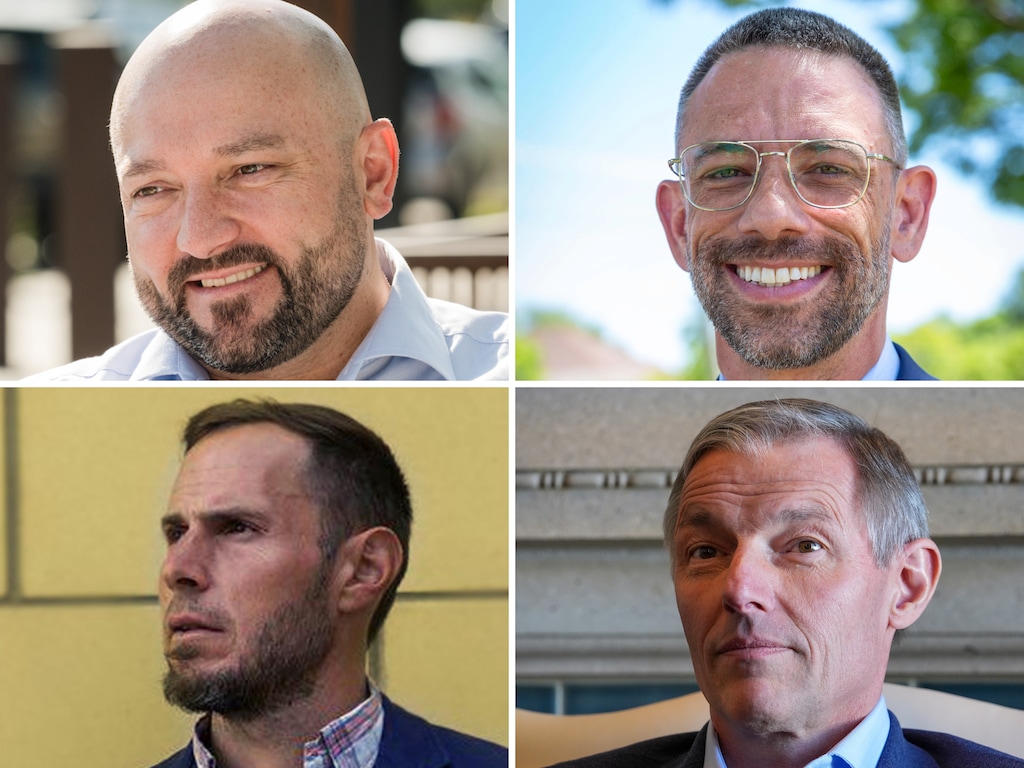
In November, Kennedy will face a Democrat, a libertarian and an unaffiliated candidate. Although Kennedy did not respond to The Salt Lake Tribune’s community-sourced questions, each of his opponents shared where they fall on issues ranging from affordability to water conservation.
The Democrats’ nominee for the spot is Jonny Larsen, a U.S. Marine Corps combat veteran who describes himself as a “Blue Dog Democrat” — a segment of the party that identifies itself as fiscally responsible and dedicated to “ensuring a strong national defense.”
Taylor Wright, an elementary school teacher, is running for the seat as a libertarian.
Attorney Steven Burt, who previously worked as an executive and in-house counsel for solar energy companies, is competing for the seat without declaring a political party. On his website, Burt describes himself as “committed to protecting our God-given unalienable rights and principles of federalism, limited government, separation of powers and the rule of law.”
Election Day is Nov. 3.
If returned through the postal service, mail ballots must be sent early enough to arrive at the county clerk’s office by 8 p.m. on Election Day. Otherwise, they can be left at a drop box until polls close at 8 p.m.
Candidates submitted photos and answers through a questionnaire. Answers may have been edited for style and clarity. Candidate responses are listed in alphabetical order by last name.
Utah voters told us government corruption is their top concern in this year’s election. Why do you think voters feel this way? And why should Utahns trust you to represent them?
Burt: Addressing corruption would be among my highest priorities, and I am in the best position to do so effectively. I have not accepted corporate or PAC money, and owe no favors. As an unaffiliated independent, I answer only to my constituents and not party bosses. I am the only candidate who lives in District 4. My campaign is based on service, not calculated political ambition. Congressional stock trading, exchanging donations for government contracts and selling pardons — these things must end.
Kennedy: Did not answer.
Larsen: Americans have watched politicians get rich in office while serving donors instead of folks back home. Members of Congress have access to information you and I will never see, creating opportunities to profit from their positions. Utahns are angry. I’ve joined the Unrig Washington campaign to ban congressional stock trading, reject corporate PAC money and end dark money. I support repealing Citizens United. As a U.S. Marines combat veteran, I believe Washington needs leaders with spines.
Wright: Government has become an organized mafia: It takes your money, expands its power, then sells that power to the highest bidder. The larger the state, the greater the prize for interests to capture. When government fails, it demands more funding; when businesses fail, they compete, innovate or disappear. Even healthcare and education deserve markets, choice and accountability. Government should protect life, liberty and property — then get out of the way. Less government means less corruption.
Utahns told us affordability is their second-highest priority in this election. How would you help Utahns afford housing, groceries, gas and other day-to-day expenses?
Burt: First, end the war in Iran. Nothing has impacted affordability more than that disastrous decision and the congressional cowardice that followed it. Second, address skyrocketing housing costs through policy that encourages local governments to reform zoning laws, government programs like the Low-Income Housing Tax Credit and develop public housing. Third, Congress needs to reassert its authority and rein in President Donald Trump’s tariffs. Finally, we must end deficit spending and balance the budget.
Kennedy: Did not answer.
Larsen: The war in Iran is a major driver of today’s affordability crisis. We have spent more than $43 billion since the war began in February, averaging $3 billion each month it drags on. Nearly every product we buy depends on fuel for transportation. Diesel now averages more than $6 per gallon in Utah, and costs have hit farmers and ranchers especially hard. I do not support this war. Ending it and putting taxpayer dollars toward making Americans’ lives better would be my top priority.
Wright: Government cannot regulate, tax and spend us into prosperity. End tariffs that raise the prices of groceries, gas and everyday goods. Stop inflationary spending. Slash taxes and regulations so Utahns keep more of what they earn. For housing, protect property rights, cut zoning barriers and let builders build. Competition, free trade and abundant supply drive prices down. Government created many of these barriers. Get government out of the way and let free people create prosperity.
Water resources were also a top concern for voters. What policies would you support as Utah looks to balance growth with preservation of the Great Salt Lake and the Colorado River?
Burt: First, as the Central Utah Project’s infrastructure buildout comes to an end we need a new plan, which must acknowledge the reality of climate change and the diminishing capacity of the Colorado River basin. Second, we must prioritize policies that encourage increased water flow to the Great Salt Lake. Finally, we need to improve coordination between federal and local authorities — action frequently requires congressional approval to build water infrastructure since doing so often impacts federal land.
Kennedy: Did not answer.
Larsen: Toxic dust from the shrinking Great Salt Lake threatens the more than 2 million people living in the surrounding area and creates up to $116 million a year in health costs, according to a University of Utah report. Agriculture accounts for 80% of Utah’s annual water use. Federal funding should help farmers to convert irrigation systems to be efficient and work toward efforts that put water back into the lake. Protecting the lake will require cooperation and compromise, because it is essential to public health, Utah’s economy and future generations.
Wright: Utah doesn’t have a water problem so much as an incentives problem. When a scarce resource is politically allocated and artificially priced, we encourage waste and discourage innovation. Protect water rights and create real markets where conserved water has value and can flow voluntarily to its highest use — including the Great Salt Lake. Growth should bear its own water costs. Scarcity requires prices, property rights and innovation — not another bureaucracy deciding who gets what.
What is another topic you care about and want to address if elected to public office?
Burt: Congress must stop acting powerless as it relates to regulation of artificial intelligence. I would support a comprehensive review of the good work that states have done already, including the Utah Office of Artificial Intelligence Policy, and prioritize aggressive federal legislation that creates a pro-human, safety-focused regulatory regime. We cannot continue to ignore the risks that A.I. poses, nor should we simply trust that the companies developing A.I. will regulate themselves.
Kennedy: Did not answer.
Larsen: Gov. Spencer Cox is known for saying “Disagree Better.” I believe we also need to “Agree Better.” I was stationed in Washington on 9/11 and witnessed the Pentagon attack. I often look back at how united America was afterward. I want us to focus on the 90% of issues we agree on instead of fighting over the 10% we don’t. As President Ronald Reagan said, “The person who agrees with you 80% of the time is a friend and an ally, not a 20% traitor.”
Wright: I am also focused on decentralization and secession. Washington’s debt, monetary destruction and concentration of power are driving us toward hyperinflation and civil war. States should have the right to peacefully secede, nullify unconstitutional federal power and pursue alternative currencies. I want 50 sovereign republics cooperating through free trade — not one empire ruling 330 million people. Decentralize now, peacefully, before crisis does it violently.
How will you vote on Constitutional Amendment A? If passed, the amendment will stop the practice of publishing the full text of amendments and ballot questions by lawmakers in a newspaper for 60 days ahead of an election and instead require that text to be published on two state websites.
Burt: Against
Kennedy: Did not answer.
Larsen: For.
Wright: Decline to answer.
How will you vote on Constitutional Amendment B? If passed, citizen-proposed laws that increase taxes would need to be approved by 60% of voters, instead of a simple majority.
Burt: Against.
Kennedy: Did not answer.
Larsen: Against.
Wright: For.
What’s your favorite book and why?
Burt: “The Brothers Karamazov” by Fyodor Dostoevsky. Its portrayal of human nature is both unflinching and charitable, and its exploration of religion appeals to the skeptic and the faithful alike. I have learned a lot about myself and human nature from this book.
Kennedy: Did not answer.
Larsen: “Ender’s Game” by Orson Scott Card. I don’t share the author’s personal views, but the book had a profound impact on me. After being placed in foster care and living in a group home, I felt lost in high school. It inspired me to be better when no one was watching and join the Marine Corps at 17 years old.
Wright: “The Alchemist” by Paul Coelho. Santiago’s treasure was near him all along, but he had to cross the world to become capable of finding it. That’s life: The destination matters, but the real treasure is the journey, the struggle and who you become along the way.