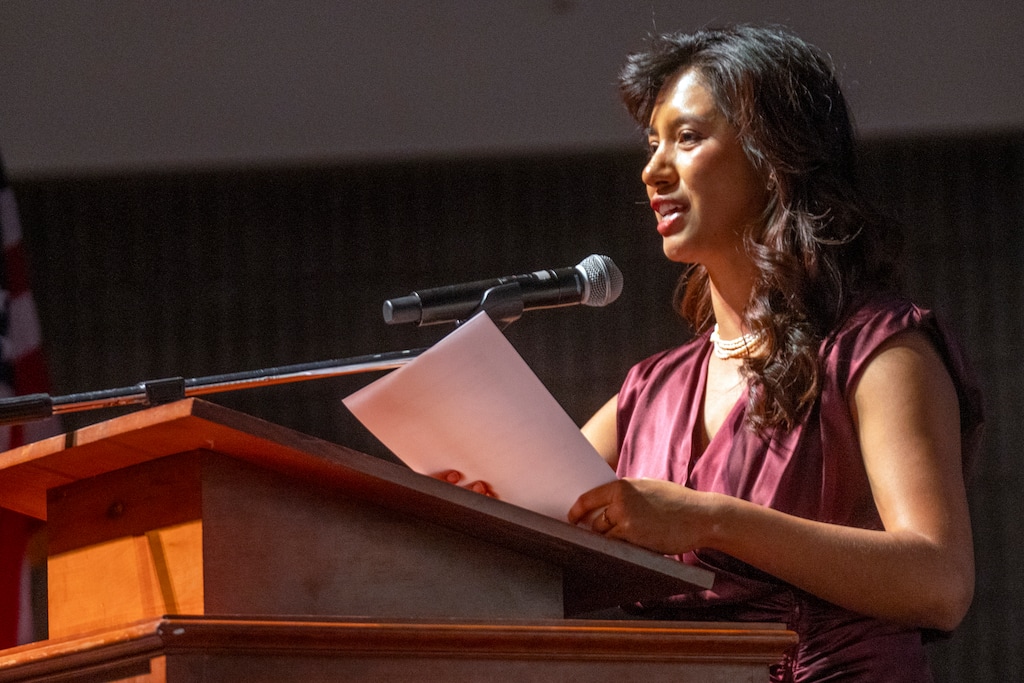
 Robert Gehrke
Last September, Salt Lake City Council member Eva Lopez Chavez closed on a new home outside her council district. Now one of her constituents is asking the city attorney to investigate if that’s where she is living — which, if the answer is yes, would force her to give up her seat on the council.
Lopez Chavez’s attorney declined to comment on the council member’s residence. Salt Lake County property records show that on Sept. 20, 2025, Lopez Chavez purchased a home in District 5 for $640,058.
The District 4 constituent, Nicholas Rupp, sent an email to the city attorney’s office Tuesday evening, questioning whether she met the residency requirements and requesting that the city attorney look into the issue and, if necessary, take the steps under the law to remove her from office.
“Rumors about the council member’s residency had swirled in what I call ‘City Nerd’ circles since last fall, and this week I formally inquired with the city attorney about her residency,” Rupp told The Salt Lake Tribune.
He cited two reasons for raising the issue now: One was what he described as Lopez Chavez’s “moral grandstanding” after recent allegations that she had behaved in a sexually aggressive manner toward four people — allegations she has denied.
“More important was her insistence in staying on the council amidst these allegations is a disruption to the business the council has to do and District 4 deserves robust, legitimate representation,” he said. “I do want to be clear, though, that the allegations and outcome are immaterial to the residency investigation.”
Under city code, “A vacancy shall occur if a council member shall die, resign, terminate legal domicile within the corporate limits of the city and the appropriate council district boundaries.”
State law has a similar requirement and states that “an elected municipal office is automatically vacant if the officer elected to the municipal office, during the term of office, establishes a principal place of residence outside the district that the elected officer represents.”
When Lopez Chavez was elected to represent Council District 4 in 2023, she was renting an apartment near the University of Utah. She is still registered to vote at that address, according to state voting records.
Under the terms of the deed of trust on file with the Salt Lake County Recorder’s office, Lopez Chavez is required to occupy the home she purchased in September as her “principal residence” within 60 days of signing the agreement and to continue to use it as her principal residence for at least one year, unless the lender agrees to waive the requirement or other extenuating circumstances arise.
Misrepresenting the intent to occupy the house as the primary residence would cause the mortgage to be in default, the deed states.
In March, Lopez Chavez posted a listing on Facebook Marketplace looking for someone to rent the two-bedroom, two-bath basement of the home with a deck and hot tub for $2,100 a month.
A local official can, under state law, reside outside the district for up to 60 days. The law allows a city council to extend that for up to a year if a vote is taken in a public meeting within the first 60 days of the elected official’s absence.
Based on a search of meeting minutes, the council has not taken such a vote.
“District 4 residents deserve full and lawful representation,” Rupp wrote in the email to the city attorney, Mark Kittrell, obtained through an open records request. “Transparency on this matter is essential to maintaining public trust in the integrity of the City Council.”
If she moved out of the district shortly after closing on the home, Rupp wrote, the 60-day window for the council to have granted approval for her absence from the district would have passed months ago.
The questions about whether she meets the residency requirement to serve on the council come after The Tribune first reported last week that four people — three of them elected officials — allege Lopez Chavez restrained them during what they considered unwanted sexual advances.
In February, based on concerns raised about Lopez Chavez’s behavior, Salt Lake City Council Chair Alejandro Puy asked staff to conduct a review of the council’s code of conduct and other city policies to ensure that anyone who doesn’t feel safe has an avenue to report allegations of wrongdoing.
Through her attorney, Lopez Chavez denied any inappropriate contact with three of the people and said the fourth allegation never occurred. In a subsequent social media post, Lopez Chavez said the allegations “should be treated seriously” and welcomed an independent investigation.
“At the same time, I want to be clear that I deny wrongdoing and will defend myself through the proper process,” she said.
Seen as a rising star in Democratic politics, Lopez Chavez had been part of a crowded field seeking the party’s nomination in the court-adopted 1st Congressional District, but she failed to gather enough signatures to qualify for the primary ballot and was eliminated from the race at the state party’s convention Saturday.