 Robert Gehrke
As sports fans obsess about March Madness matchups, Utah is bracing for a showdown of its own — taking on the planet’s most lucrative predictive betting market and potentially picking a fight with the Trump administration in the process.
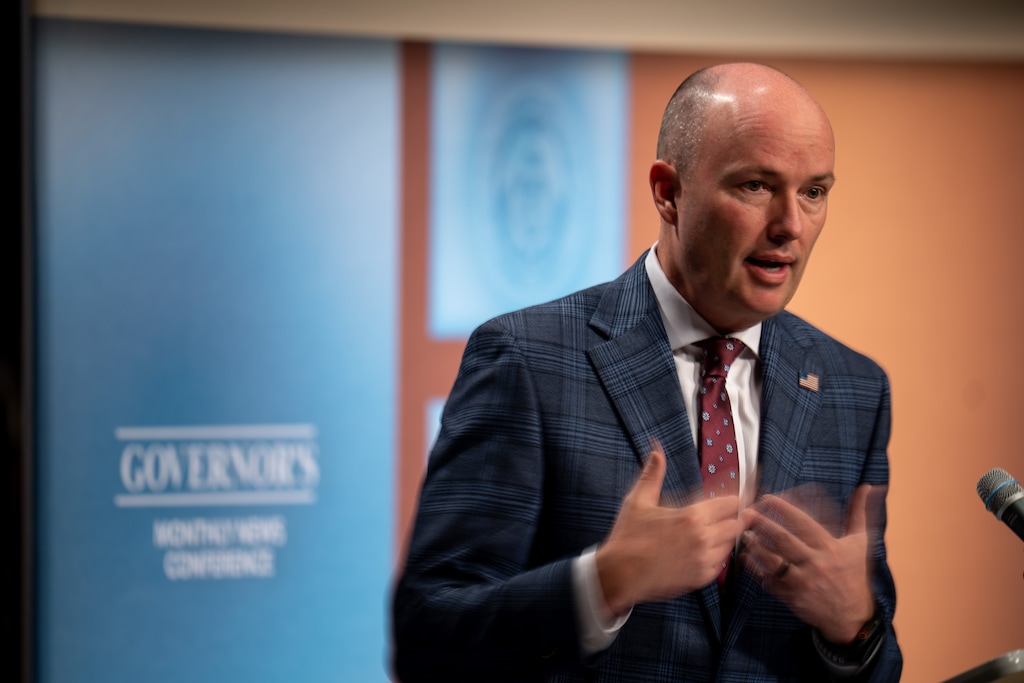
Gov. Spencer Cox said Thursday the state is exploring whether prop betting platforms like Kalshi are breaking a ban on all “games of chance” and lotteries, a prohibition that has existed since statehood and aligns with the teachings of The Church of Jesus Christ of Latter-day Saints, the state’s predominant religion.
But Kalshi, in court documents in Utah and other states, contends it is not a gambling app.
While it might look like a bet to put $20 on Utah State University winning its first-round game against Villanova, Kalshi argues app users are buying an “event contract” that pays out if the Aggies win.
Those event contracts are not limited to sports. Customers have won on everything from Oscar winners to the U.S. war with Iran. Kalshi reportedly handled $10 billion in transactions in January and is on pace to process as much as $1.5 billion in trades this year.
Utah Attorney General Derek Brown doesn’t buy the company’s argument.
Brown recounted during a legislative hearing how he was watching the Super Bowl with his son, who received a targeted ad promoting trading football futures on the big game.
“You can’t bet that the Seahawks were going to win that evening, but you could trade on a potential future outcome in which the Seahawks would win,” Brown said. “Now, if that sounds like a distinction without a difference, it absolutely is, in my mind, and it is gambling.”
On Tuesday, Arizona Attorney General Kristin Mayes charged Kalshi with 20 criminal counts of illegal betting on basketball and football games, as well as the winner of the state’s gubernatorial election and other political races.
Cox said Thursday, from his perspective, Kalshi is a gambling platform.
“It walks like a duck and quacks like a duck, it’s a duck,” he told reporters during a news conference. “And I think everybody agrees with that, except the people who are making billions off of trying to destroy our kids.”
The governor added that he’s “excited about what Arizona is doing” and, to him, the app is “a very clear violation.”
“You can’t bet on local elections in Arizona. You can’t do that here in Utah, either. So the attorney general, I know, is taking a look at it, and I’m hopeful that, if there is a violation, he would follow suit.”
States push back
In the just-concluded legislative session, Utah lawmakers sent Cox HB243, clarifying that proposition bets — like those one can place on Kalshi — are considered gambling and are explicitly prohibited under the law.
Before it even reached Cox’s desk, Kalshi sued Utah in federal court. Attorneys for the company contend that event contracts are a type of futures trading, like trading corn or soybean futures, and, as such, the power to regulate that trading belongs solely with the federal government.
Specifically, attorneys for the company argue, it is the U.S. Commodity Futures Trading Commission charged with watchdogging the platform, after the CFTC officially recognized Kalshi as a Designated Contract Market in 2020.
In a court filing this month, Kalshi agreed to pause the litigation, saying it has engaged in discussions of the issues surrounding the case and wants up to 60 days to continue those talks.
The head of the CFTC appears to agree with the perspective of Kalshi. Last month, commission chairman Mike Selig posted a video on social media warning states to back off in their attempts to regulate prediction markets.
“To those who seek to challenge our authority in this space, let me be clear: We will see you in court,” he said.
Cox shot back that the prediction markets Selig was defending “are gambling—pure and simple.”
“They are destroying the lives of families and countless Americans, especially young men,” he said. “They have no place in Utah.”
Utah is not the only state in legal tangles with the proposition betting company.
In Nevada, where gambling is legal, a judge initially prevented the state from regulating Kalshi, siding with the company’s argument that only federal rules apply, but then reversed course and said it was similar enough to a betting platform that Nevada gambling laws applied. Kalshi appealed, and a federal appeals court ruled last month the betting app can be regulated as a betting platform.
Attempts by states to regulate the app have also been blocked, at least temporarily, in New Jersey, Tennessee, Ohio, New York and Connecticut.
In Maryland, however, a judge ruled that Congress did not intend to preempt state gambling laws. Likewise, a judge in Massachusetts ruled in January that Kalshi could not accept wagers from residents of the state without getting a license.
“Ultimately, the courts are going to decide this,” Cox said. “I feel confident that once the courts have a chance to look at this, they’re going to agree with us that this is gambling, pure and simple, and they need to follow the same laws that are in place for DraftKings and other organizations.”
Cox concluded his news conference with a nod to the NCAA tournament and “wishing everyone good luck with their brackets.”