 Robert Gehrke
Tradition at the Utah Legislature is, after the body adjourns for the year, to play some lighthearted videos or songs, giving colleagues a good-natured ribbing.
This year was no exception, and after the final gavel fell, a sequence of images and a song that included an image with a caption that read: “You prob-ly should vote for Val’s budget or forfeit your RFA.”
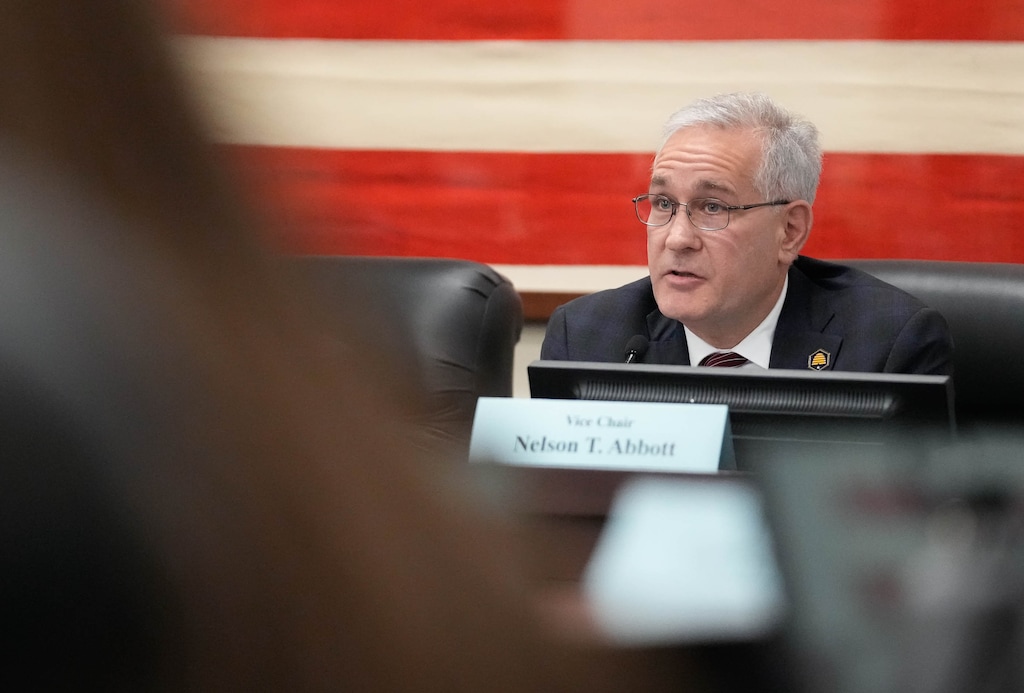
An RFA, a “request for appropriation,” is an application to have a project funded in the budget, but the joke didn’t sit well with Rep. Nelson Abbott, who was featured in the image behind Rep. Val Peterson, R-Orem, the budget chair.
Abbott said House leaders killed his bill aimed at stimulating rural economies in retaliation for his questioning plans to spend $10 million on The Pioneer Trail, a proposed 1.3-mile walking path connecting landmarks in downtown Salt Lake City.
“I was super surprised that they put that graphic up, because I don’t think it’s proper to punish somebody for their vote,” Abbott said in an interview. “They were rubbing my nose in it and maybe even laughing at me.”
In the final days of the session, Abbott voiced concerns about the path, which would run from The Church of Jesus Christ of Latter-day Saints’ Salt Lake Temple, to City Creek Park, up to the Capitol grounds and down into Memory Grove.
Supporters originally sought $2 million, but the subcommittee that heard economic development requests put it low on the list, behind 27 other items — things like $5 million for homeless housing, $1 million for food banks, $450,000 for housing people with disabilities, and $1.2 million in renovations to a nursing home for 185 low-income Utahns.
Many of those priorities did not get funded. But legislative leaders, who have final say on the budget, not only allocated money to The Pioneer Trail but also appropriated $10 million to the project — five times what was requested and a cost approaching $1,300 per foot for each of the 7,920 feet it would cover.
And, Abbott said, his understanding is that the $10 million is “just a down payment on a very, very expensive trail,” which could cost the state as much as $50 million.
While he’s not opposed to the concept, Abbott said, “I’m having a hard time imagining what kind of trail would be worthy of that kind of price tag. So I thought it was a little wasteful — a lot wasteful.”
But when Abbott rose on the House floor seeking to delay the vote so he could propose striking the trail funding, Rep. Val Peterson, R-Orem, and others in leadership resisted.
“There’s things in here that people love, there’s things that people don’t like,” Peterson said during debate. “As we start to try to mess with our budget bill, that unravels all the work we’ve done over the last six weeks.”
House Majority Leader Casey Snider, R-Paradise, said setting the budget is a complicated process that took months.
“This bill is the fruits of all of our labors, collectively, and we’re here at this juncture to move it, as we do every year,” he said.
Rep. Trevor Lee, R-Layton, sided with Abbott during the discussion and wanted to at least debate the merits of the project.
“It’s OK to have the discussion on something that is $10 million,” Lee said, “especially if it was something that those doing their job on the committee said they don’t want funded.”
Ultimately, the House rebuffed Abbott’s attempt to amend the bill and it passed with the trail money intact.
Senate President Stuart Adams, R-Layton, defended the appropriation.
“We’ve invested a lot in trying to make the Capitol complex something that is not just a Capitol, but it actually becomes a tourist attraction, an iconic situation for the state,” he said. “[The Pioneer Trail] brings people into the [Capitol] museum and actually makes that area kind of a focal point.”
Senate Budget Chair Jerry Stevenson, R-Layton, said it would be “a landmark that will be recognized for centuries in the city.”
And Senate Minority Leader Luz Escamilla, D-Salt Lake City, said the walking trail would be a tourist draw and “enhance not only the beauty of our buildings but also the entire surrounding landscape.”
That wasn’t the end of it, though.
After the budget vote, Abbott said, House leaders called a closed-door meeting and said the six Republicans who voted against the budget bill would lose any funding for their projects, including those previously approved.
Other Republican representatives, who spoke on condition of anonymity to avoid retaliation from leadership, confirmed Abbott’s version of events.
In Abbott’s case, he was trying to get Senate approval for HB466, an expansion of the Utah Rural Jobs Act that would have allowed tax credits for businesses that invest in rural economies. It had almost no opposition, passing the House 68-2 and receiving unanimous support in a Senate committee, but it died without getting a Senate floor vote.
Abbott said he believes leaders made good on their vow to punish him for speaking out against the trail. And then came the salt in the wound, with the song and image ridiculing him on the closing night.
“I’ve been elected, just like everyone else there, to speak for my constituents, to speak for the people of Utah as I see fit, and I think I was doing my job,” he said. “It’s frustrating to me that when I do that, there’s retribution and there’s also this mockery.”
A House spokesperson said that Abbott’s bill allowed up to $6 million a year in tax credits to be given out, which meant a $6 million tax cut obligation. “That’s what killed the bill,” the spokesperson said, “not a no vote on the budget.”
As the bill is structured, companies can get tax credits for investing in rural jobs, but the credits can’t exceed the amount of new revenue generated, so the net budgetary impact is zero. Abbott said he had met with the budget committee chairs in both the House and Senate and had been assured it would not be a problem.
Last year, Abbott was removed as chair of the House Judiciary Committee after he resisted leadership’s effort to rush through a medical malpractice bill that was a priority for Adams, the Senate president. He says it, too, was retaliatory.
Said Abbott: “I think that’s absolutely why I’m not chair of the judiciary committee anymore.”
Note to readers • This story is available to Salt Lake Tribune subscribers only. Thank you for supporting local journalism.