 Addy Baird
Utah’s U.S. Sen. John Curtis applauded the U.S. Supreme Court’s 6-3 ruling striking down President Donald Trump’s tariffs, saying it “affirms, despite all the noise of the moment, that the Founders’ system of checks and balances remains strong nearly 250 years later.”
Curtis, a Republican, has long been critical of Trump’s wide-ranging tariffs, implemented last year and imposed on nearly every U.S. trading partner.
“If we’re not careful, we’ll destroy small businesses with tariffs,” the senator said during a CNN interview last May.
In a statement Friday morning following the court decision, Curtis said, “Several questions remain unanswered, including what happens to the revenue already collected and how the Administration may use alternative authorities to impose tariffs.”
He added, “Looking ahead, it is critical that we provide the clarity and predictability businesses need.”
U.S. Sen. Mike Lee, meanwhile, critiqued the decision in a lengthy post to social media Friday morning, but said Congress was to blame, at least in part, for the issue.
“While IEEPA is absurdly vague in countless ways, it expressly authorizes the President to ‘regulate … importation,’” Lee wrote, referring to the International Emergency Economic Powers Act.
“Given that tariffs are the principal means by which the U.S. government ‘regulate[s] … importation,’ I find it puzzling that the Supreme Court believes IEEPA confers no authority to impose tariffs in this instance,” he added. “The Supreme Court purported to resolve this case while deciding very little — creating a massive mess of avoidable confusion and uncertainty.”
Congress, Lee said, carries some blame for “enacting obscenely vague laws,” the senator wrote, “effectively delegating its lawmaking power to the other two branches.”
“Today the Supreme Court did not meaningfully address this problem,” he concluded. “If anything, it made matters much worse.”
Historically, Lee has been critical of tariffs, and has pushed for more Congressional authority over the issue, repeatedly introducing legislation that would give lawmakers more authority over international trade.
But he praised the tariffs enacted by Trump last year as a negotiating tactic.
“Trump could go down as the most pro-trade, pro-growth president in modern U.S. history if he uses this moment as an opportunity to reduce trade barriers,” he wrote on X last year.
In a statement to The Salt Lake Tribune Friday night, Rep. Blake Moore said he had heard concerns from Utah’s manufacturing companies about tariffs.
“The volatility from the IEEPA tariff regime has made it more expensive to reshore critical supply chains, harder to generate jobs, and tougher to stay competitive in global export markets,” Moore said. “While businesses still face uncertainty about how the administration will deploy congressionally-approved tariff authority, today’s Supreme Court ruling provides greater clarity and affirms Congress’s role as the ultimate arbiter of all federal revenue issues.”
Moore added, “If Congress and the administration work collaboratively, we could accomplish something substantive that empowers manufacturing and strengthens our exporters.”
When asked by The Tribune about the high court’s decision, Utah’s Reps. Celeste Maloy, Mike Kennedy and Burgess Owens did not comment on the ruling.
Moore, in the past, has been critical of Trump’s tariffs.
“This is something that has not been difficult for me, to speak in opposition to some of the decisions that are being made at the administration level,” Moore said of the White House’s widespread tariffs during a telephone town hall last April. “We are getting taken advantage of in a lot of different scenarios with regards to trade … but the approach taken with the specific numbers and the way that it’s been rolled out isn’t necessarily targeting those issues.”
The congressman said then that he would like to see more targeted and specific trade policies.
“Otherwise, we’re going to see a mass increase in prices across the country, and ... we do not think that our economy can handle that right now,” he said.
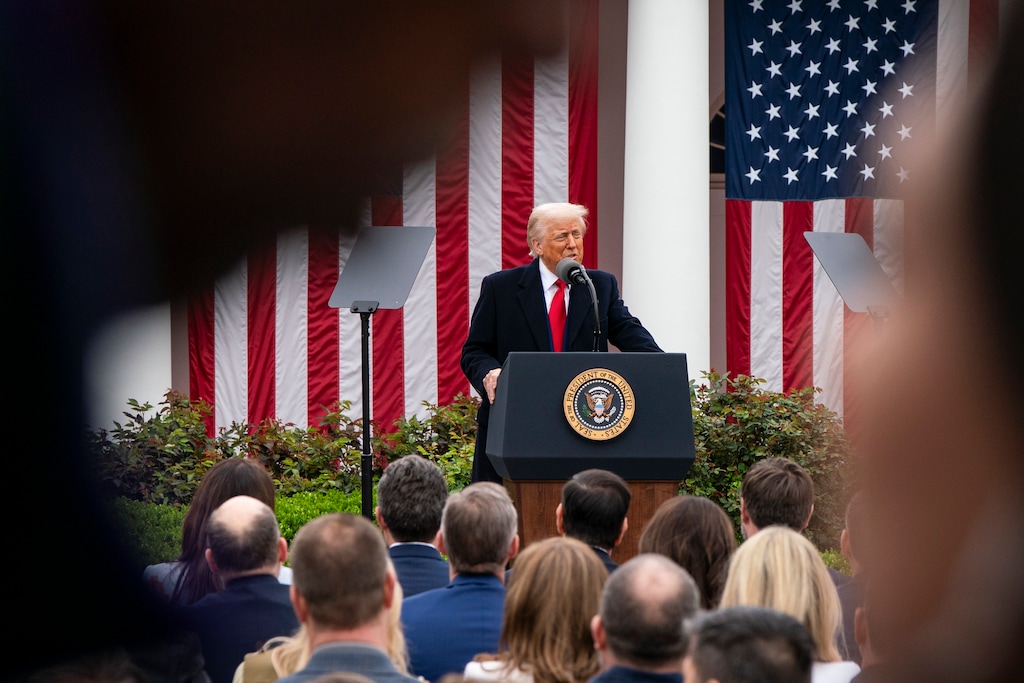
Following the ruling Friday, Trump lambasted the justices during a news conference, calling them “fools and lap dogs,” and swore to work around the decision.
“They’re very unpatriotic and disloyal to our Constitution,” Trump said of the Supreme Court’s ruling. Two of Trump’s appointees, Justices Amy Coney Barrett and Neil M. Gorsuch, voted against his administration, while Brett Kavanaugh, another Trump pick, voted with the two other dissenting conservative justices.
“It’s my opinion that the court has been swayed by foreign interests and a political movement that is far smaller than people would ever think,” Trump said.
Note to readers, 7:50 p.m. • This story has been updated to include a comment on the ruling by Rep. Blake Moore.