facebook-pixel

‘Do the right thing’: Utah Senate president who intervened in child rape case must resign, Democratic senator says

The Salt Lake Tribune first reported that Sen. President Stuart Adams prompted a law change that helped a teen charged with child rape receive a less severe sentence.
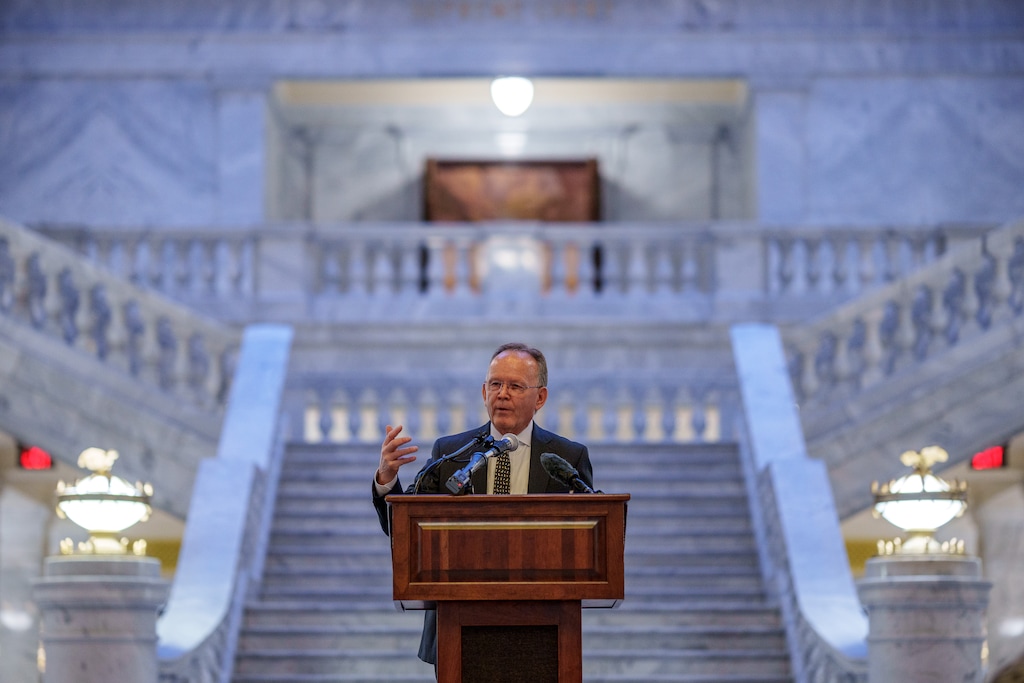
(Trent Nelson | The Salt Lake Tribune) Senate President Stuart Adams, R-Layton, at Utah School Boards Association's Day on the Hill event at the Utah Capitol in Salt Lake City on Monday, Jan. 27, 2025.

Democratic state Sen. Nate Blouin is calling on Utah Senate President J. Stuart Adams to resign after The Salt Lake Tribune first reported that Adams had initiated a change to Utah law that helped an 18-year-old relative who was charged with child rape receive a more lenient sentence.

“Senate President Stuart Adams must do the right thing and resign,” Blouin said in a statement Friday. “The rule of law should not be subject to change simply because of who you know.”

Blouin, a first-term minority senator, is the first Democrat to publicly address Adams’ involvement in the criminal case, which has garnered national attention.

“Senate President Adams’ conduct is unbecoming of this body. We are meant to serve the public, not give special treatment to our relatives,” Blouin said. “All of our constituents deserve equal treatment under the law, and the Utahns I represent are demanding accountability. This body should be fighting against abuses of power, not enabling them.”

Phone calls and messages from The Tribune to two members of Adams’ staff, who typically field media inquiries for the Senate president, were not returned.

In a statement Adams’ office sent to other members of the Utah media but did not share with The Tribune, the Senate president said Blouin’s call for resignation was “misleading political grandstanding fueled by misinformation and deliberate distortions.”

“He has repeatedly contributed to spreading blatantly false information, relying on fabricated and sensationalized narratives that ignore both the facts and the intent of the legislation,” Adams said.

Adams also criticized “sensationalized and inflammatory” news articles that have “irresponsibly propagated misinformation driven by political motives rather than facts.”

Blouin also aimed a challenge toward House Speaker Mike Schultz and Gov. Spencer Cox: “Do you condone this abuse of power?”

Cox’s spokesperson declined to comment, and a spokesperson for Schultz did not respond to a request to respond to Blouin’s statements.

(Rick Egan | The Salt Lake Tribune) Sen. Nate Blouin, D-Salt Lake City, asks a question of the sponsor, as the Senate discusses a constitutional amendment over citizen initiatives during a special session, on Wednesday, Aug. 21, 2024.

The statement came from Blouin individually, not the larger Democratic caucus. Senate Minority Leader Luz Escamilla, D-Salt Lake City, did not immediately respond regarding whether she or the rest of the caucus support Blouin’s position.

Blouin is frequently among the most outspoken members of the caucus and an irritation to some of his Republican colleagues.

In Utah, where Republicans hold supermajorities in both the House and Senate, Democrats need Republicans’ support to pass any of their legislative proposals.

But recently elected Utah Democratic Party Chair Brian King, a former Utah House minority leader and gubernatorial candidate, echoed Blouin’s call.

“This is the perfect example of the kind of corruption that stems from unchecked supermajority control,” King said in a statement posted to social media.

“Adams should resign,” he concluded.

Sen. Kirk Cullimore, one of Adams’ top deputies, told The Tribune that the Senate president had confided in him about the case, which involved an 18-year-old accused of having sex with a 13-year-old. The 18-year-old was arrested and charged with counts of child rape and child sodomy, and, at the time, plea negotiations were at an impasse.

Cullimore said he consulted with attorneys, including the defense attorney representing the 18-year-old high school student, who he said helped draft a change to the law that was added to a larger criminal justice bill during the 2024 legislative session.

[READ: Utah’s Senate president prompted law change that helped a teen charged with child rape]

Adams contends that his actions did not influence the outcome of the case.

“Some have suggested this change was made to benefit the case I was made aware of involving the high school senior. That is simply not true,” he said in an earlier statement to The Tribune. “While the sponsor of [the bill] was aware of the case, I did not request the legislation and did not intervene or give input on the drafting of the bill.”

Before lawmakers changed the law last year, 18-year-old high school students who had sex with a 13-year-old could face a charge of child rape, a first-degree felony. A conviction on that charge generally requires registration as a sex offender.

But under the change, an 18-year-old high schooler who has sex with a 13-year-old would be charged with “unlawful adolescent sexual activity,” a third-degree felony, provided the actions were willing and did not involve force or coercion.

The change was not retroactive, but in court hearings, the prosecutor and defense attorney acknowledged that the government changed its plea offer because of the new law. The new plea deal meant the defendant would not be sent to jail and would not have to register as a sex offender.

The mother of the victim, an 8th grader when the sexual activity occurred, said she “felt like I was punched in the gut.”

“I feel like a law is the law, regardless of who you are, but that wasn’t what was going on here,” she told The Tribune. “I feel like [the 18-year-old] just got special treatment … and nobody was going to say anything about it.”

The Tribune generally does not name victims of sexual assaults and is not naming the 13-year-old’s mother to protect the child’s identity. It also is not identifying the 18-year-old, since The Tribune typically does not cover such cases. The mother of the 13-year-old victim agreed to speak on the record about the case.

In his statement Friday, Adams said that “attempts to politicize this ... are nothing more than politically motivated, blatant lies, plain and simple.” He also pointed out that the law was not retroactive and did not change the legal age of consent.

The Tribune, in its original reporting, included that the law is not retroactive, as well as the fact that it only applies in instances not involving force, coercion or threats. The reporting did not suggest the law changed the legal age of consent.

Note to readers • The Salt Lake Tribune is moderating comments on this story due to the sensitive nature of some material.

Help The Tribune report the stories others can’t—or won’t.

For over 150 years, The Salt Lake Tribune has been Utah’s independent news source. Our reporters work tirelessly to uncover the stories that matter most to Utahns, from unraveling the complexities of court rulings to allowing tax payers to see where and how their hard earned dollars are being spent. This critical work wouldn’t be possible without people like you—individuals who understand the importance of local, independent journalism.  As a nonprofit newsroom, every subscription and every donation fuels our mission, supporting the in-depth reporting that shines a light on the is sues shaping Utah today.

You can help power this work.