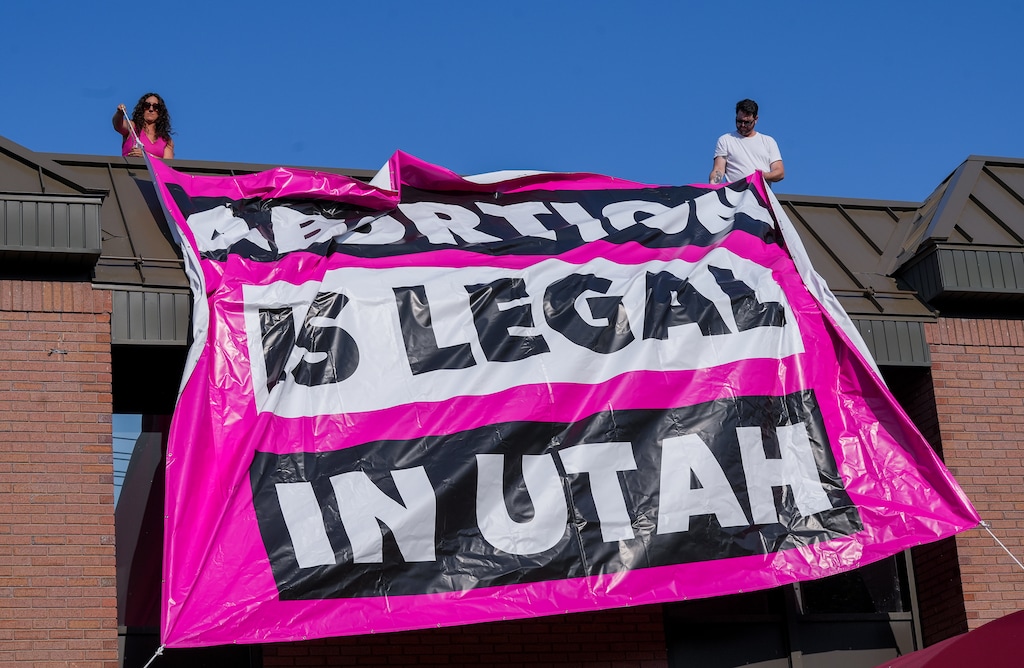
For over three years, Planned Parenthood Association of Utah has argued in court that Utah’s constitution protects access to abortions.
But as the state’s near-total abortion ban remains on hold, Utah’s primary abortion provider is now also suing to fend off a federal threat to reproductive care in the Beehive State: a measure in the “Big Beautiful Bill” that seeks to defund the organization by blocking patients from using Medicaid there.
The Utah chapter joined its parent entity Planned Parenthood Federation of America, and Planned Parenthood League of Massachusetts, in a complaint filed in Boston federal district court Monday. Hours later, a district judge pushed pause on the provision, issuing a temporary restraining order while the court considers the case.
It argues a portion of the massive budget bill signed into law Friday preventing nonprofits that provide elective abortions from being reimbursed for treating Medicaid patients, who are among the lowest income Americans, is unconstitutional.
A 1980 law called the Hyde Amendment already prohibits federal Medicaid funds from paying for most abortions, so the law will only stop patients from accessing other medical services at Planned Parenthood clinics.
“Here in Utah, we are used to politicians trying to strip away our rights for political gain,” Shireen Ghorbani, the interim president of Planned Parenthood Association of Utah, said in a statement. “We haven’t backed down before, and we won’t now.”
Last year, over 2,000 people covered by Medicaid sought care at Utah’s Planned Parenthood clinics, according to the Monday filing, and in fiscal 2023, the local organization received $706,251 in Medicaid reimbursements.
That’s below the $800,000 mark outlined in the bill that would make Planned Parenthood Association of Utah a “prohibited entity,” or one that would be barred from being paid through Medicaid. And in 2024, according to the Utah affiliate’s annual report, less than 1% of its revenue came from Medicaid.
But Ghorbani said Utahns will feel the impact. The former congressional candidate sees the move as part of a pattern of the government increasingly limiting the health care Americans have access to.
Planned Parenthood predicts nearly 200 of its clinics across the country will close as a result of the law.
“What we are seeing in this administration, with the support of every single one of Utah’s members of Congress, is an unrelenting effort to undermine the access that individuals already have — their freedom to choose where they received their health care,“ Ghorbani said in an interview, adding, ”This is not the issue where we’re going to back down because it’s a small percentage of our budget."
The bill made other sweeping changes to health care access, including implementing a work requirement for many adults on Medicaid, increasing the amount Medicaid recipients pay out-of-pocket for care, introducing more barriers to enrolling in federal marketplace plans and cutting some immigrants off from federal insurance.
Approximately 188,000 Utahns are at risk of losing health coverage under the new law, according to an estimate by the Congressional Joint Economic Committee’s Democratic staff. All six members of Utah’s federal delegation voted to pass the bill.
Local anti-abortion group Pro-Life Utah celebrated Trump’s Fourth of July signing of the bill with a Facebook post, saying the law is “defunding one of the most oppressive corporations in our country.”
Although Planned Parenthood is largely being targeted for providing abortions, which are currently legal up to 18 weeks in Utah, reproductive health services at its six clinics in the state go beyond terminating pregnancies.
Utah patients more frequently turn to Planned Parenthood’s clinics for birth control and sexually transmitted infection testing. According to the court filing, approximately 91% of visits to the Utah organization’s clinics in 2024 were for services other than abortion.
Since President Donald Trump took office, Utah has already begun seeing the impacts of his administration’s attacks on the organization that has offered family planning care in the state for over half a century.
At the start of the year, Utah had eight Planned Parenthood clinics. But after the Department of Health and Human Services froze millions in federal funds that helped pay for family planning care — not abortions — for the poorest Utahns, the nonprofit was forced to close a quarter of its locations in the state.
The two shuttered clinics were in Logan and St. George — the furthest locations from Salt Lake City, and often the most accessible for rural residents.
Providing free and deeply discounted family planning services has become more difficult for the clinics that remain open, and Planned Parenthood Association of Utah has had to raise many of its fees to continue operating.
During this year’s legislative session, state lawmakers blocked the organization from providing sex education in public schools, and in a previous year, the Legislature attempted to ban abortion clinics from operating. It later repealed that law after it was enjoined in court and would have likely delayed a ruling in the larger abortion ban lawsuit.
Ghorbani described attacks on Planned Parenthood as “the tip of the iceberg in the unraveling and dismantling of our health care,” predicting clinic closures will result in longer wait times at hospitals and higher medical bills as the costs of the care once provided at disappearing clinics are passed on to everyone else.
“Our system is strained as it is. We are an important part of that system,” Ghorbani said, “and we’re going to fight to continue to serve patients who want to see us.”