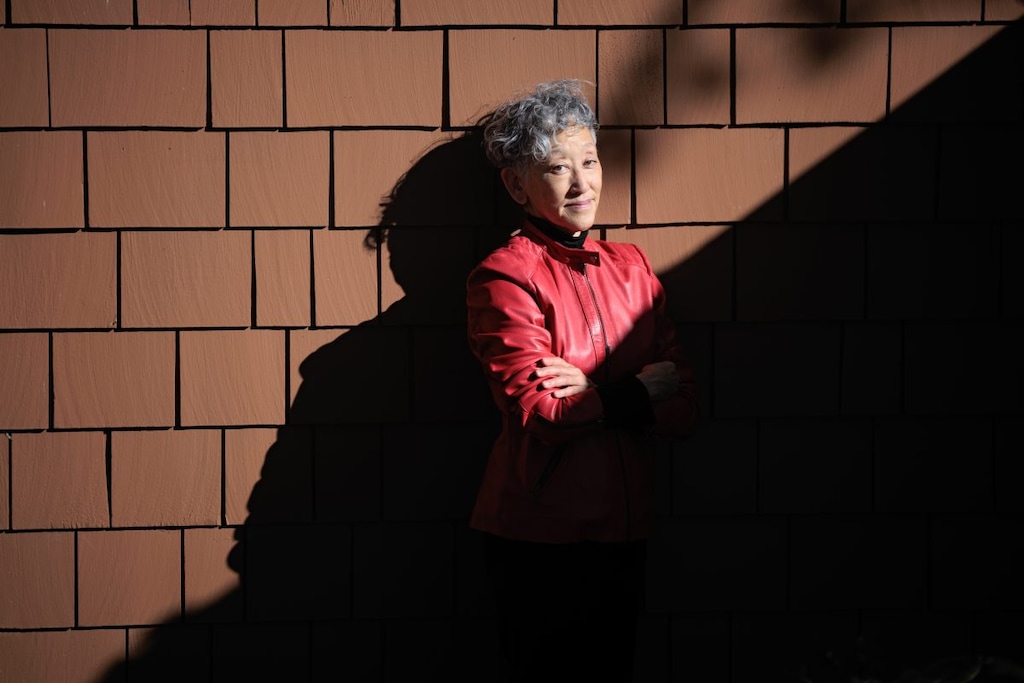
On a recent morning, the novelist Karen Tei Yamashita was at home in this beachfront town, talking about the time she came upon a little-known — but enormous — archive of materials at the University of California at Berkeley.
There were 335 boxes containing records related to the Japanese American Evacuation and Resettlement Study (JERS), a controversial research project conducted inside Japanese American incarceration camps during World War II.
The Berkeley sociologist Dorothy Swaine Thomas had enlisted young students, themselves prisoners inside the camps, to report on their fellow prisoners — and, in the end, on themselves. Among other things, the study sought to uncover what sorts of people were imprisoned, who was loyal, and who was not. The study was also, by several measures, grossly unethical.
“She had hired these people, who were basically kids, and they were doing this secretly, typing these things out and mailing them over to Berkeley out of the camps,” Yamashita said.
As she learned more about the project, Yamashita, whose own parents were incarcerated at the Topaz camp in Utah, had further questions about the experience. What does loyalty mean? How could you demonstrate loyalty to a nation that’s unjustly imprisoned you? Why would you even want to?
Those questions and others led Yamashita to write “Questions 27 & 28,” her first novel in 16 years, which Graywolf Press published in late April. A 450-page chronicle of the Japanese American experience, the book leans on the actual stories of figures like Yone Noguchi, the first Japanese-born writer to publish poetry in English, and Yuri Kochiyama, a civil rights activist and friend of Malcolm X.
But despite its historical trappings, Yamashita insists the book is a novel.
(Graywolf Press)
That’s because Yamashita, a storyteller of the first order, is having a bit of fun, often a lot of fun, with her subjects. In one chapter, she imagines two heroes of the Japanese American reparations movement discussing historic civil rights cases in the afterlife; in another, we hear the story of Harry Kitano, a pioneering social scientist and U.C.L.A. professor, narrated by his trombone.
“I guess it’s a roman à clef in that respect,” Yamashita, 75, admitted over cups of Earl Grey at her home on the campus of U.C. Santa Cruz, where she is a professor emerita. “I don’t know. After I had studied all of this, it just sort of came out of me.”
In person, Yamashita is much like her books: funny, thoughtful, utterly candid, full of captivating stories about how little money she’s made from a lifetime of writing, the number of rejection letters she received for her first book (100, give or take), and the time she wrote a funny piece about her mom and her family for a local Japanese American newspaper, and her mom blew up.
“I never wrote about the family again until everyone had died,” she said.
“Questions 27 & 28” is a marked departure from Yamashita’s previous novels — which themselves are marked departures, in form and content, from one another.
Her debut, “Through the Arc of the Rain Forest,” is a work of magical realism narrated by an alien orb whirling around a Japanese Brazilian’s forehead. “I Hotel,” a finalist for the National Book Award in 2010, is a series of linked novellas chronicling the rise of the Asian American civil rights movement in the 1970s.
Writing in The New Yorker, Hua Hsu called the new book “a sprawling and overwhelming volume, encompassing about a hundred real lives and spanning more than a hundred years.”
The Pulitzer Prize-winning novelist Viet Thanh Nguyen, who presented Yamashita with the National Book Foundation’s lifetime achievement award in 2021, made a bigger claim.
“If anyone is deserving of the title of the great American novelist,” he said in an interview, “it’s Karen Tei Yamashita.”
The title of Yamashita’s new book refers to two questions included in a loyalty questionnaire given to Nisei (second generation Japanese American) men in the camps. Are you willing to serve in the armed forces of the United States on combat duty, wherever ordered? Will you swear unqualified allegiance to the U.S. and forswear any allegiance to the Emperor of Japan?
Men who answered “no” to both questions were saddled with the slur “no-no boys.”
These questions are at the heart of John Okada’s 1957 novel, “No-No Boy,” the tale of a Japanese American draft resister who returns home to Seattle after serving two years in prison. Largely ignored by readers and shunned by many in the Japanese American community when it was first released, the book is now heralded as a pioneering work of Japanese American literature and widely considered the first Asian American novel.
Like many Asian American writers and readers, Yamashita loved the book, and she includes the stories of several no-no boys and draft resisters in her own. “I liked that there was sex in it,” she said. “People beat each other up and went to bars. There was a rawness to it.”
Even after publishing “Letters to Memory,” a 2017 memoir about her extended family’s experiences during World War II, the JERS project, and the history of internment, kept calling to her.
Ultimately she spent five years doing research. It’s the sort of commitment that Maxine Hong Kingston (“The Woman Warrior”), the only other Asian American female writer to win the book foundation’s lifetime achievement prize, envies about Yamashita’s work and career.
“There must be hundreds of people she has worked with and interviewed and talked to and read about,” Kingston said. “She gets to know the people that she writes about in a real way. I’m trying to do that myself now, instead of just making it all up.”
For years, many Japanese Americans tried to present a unified story about the camps — one of patriotic citizens unjustly imprisoned and eager to prove their loyalty by fighting for their country.
But Yamashita’s book doesn’t pull any punches about the internal strife within the camps and the community: the conflicts between snitches (the so-called “inu,” the Japanese word for dogs) and resisters, between the assimilationist Japanese American Citizens League and the camp’s more pro-Japan elements.
Even so, Yamashita said, many of the stories are fictionalized. Some characters are composites. “In the first draft I sent to the editor, there were just first names,” she said.
In the end, “Questions 27 & 28” will likely stand as a companion piece to “No-No Boy,” the book that inspired Yamashita as a young writer, said Frank Abe, an Okada expert and co-editor of “The Literature of Japanese American Incarceration.”
“Both have that reach, that drive, that desire to take everything in and spit it all back out in a coherent way that captures the arc of the experience, from immigration to incarceration to resettlement,” he said.
At the end of the book, the disembodied spirits of the activist Aiko Herzig-Yoshinaga and the civil rights attorney Peter H. Irons travel back to 1942 and watch as government officials lie and conceal evidence in order to justify the executive order authorizing the creation of the camps, chummily hashing it all out over drinks and cake at a fancy Georgetown estate. (Among them is John J. McCloy, the assistant secretary of war, who said the Constitution “is just a scrap of paper,” Yamashita explained. “It’s unforgivable.”)
Asked whether she was concerned about airing the Japanese American community’s own dirty laundry, Yamashita paused.
Well, she said slowly, many of the real people in the book have died. Her voice trailed off.
“This is what we have to do,” she continued. “I don’t even think of it as dirty laundry anymore. It’s our story. I feel for people when they’re hurt, but I think that arguments are necessary so that we can learn from them, and so that things change.”
This article originally appeared in The New York Times.