SpaceX docked the first commercial spaceship built for astronauts to the International Space Station
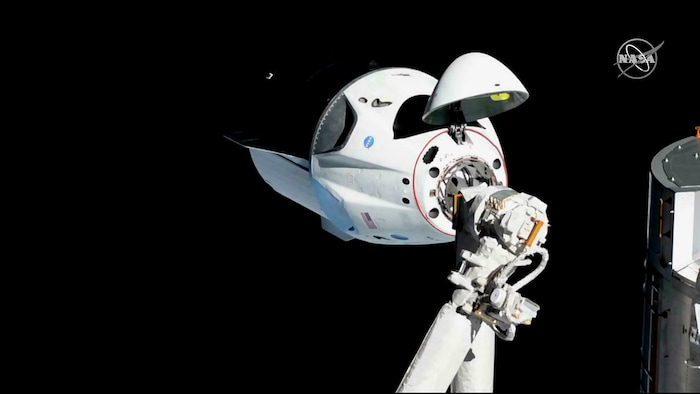
In this photo provided by NASA, the SpaceX Crew Dragon is pictured about 20 meters (66 feet) away from the International Space Station’s Harmony module, Sunday, March 3, 2019. SpaceX's new crew capsule arrived at the International Space Station on Sunday, acing its second milestone in just over a day. (NASA via AP)
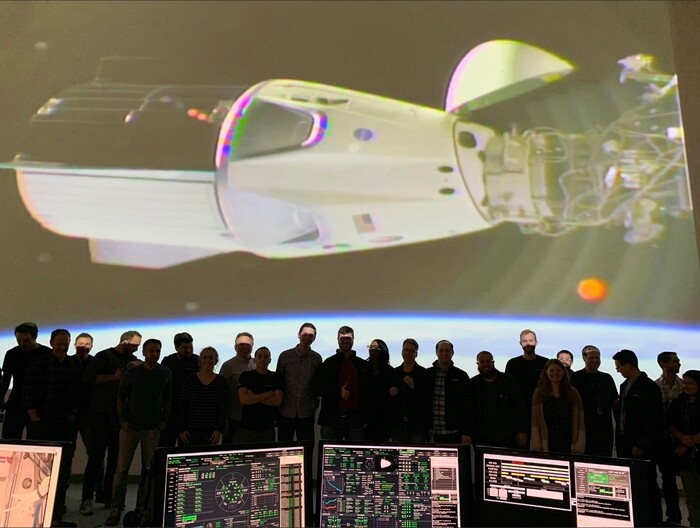
In this photo provided by SpaceX, the SpaceX team in Hawthorne, Calif., watches as the SpaceX Crew Dragon docks with the International Space Station’s Harmony module, Sunday, March 3, 2019. SpaceX's new crew capsule arrived at the International Space Station on Sunday, acing its second milestone in just over a day. (NASA via AP)
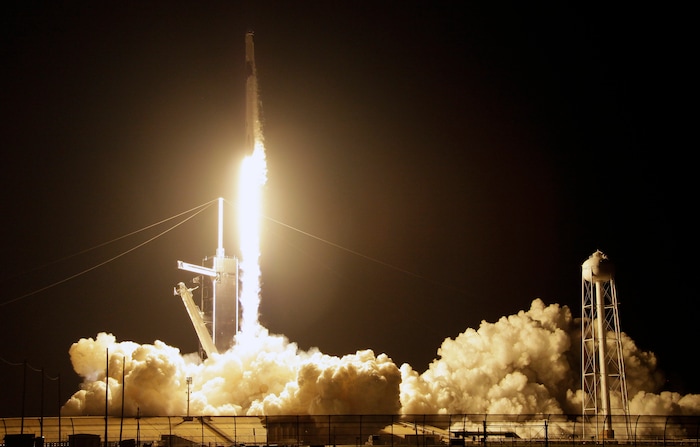
A SpaceX Falcon 9 rocket with a demo Crew Dragon spacecraft lifts off from pad 39A on an uncrewed test flight to the International Space Station at the Kennedy Space Center in Cape Canaveral, Fla., Saturday, March 2, 2019. (AP Photo/Terry Renna)
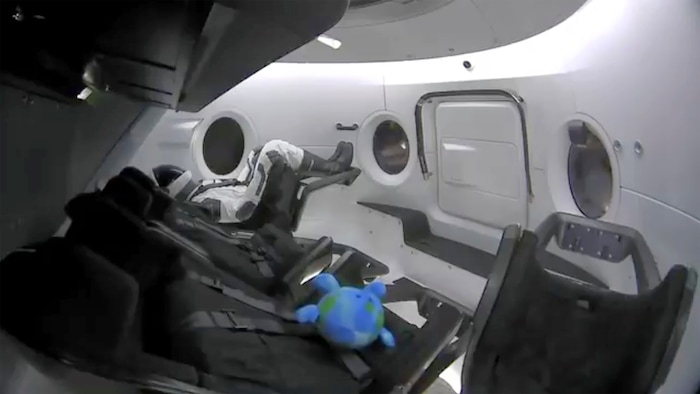
This photo provided by SpaceX shows a life-size test dummy along with a toy that is floating in the Dragon capsule as the capsule made orbit on Saturday, March 2, 2019. America's newest capsule for astronauts rocketed toward the International Space Station on a high-stakes test flight by SpaceX. This latest, flashiest Dragon is on a fast track to reach the space station Sunday morning, just 27 hours after liftoff. (SpaceX via AP)
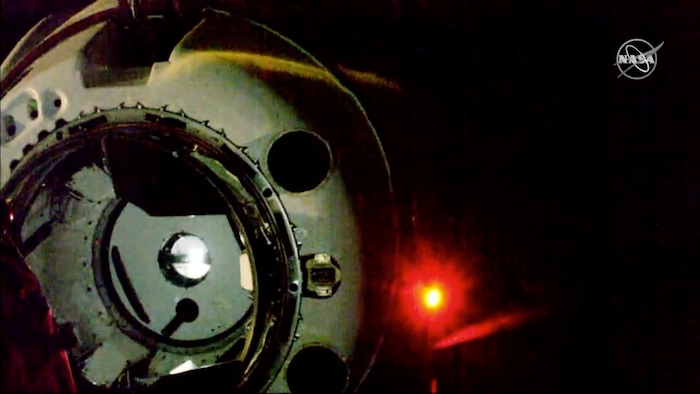
In this image taken from NASA Television, Sunday, March 3, 2019. SpaceX's new crew capsule approaches just before docking at the International Space Station Sunday, March 3, 2019. SpaceX's new crew capsule arrived at the International Space Station, acing its second milestone in just over a day. No one was aboard the Dragon capsule launched Saturday on its first test flight, only an instrumented dummy. (NASA TV via AP)
In this image taken from NASA Television, Sunday, March 3, 2019, a live screen shows docking scene of SpaceX's new crew capsule and the International Space Station Sunday, March 3, 2019. SpaceX's new crew capsule arrived at the International Space Station, acing its second milestone in just over a day. No one was aboard the Dragon capsule launched Saturday on its first test flight, only an instrumented dummy. (NASA TV via AP)
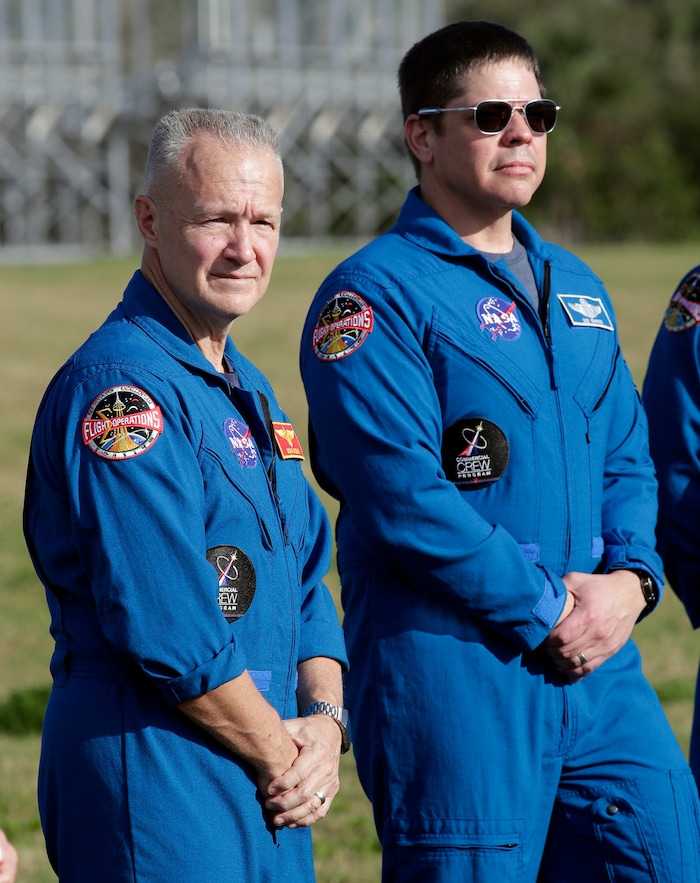
NASA astronauts Doug Hurley, left, and Bob Behnken attend a news conference before the Falcon 9 SpaceX Crew Demo-1 rocket launch at the Kennedy Space Center in Cape Canaveral, Fla., Friday, March 1, 2019. The astronauts are assigned to fly in the SpaceX Demo-2 flight test later this year. (AP Photo/John Raoux)
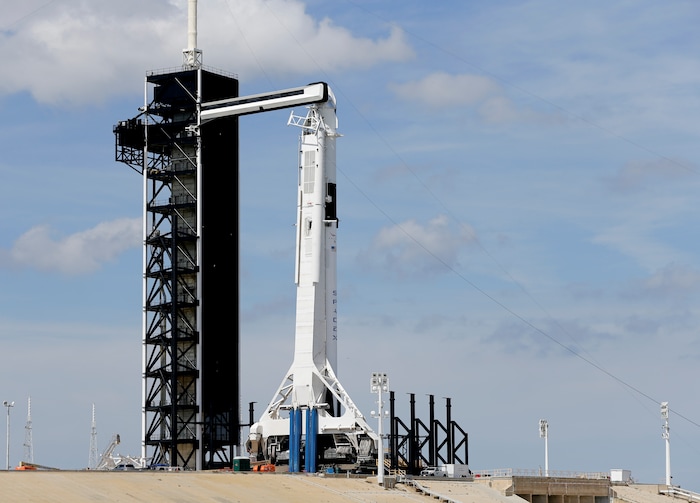
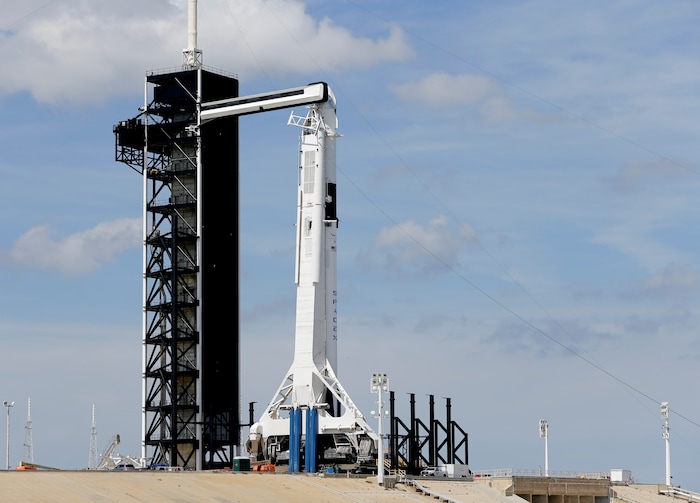
A Falcon 9 SpaceX rocket, ready for launch, sits on pad 39A at the Kennedy Space Center in Cape Canaveral, Fla., Friday, March 1, 2019. The Crew Dragon spacecraft unmanned test flight is scheduled for launch early Saturday morning. (AP Photo/Terry Renna)
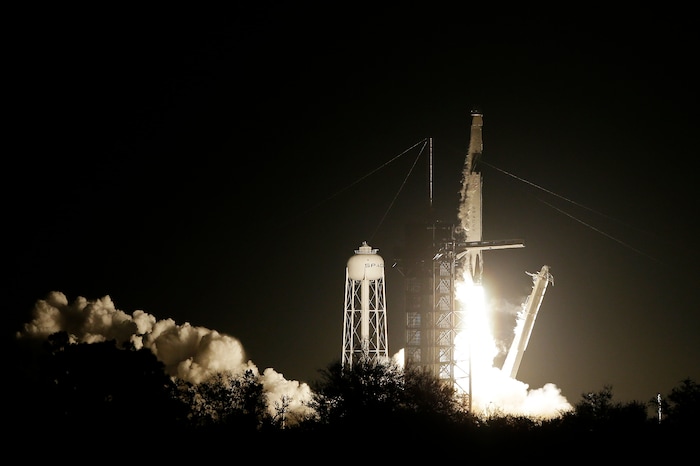
A SpaceX Falcon 9 rocket with a demo Crew Dragon spacecraft on an uncrewed test flight to the International Space Station lifts off from pad 39A at the Kennedy Space Center in Cape Canaveral, Fla., Saturday, March 2, 2019. (AP Photo/Terry Renna)
The launch of the SpaceX Crew Dragon capsule atop a Falcon 9 rocket to the International Space Station from Pad 39A at Kennedy Space Center Saturday morning, March 2, 2019, in Florida. (Malcolm Denemark/Florida Today via AP)
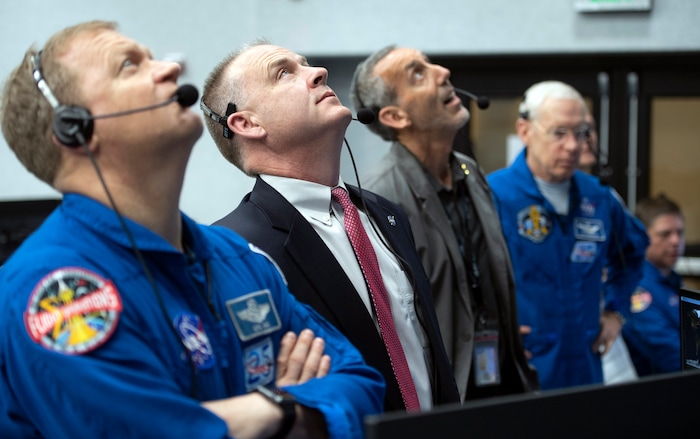
NASA astronaut Eric Boe, assistant to the chief of the astronaut office for commercial crew, left, and Norm Knight, deputy director of flight operations at NASA's Johnson Space Center watch the launch of a SpaceX Falcon 9 rocket carrying the company's Crew Dragon spacecraft on the Demo-1 mission from firing room four of the Launch Control Center, Saturday, March 2, 2019 at the Kennedy Space Center in Florida. America's newest capsule for astronauts rocketed Saturday toward the International Space Station on a high-stakes test flight by SpaceX. (NASA/Joel Kowsky)
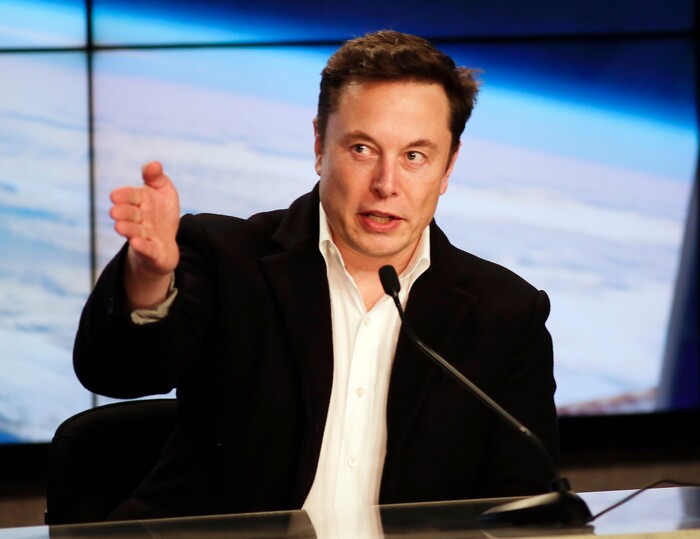
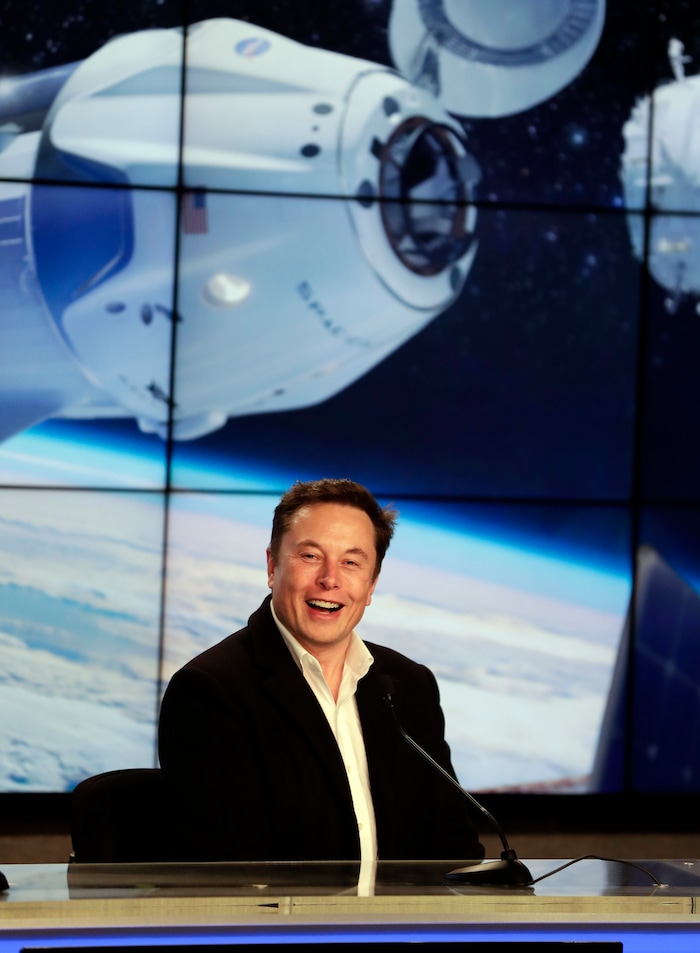
Elon Musk, CEO of SpaceX, speaks during a news conference after the SpaceX Falcon 9 Demo-1 launch at the Kennedy Space Center in Cape Canaveral, Fla., Saturday, March 2, 2019. (AP Photo/John Raoux)
Elon Musk, left, CEO of SpaceX, speaks as NASA astronauts Bob Behnken, center, and Doug Hurley, right, listen during a news conference after the SpaceX Falcon 9 Demo-1 launch at the Kennedy Space Center in Cape Canaveral, Fla., Saturday, March 2, 2019. (AP Photo/John Raoux)
Elon Musk, CEO of SpaceX, speaks during a news conference after the SpaceX Falcon 9 Demo-1 launch at the Kennedy Space Center in Cape Canaveral, Fla., Saturday, March 2, 2019. (AP Photo/John Raoux)
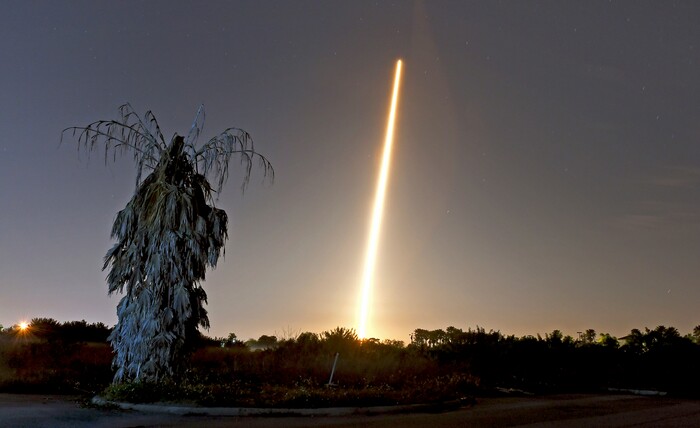
The SpaceX Falcon 9 rocket and Crew Dragon capsule launch from NASA pad 39A as seen in a time exposure from Viera, FL. on March 2 with a lone, untrimmed palm tree in the foreground. (Tim Shortt/Florida Today via AP)
A SpaceX Falcon 9 rocket with the Demo 1 crew capsule lifts off from pad 39A, Saturday, March 2, 2019, in Cape Canaveral, Fla. (AP Photo/Terry Renna)
A Falcon 9 SpaceX rocket, ready for launch, sits on pad 39A at the Kennedy Space Center in Cape Canaveral, Fla., Friday, March 1, 2019. The Crew Dragon spacecraft unmanned test flight is scheduled for launch early Saturday morning. (AP Photo/Terry Renna)
Cape Canaveral, Fla. • A sleek new American-built capsule with just a test dummy aboard docked smoothly with the International Space Station on Sunday, bringing the U.S. a big step closer to getting back in the business of launching astronauts.
The white, bullet-shaped Dragon capsule, developed by Elon Musk’s SpaceX company under contract to NASA, closed in on the orbiting station nearly 260 miles above the Pacific Ocean and, flying autonomously, linked up on its own, without the help of the robotic arm normally used to guide spacecraft into position.
Dragon's arrival marked the first time in eight years that an American-made spacecraft capable of carrying humans has flown to the space station.
If this six-day test flight goes well, a Dragon capsule could take two NASA astronauts to the orbiting outpost this summer.
"A new generation of space flight starts now with the arrival of @SpaceX's Crew Dragon to the @Space_Station," NASA Administrator Jim Bridenstine tweeted. "Congratulations to all for this historic achievement getting us closer to flying American Astronauts on American rockets."
Ever since NASA retired the space shuttle in 2011, the U.S. has been hitching rides to and from the space station aboard Russian Soyuz spacecraft. In the meantime, NASA is paying two companies — SpaceX and Boeing — to build and operate America's next generation of rocket ships.
SpaceX’s 27-foot-long capsule rocketed into orbit early Saturday from NASA’s Kennedy Space Center with a mannequin strapped into one of its four seats in a dashing, white-and-black, form-fitting SpaceX spacesuit. The test dummy was nicknamed Ripley after the main character in the “Alien” movies.
Ripley and the capsule are rigged with sensors to measure noise, vibration and stresses and monitor the life-support, propulsion and other critical systems.
As the capsule closed in on the space station, its nose cap was wide open like a dragon's mouth to expose the docking mechanism. In a docking with a crew aboard, the capsule would likewise operate autonomously, though the astronauts might push a button or two and would be able to intervene if necessary.
The three U.S., Canadian and Russian crew members aboard the space station watched the rendezvous via TV cameras. Within hours, the capsule's hatch swung open and the three astronauts floated inside to remove supplies and take air samples, wearing oxygen masks and hoods until they got the all-clear.
Canadian astronaut David Saint-Jacques pronounced the docking flawless and called it "a beautiful thing to see."
"Welcome to the new era in spaceflight," he said.
Dragon will remain at the space station until Friday, when it will undock for an old-school, "Right Stuff"-style splashdown in the Atlantic, a few hundred miles off Florida.
As part of Sunday's shakedown, the space station astronauts sent commands for Dragon to retreat and then move forward again, before the capsule closed in for good. SpaceX employees at company headquarters in Hawthorne, California, cheered the docking, then burst into applause again when the Dragon's latches were secured.
The two astronauts set to fly aboard Dragon as early as July, Doug Hurley and Bob Behnken, witnessed the Florida liftoff, then rushed to Southern California to watch Sunday's maneuver.
"Just super excited to see it," Behnken said minutes after the linkup. "Just one more milestone that gets us ready for our flight coming up here."
Next up, though, is Boeing, which is looking to launch its Starliner capsule without a crew as early as April and with a crew possibly in August.
SpaceX already has made 16 trips to the space station using cargo Dragons. The version designed for humans is slightly bigger and safer.
It can carry as many as seven people and has three windows, emergency-abort engines that can pull the capsule to safety, and streamlined controls, with just 30 buttons and touch screens, compared with the space shuttle cockpit's 2,000 switches and circuit breakers.
The Associated Press Health & Science Department receives support from the Howard Hughes Medical Institute’s Department of Science Education. The AP is solely responsible for all content.
Help The Tribune report the stories others can’t—or won’t.
For over 150 years, The Salt Lake Tribune has been Utah’s independent news source. Our reporters work tirelessly to uncover the stories that matter most to Utahns, from unraveling the complexities of court rulings to allowing tax payers to see where and how their hard earned dollars are being spent. This critical work wouldn’t be possible without people like you—individuals who understand the importance of local, independent journalism. As a nonprofit newsroom, every subscription and every donation fuels our mission, supporting the in-depth reporting that shines a light on the is sues shaping Utah today.




Donate to the newsroom now. The Salt Lake Tribune, Inc. is a 501(c)(3) public charity and contributions are tax deductible