 Leia Larsen
Despite the Trump administration’s efforts to “reinvigorate” American coal, the industry isn’t gaining much steam.
The Department of Interior offered up thousands of acres for coal mining on public lands in prime locations across Utah last month. But a bid from a single company to mine lands in the Manti-La Sal National Forest fell flat weeks ago and was rejected by the feds, the Associated Press confirmed. The failed auction followed another in Montana, where a company bid fractions of a penny per ton.
Energy and economics experts say coal probably won’t see a comeback, despite President Donald Trump’s new initiatives.
“We’re unlikely to see whatever steps they take [bring] a revival of the coal industry in the country,” said Josh Craft, director of government relations for Utah Clean Energy. “It’s not competitive on price. Customers want cleaner, more affordable options.”
The biggest market for coal is by far utility-scale power generation. U.S. consumption of coal for energy production peaked in 2005 and has done a nosedive in the decades since according to federal data. At the same time, demand for electricity has remained steady.
That means as coal-fired power plants scale back, other energy sources — like wind, solar and natural gas — have made up the difference.
(Trent Nelson | The Salt Lake Tribune) The Skyline coal mine on Saturday, June 4, 2022.
While some of coal’s crash was fueled by stronger environmental and public health protections, the reality is, coal simply isn’t cost effective, according to Joshua Linn, a professor at the University of Maryland who specializes in environmental economics.
“Wind and solar, once they’re built, can produce electricity for nothing, practically,” said Linn. “Coal can’t compete with that.”
In Utah, Gov. Spencer Cox has made energy production a top priority with his “Operation Gigawatt” initiative announced last year. He calls it an “all-of-the-above” strategy that embraces traditional sources of power in the state, like coal, while fostering new technologies such as small modular nuclear reactors and geothermal heat.
“The state is committed to keeping our coal resources online,” said Emy Lesofski, director of the Utah Office of Energy Development, in an emailed statement. “They have long been the backbone of reliable and affordable dispatchable power.”
Coal extraction in Utah has increased over the last three years, the state reported. Miners produced 7 million tons in 2023 and an estimated 8.3 million tons in 2025. Almost all of that coal stays in Utah and is consumed by power plants.
(Rick Egan | The Salt Lake Tribune) Gov. Spencer Cox speaks during a panel discussion about nuclear power with Idaho Gov. Brad Little, left, and John Wagner, right, the director of the Idaho National Laboratory, at the Energy Superabundance Idaho workshop in Idaho Falls, Idaho, on Monday, Sept. 22, 2025.
But not all of the electricity generated by coal in states like Utah stays local. Policies in more densely populated states like California, Oregon and Washington have also accelerated the movement away from coal as they adopt policies that require clean energy sources.
“These markets are becoming increasingly integrated,” Linn said. “This integration means that one state’s policies may … reduce imports of fossil fuel generation from out of state.”
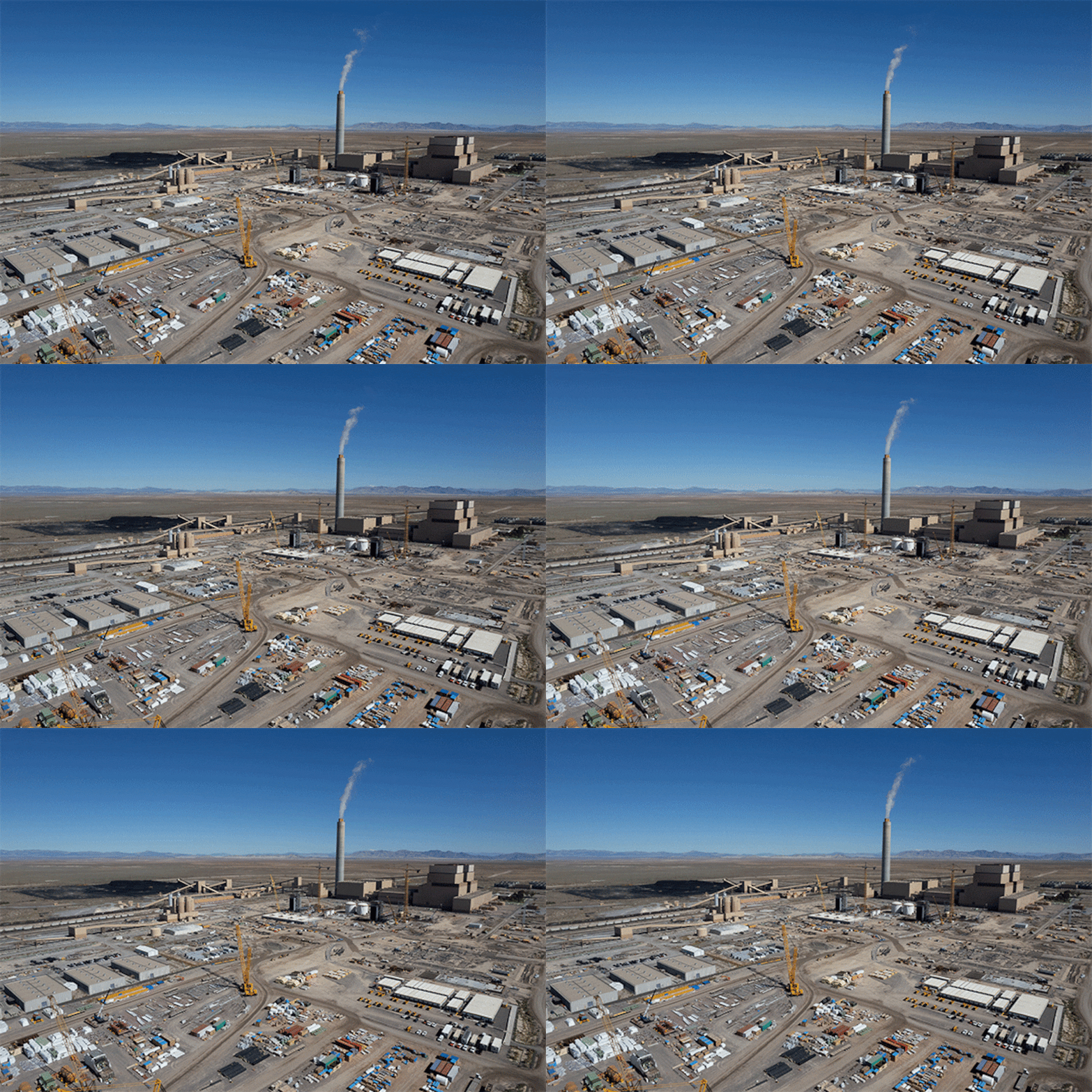
That trend caused the Intermountain Power Plant in Delta to pivot when its California customer base opted not to renew contracts for coal electricity.
A newly converted natural gas unit went online a few weeks ago, according to an Intermountain Power Agency spokesperson. A second will start producing commercial power by the end of November, at which point the plant’s remaining two coal units will sit offline until Utah regulators decide whether and how to keep operating them.
Similar initiatives caused Pacific Northwest customers to abandon ownership of the Colstrip power plant in Montana and decommission half its units.
Rocky Mountain Power, Utah’s largest electric utility provider, and its parent company PacifiCorp have their own plans to continue scaling down coal burning, converting coal plants to natural gas and lowering carbon emissions throughout the West.
The strategy is partly driven by federal regulations requiring reduced haze in national parks — a policy dictated by the Clean Air Act, which would take an act of Congress, not the president or his administration, to change.
PacifiCorp’s move away from coal is also the result of its participation in the Western Energy Imbalance Market, which allows it to plug into a regional grid and more diverse energy supplies, according to the company’s 2025 Integrated Resource Plan.
A spokesperson for the utility said coal plants remain “essential” to its energy mix to ensure reliability. But it acknowledged it has operated those resources at reduced capacity in recent years.
“PacifiCorp is committed to achieving emissions reduction targets as required by state and federal regulatory obligations,” the spokesperson wrote in an email, “and welcomes the development of alternative fuel sources that can provide a similar level of system flexibility.”
Beyond becoming less cost effective, burning coal also accelerates climate change. Coal combustion released a massive amount of mercury over the last century, polluting airsheds and waterways.
The fuel has since been eclipsed by natural gas as the primary source of electricity generation in the U.S., accounting for 43% of the nation’s energy portfolio in 2023, compared to 16% for coal according to the U.S. Energy Information Administration, or EIA.
But clean energy and environmental advocates argue “natural gas” is a misnomer and a pervasive form of industry greenwashing. While it doesn’t produce mercury or toxic ash waste like coal, it remains a polluting fossil fuel comprised almost entirely of methane, a potent greenhouse gas.
Non-emitting renewables like wind, solar and hydropower accounted for 23% of the nation’s utility-scale electricity generation in 2024, compared to 15% in 2015, per EIA data.
The Trump administration nixed Biden-era incentives to build more renewable resources at both the utility and local scales, citing mismanagement of funds by middlemen. The groups administering those canceled programs in Utah denied any wrongdoing.
“There is no doubt that energy has been politicized,” said Craft with Utah Clean Energy. “There are some resources that are seen as Red Team resources, and some seen as Blue Team resources. I don’t think that is healthy and helpful.”
Linn, the economics professor, said the new administration’s actions may slow some of the momentum for building renewables. But, he added, places where wind and sunshine remain abundant may not need federal subsidies to continue building.
“You can take away some regulations and try to reduce costs for producing coal and for using coal,” Linn said. “But these market forces aren’t going away.”
Leaving renewables in the dark also won’t change the fact that America’s grid will soon see a surge of demand brought by electric vehicles, the rise of artificial intelligence and rapid construction of more data centers nationwide. Cox has thrown much of his own energy behind nuclear power as a solution, and Trump issued executive orders to usher in that industry’s renaissance.
Both Linn and Craft called nuclear a promising future resource considerably less polluting than fossil fuels.
“We are wholly … supportive of the region vesting in new and innovative technologies,” Craft said.
It will take years for nuclear projects to come online, however, and they’ll likely be expensive, they added.
“We know that we need to invest in energy resources; demand is going up,” Craft said. “Solar and wind with storage are the cheapest resources that we have available to us. And they’re things that we can deploy today.”
Leia Larsen is a sixth generation Utahn and a water and land use reporter reporter for The Salt Lake Tribune. She has covered environment, energy and political issues throughout the West. When she’s not chasing the news, Leia can be found exploring the Wasatch Mountains, sleeping in the desert or rooting around her garden.